Multiple Choice
Passage
Abnormal blood lipid levels play a significant role in the development of coronary artery disease (CAD) . The discovery of genomic variations that confer a protective effect against CAD has prompted investigations into the biological impact of these protective alleles. Researchers have observed that specific single-base variations in the ANGPTL4 gene are common among patients with a low occurrence of CAD. ANGPTL4 is located on chromosome 19 and codes for angiopoietin-like 4, a multifunctional glycosylated protein.One of the functions of angiopoietin-like 4 is the regulation of lipid metabolism. The N-terminal domain of angiopoietin-like 4 induces a conformational change in the enzyme lipoprotein lipase (LPL) , forcing the LPL homodimer to dissociate into two inactive 225-residue monomers. LPL functions on the surface of vascular endothelial cells and degrades the triglycerides of chylomicrons and very-low-density lipoproteins (VLDLs) in the blood. Elevated triglyceride levels have been correlated with increased CAD risk.To identify common loss-of-function mutations in ANGPTL4, DNA samples from 43,000 individuals with CAD and 78,000 individuals without CAD were genotyped. A detailed analysis of ANGPTL4 genomic variants was performed, and the results of individuals without CAD were mapped in Figure 1. The lipid profiles of ANGPTL4 mutation noncarriers were also compared to those of mutation carriers (Figure 2) .
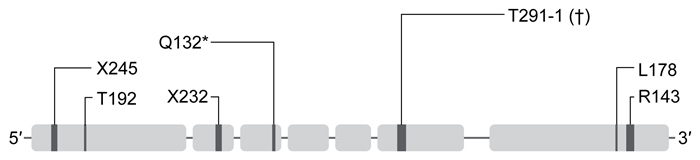 Figure 1 Loss-of-function mutations observed in ANGPTL4 in participants without CAD (Note: * = mutation resulting in a truncated protein; † = substitution of a cytosine for its complementary base.)
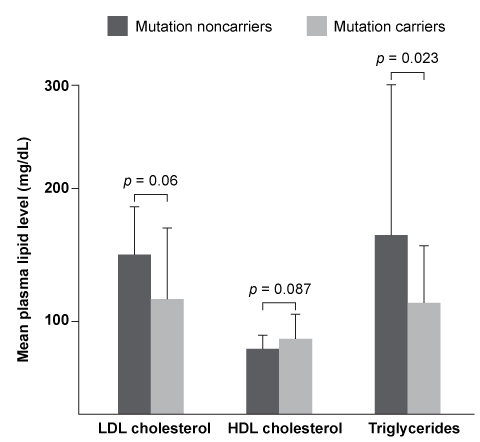 Figure 2 Mean plasma lipid levels for ANGPTL4 mutation carriers and noncarriers (Note: LDL = low-density lipoprotein; HDL = high-density lipoprotein; error bars = standard deviation.) To further analyze the effect of ANGPTL4 on blood lipid levels, ANGPTL4 knockout mice and mice that constitutively express ANGPTL4 were created. Researchers hypothesized that two of the four biological profiles shown in Table 1 would be observed in these mice.Table 1 Predicted Biological Profiles of ANGPTL4 Mouse Models
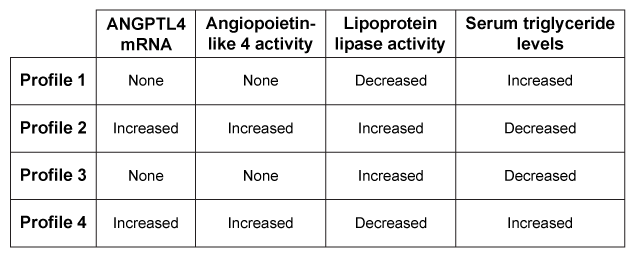
-The knockout mouse model and the constitutively active mouse model of ANGPTL4 are best represented by:
A) Profile 1 and Profile 2, respectively.
B) Profile 1 and Profile 4, respectively.
C) Profile 3 and Profile 4, respectively.
D) Profile 3 and Profile 2, respectively.
Correct Answer:

Verified
Correct Answer:
Verified
Q240: Passage<br>A 6-day-old, genotypically normal (46,XX) female patient
Q241: Which of the following is generally true
Q242: Passage<br>Autosomal dominant polycystic kidney disease (ADPKD) is
Q243: During a parasitic infection, which of the
Q244: Passage<br>Bone remodeling is the continuous, microscopic process
Q246: Renal studies in mice have revealed that
Q247: Passage<br>Viruses are known as obligate intracellular parasites
Q248: During a nutrition study, a participant consumes
Q249: Passage<br>The Bloom syndrome helicase (BLM) transcript is
Q250: Researchers are screening bacterial chromosomes for mutations