Multiple Choice
Passage
Alzheimer disease (AD) is a progressive condition affecting memory and cognition that can be pathologically characterized by the presence of neurofibrillary tangles (NFTs) . NFTs, aggregates of hyperphosphorylated tau proteins that have dissociated from microtubules, are believed to contribute to neuronal degradation and subsequent AD symptoms. In general, ribosomes initiate translation of tau mRNA by binding the 7-methylguanosine (m7Gpp) cap present at the end of the 5′ untranslated region (UTR) of the mRNA molecule. However, researchers believe that tau protein translation initiation can occur without recognition of the m7Gpp cap. This alternate mechanism, referred to as cap-independent translation, indicates that ribosomes are recruited by internal ribosome entry sites (IRES) generally located in the 5′ UTR of the mRNA sequence.To determine the initiation mechanism of tau mRNA translation, neuroblastoma cells of AD mice were transfected with two different DNA constructs (Figure 1) . Construct 1 contained the 5′ UTR of tau mRNA isoforms (v1 and v2) extracted from cells displaying NFTs. Construct 2 included the 5′ UTR of the β-globulin gene, which normally codes for a plasma protein. The luciferase reporter genes, Renillla and Photinus, were also included in the two constructs.
/_
/_
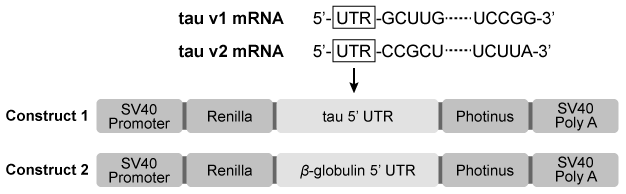 Figure 1 DNA constructs containing β-globulin or tau gene used to transfect neuroblastoma cellsLuciferase gene expression from the constructs was monitored in the absence and presence of a synthetic m7Gpp cap analog (Figure 2) . Translation of Renillla luciferase mRNA depended on ribosomal binding to the m7Gpp cap of the mRNA, but translation of Photinus luciferase required ribosome recruitment by an IRES in the 5′ UTR of the adjacent gene.
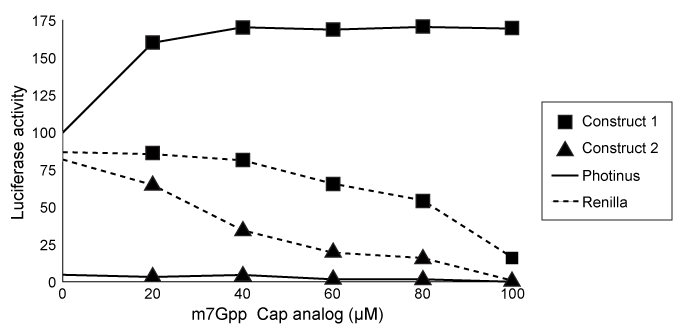 Figure 2 Luciferase activity in neuroblastoma cells exposed to m7Gpp cap analogIn a second study, researchers used siRNA to target initiation factor eIF4E, a peptide translated in a cap-dependent manner that facilitates the binding of ribosomes to the m7Gpp cap. Expression of factor eIF4E, elongation factor eEF2K, and tau v2 protein was assessed in siRNA-treated cells (Figure 3) .
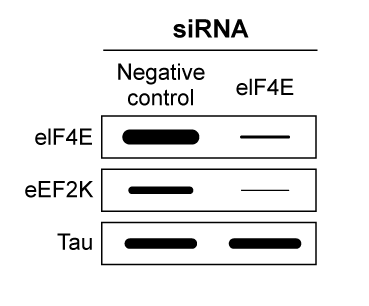 Figure 3 Western blot of eIF4E, eEF2K, and tau v2 extracted from non-AD cells treated with eIF4E siRNA
Adapted from Veo BL, Krushel LA. Translation initiation of the human tau mRNA through an internal ribosomal entry site. J Alzheimers Dis. 2009; 16(2) :271-5.
-Recently fed ob/ob mice show deficient binding of glucagon to its G protein-coupled receptor, which most likely leads to:
A) decreased cAMP to ATP conversion.
B) upregulated adenylate cyclase activity.
C) increased exchange of GDP for GTP.
D) reduced protein kinase A activity.
Correct Answer:

Verified
Correct Answer:
Verified
Q81: Passage<br>The sex chromosomes X and Y are
Q82: In neurons, action potential propagation occurs along
Q83: Passage<br>Abnormal blood lipid levels play a significant
Q84: Passage<br>The heart is a muscular organ comprising
Q85: Passage<br>The lac operon encodes the proteins that
Q87: Passage<br>Enterohemorrhagic Escherichia coli (EHEC) O157:H7 is a
Q88: A scientist claims that endurance training is
Q89: Impaired release of which of the following
Q90: Following digestion in the small intestine, certain
Q91: Passage<br>Neurulation refers to the early formation of