Passage Enterohemorrhagic Escherichia Coli (EHEC) O157:H7 Is a Bacterium Responsible for for Causing
Multiple Choice
Passage
Enterohemorrhagic Escherichia coli (EHEC) O157:H7 is a bacterium responsible for causing foodborne illnesses. EHEC virulence, or the ability to cause disease, is acquired through quorum sensing, a form of bacterial cell-cell communication dependent on population density. EHEC O157:H7 bacteria monitor population density by detecting changes in the concentration of autoinducer-3 (AI-3) , an extracellular signaling molecule secreted by many bacterial species. AI-3 generally acts on neighboring bacteria to activate the genes on the enterocyte effacement (LEE) locus. These genes code for type III secretion proteins (EspA, EspB, EspD, Tir) , which promote entry of Shiga-like toxins secreted by EHEC into host intestinal epithelial cells. This ultimately leads to cell death, lesions, and symptoms such as bloody diarrhea and abdominal cramps.It has been reported that a mutation in S-ribosylhomocysteine lyase (LuxS) , an enzyme involved in quorum sensing, may result in diminished production of AI-3. However, researchers predict that certain peptide hormones can activate LEE gene transcription in the LuxS. To test this hypothesis, mutant EHEC bacteria deficient in LuxS (LuxS−) were cultured and separately exposed to the hormones epinephrine (E) , norepinephrine (NE) , gastrin (G) , and secretin (S) at 37°C. Total RNA was extracted from the treated bacterial cultures, and LEE mRNA was quantified (Figure 1) .
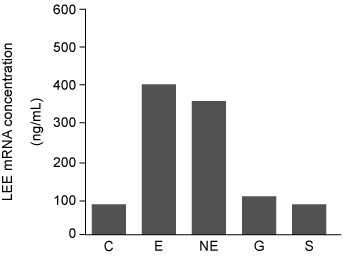 Figure 1 Concentration of LEE mRNA in mutant LuxS− bacteria supplemented with purified peptide hormones (Note: C = control.) Western blot was performed to compare the presence and concentration of type III secretion proteins from wild-type (WT) , LuxS−, and LuxS− cultured in preconditioned media (PCM) . PCM was generated by culturing uninfected intestinal epithelial cells in growth media for 24 hours. After 24 hours, the cells were removed and the PCM was used to supplement the growth of LuxS− bacteria.
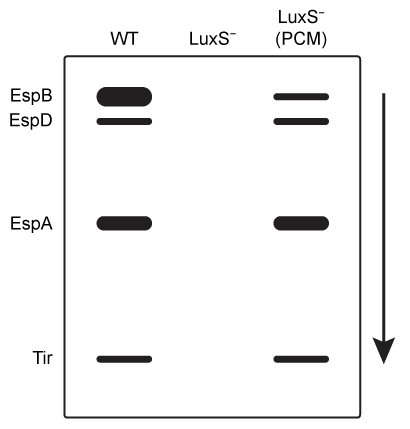 Figure 2 Western blot results of type III secretion proteins isolated from WT, mutant LuxS−, and LuxS− in PCM
-EHEC is classified as a bacilli bacterium. Given this information, this type of classification is most likely based on the bacterium's:
A) habitat.
B) oxygen dependence.
C) morphology.
D) virulence.
Correct Answer:

Verified
Correct Answer:
Verified
Q82: In neurons, action potential propagation occurs along
Q83: Passage<br>Abnormal blood lipid levels play a significant
Q84: Passage<br>The heart is a muscular organ comprising
Q85: Passage<br>The lac operon encodes the proteins that
Q86: Passage<br>Alzheimer disease (AD) is a progressive condition
Q88: A scientist claims that endurance training is
Q89: Impaired release of which of the following
Q90: Following digestion in the small intestine, certain
Q91: Passage<br>Neurulation refers to the early formation of
Q92: Passage<br>Viruses are known as obligate intracellular parasites