Passage Enterohemorrhagic Escherichia Coli (EHEC) O157:H7 Is a Bacterium Responsible for for Causing
Multiple Choice
Passage
Enterohemorrhagic Escherichia coli (EHEC) O157:H7 is a bacterium responsible for causing foodborne illnesses. EHEC virulence, or the ability to cause disease, is acquired through quorum sensing, a form of bacterial cell-cell communication dependent on population density. EHEC O157:H7 bacteria monitor population density by detecting changes in the concentration of autoinducer-3 (AI-3) , an extracellular signaling molecule secreted by many bacterial species. AI-3 generally acts on neighboring bacteria to activate the genes on the enterocyte effacement (LEE) locus. These genes code for type III secretion proteins (EspA, EspB, EspD, Tir) , which promote entry of Shiga-like toxins secreted by EHEC into host intestinal epithelial cells. This ultimately leads to cell death, lesions, and symptoms such as bloody diarrhea and abdominal cramps.It has been reported that a mutation in S-ribosylhomocysteine lyase (LuxS) , an enzyme involved in quorum sensing, may result in diminished production of AI-3. However, researchers predict that certain peptide hormones can activate LEE gene transcription in the LuxS. To test this hypothesis, mutant EHEC bacteria deficient in LuxS (LuxS−) were cultured and separately exposed to the hormones epinephrine (E) , norepinephrine (NE) , gastrin (G) , and secretin (S) at 37°C. Total RNA was extracted from the treated bacterial cultures, and LEE mRNA was quantified (Figure 1) .
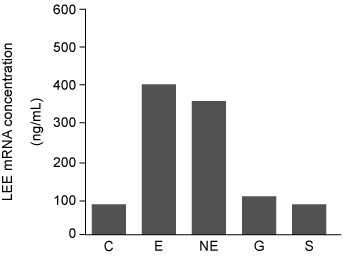 Figure 1 Concentration of LEE mRNA in mutant LuxS− bacteria supplemented with purified peptide hormones (Note: C = control.) Western blot was performed to compare the presence and concentration of type III secretion proteins from wild-type (WT) , LuxS−, and LuxS− cultured in preconditioned media (PCM) . PCM was generated by culturing uninfected intestinal epithelial cells in growth media for 24 hours. After 24 hours, the cells were removed and the PCM was used to supplement the growth of LuxS− bacteria.
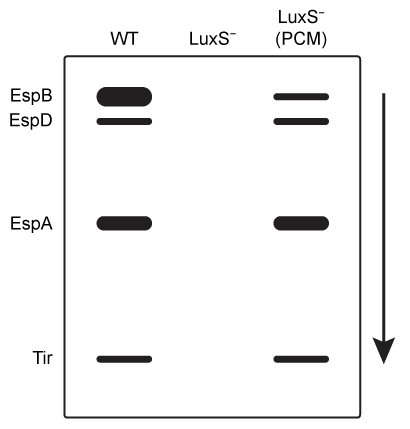 Figure 2 Western blot results of type III secretion proteins isolated from WT, mutant LuxS−, and LuxS− in PCM
-Based on the passage, what best explains the western blot results of type III secretion proteins in LuxS− E. coli cells cultured in PCM?
A) Intestinal epithelial cells secreted secretin and gastrin into the PCM.
B) Type III secretion proteins were produced by intestinal epithelial cells.
C) LuxS− cells underwent a spontaneous reverse mutation that restored normal LuxS function.
D) Compounds released by intestinal epithelial cells into the PCM activated transcription of LEE genes.
Correct Answer:

Verified
Correct Answer:
Verified
Q309: Passage<br>Saliva, a secreted fluid with multiple physiologic
Q310: Passage<br>In the central nervous system, myelin produced
Q311: Passage<br>Osteoarthritis (OA) is a disorder marked by
Q312: As the two anatomical divisions of the
Q313: Passage<br>In 1906, the Nobel Prize in Physiology
Q314: Passage<br>Saliva, a secreted fluid with multiple physiologic
Q315: Passage<br>The sex chromosomes X and Y are
Q316: Passage<br>In the central nervous system, myelin produced
Q317: Passage<br>Eukaryotic organelles such as mitochondria and chloroplasts
Q318: Passage<br>The lac operon encodes the proteins that