Multiple Choice
Passage
Osteoarthritis (OA) is a disorder marked by the deterioration of articular (hyaline) cartilage, the connective tissue lining the ends of bones at most movable joints. The progressive erosion of articular cartilage in OA is thought to be caused by an inflammatory response induced by years of biomechanical stress due to excessive compression and friction. This response involves the release of proteolytic enzymes that break down cartilaginous proteins. The progressive breakdown of articular cartilage ultimately results in complete exposure of the cortical portion of the underlying subchondral bone with narrowing of the joint space. Repeated and abnormal joint stress can also cause the development of osteophytes, or bony growths, that form on the subchondral bone. These degenerative processes cause pain and restrict joint movement.Stem cell therapy, in which injected or grafted stem cells are induced to differentiate into chondrocytes (cartilage cells) , is a potential new treatment for OA. To further understand chondrogenesis, researchers have been studying the molecules that regulate the expression and activity of the transcription factor Sox9, which has been shown to promote chondrocyte differentiation. For example, researchers have found that binding of the growth factor TGF-β to its receptor results in Sox9 activation.MicroRNAs (miRNAs) , which are known to alter gene expression by acting at the translational level, are also potential regulators of Sox9. In particular, miRNA-145 is thought to regulate Sox9 expression by binding to the 3′-UTR of the Sox9 mRNA transcript. After chondrocyte differentiation was induced using TGF-β, researchers used Western blotting to generate an expression profile of Sox9 and β-actin (a protein not regulated by miRNA-145) in mouse stem cells transfected with miRNA-145, anti-miRNA-145, or neither (Figure 1) .
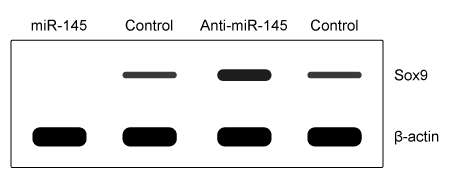 Figure 1 Expression of Sox9 in the presence and absence of miRNA-145 or anti-miRNA-145 following induction of chondrocyte differentiation
Adapted from Yang B, Guo H, Zhang Y, Chen L, Ying D, Dong S. MicroRNA-145 regulates chondrogenic differentiation of mesenchymal stem cells by targeting Sox9. PLoS ONE. 2011;6(7) :e21679.
-Osteoporosis, a disease marked by decreased bone density and mass, is similar to OA in that it is a degenerative bone disorder correlated with old age. Which two skeletal system functions would OA and osteoporosis impair, respectively?
A) Mobility and structural support
B) Mobility and leukocyte production
C) Calcium storage and structural support
D) Calcium storage and leukocyte production
Correct Answer:

Verified
Correct Answer:
Verified
Q306: Passage<br>Mitochondria are thought to have been independent
Q307: Passage<br>Mitochondria are thought to have been independent
Q308: Passage<br>Adeno-associated virus 2 (AAV2) is a nonpathogenic,
Q309: Passage<br>Saliva, a secreted fluid with multiple physiologic
Q310: Passage<br>In the central nervous system, myelin produced
Q312: As the two anatomical divisions of the
Q313: Passage<br>In 1906, the Nobel Prize in Physiology
Q314: Passage<br>Saliva, a secreted fluid with multiple physiologic
Q315: Passage<br>The sex chromosomes X and Y are
Q316: Passage<br>In the central nervous system, myelin produced