Multiple Choice
Passage
Adeno-associated virus 2 (AAV2) is a nonpathogenic, nonenveloped DNA virus that requires helper viruses such as adenovirus (AV) or herpes simplex virus (HSV) to replicate efficiently. Because it can transduce human cells, including quiescent (nondividing) cells, without causing disease, AAV2 is attractive as a gene therapy vector. In clinical trials, a modified AAV2 virus has successfully treated the retinal disease Leber's congenital amaurosis as well as the blood clotting disorder hemophilia B. AAV2 transduces cells via a multistep process, shown in Figure 1.
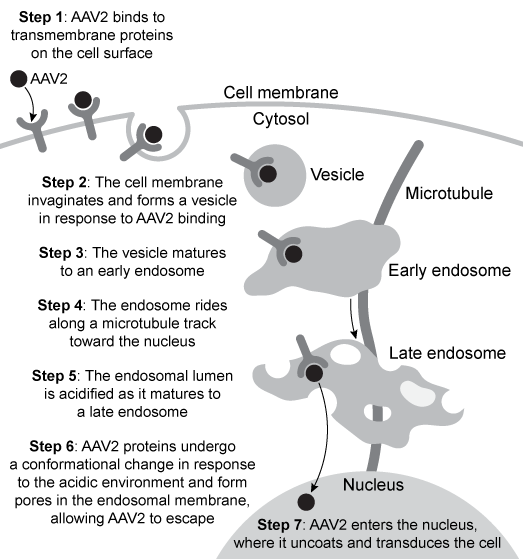 Figure 1 Schematic showing the mechanism of transduction by AAV2Studies indicate that unlike AV and HSV, AAV2 inhibits pathways other than the endosomal pathway, such as trafficking to the Golgi, increasing the percentage of invading virus particles that arrive at the nucleus.
Adapted from Xiao PJ, Samulski RJ. Cytoplasmic trafficking, endosomal escape, and perinuclear accumulation of adeno-associated virus type 2 particles are facilitated by microtubule network. J Virol. 2012;86(19) :10462-73.
-Which of the following is true concerning the proteins to which AAV2 binds in Figure 1, Step 1?
A) They localize primarily in low-cholesterol environments known as lipid rafts.
B) They are held statically in place by cytoskeletal components.
C) They are able to interact only with the phospholipids on the outer leaflet of the cell membrane.
D) They can migrate laterally through the phospholipid-rich environment of the cell membrane.
Correct Answer:

Verified
Correct Answer:
Verified
Q303: Passage<br>Overexpression of the miR-17~92 gene cluster occurs
Q304: Passage<br>Trypanosoma brucei is a eukaryotic parasite that
Q305: The genetic code is said to be
Q306: Passage<br>Mitochondria are thought to have been independent
Q307: Passage<br>Mitochondria are thought to have been independent
Q309: Passage<br>Saliva, a secreted fluid with multiple physiologic
Q310: Passage<br>In the central nervous system, myelin produced
Q311: Passage<br>Osteoarthritis (OA) is a disorder marked by
Q312: As the two anatomical divisions of the
Q313: Passage<br>In 1906, the Nobel Prize in Physiology