Multiple Choice
Passage
The Bloom syndrome helicase (BLM) transcript is catalytically inactive in Bloom syndrome (BS) , a genetic disorder that leads to genomic instability characterized by excessive somatic recombination events. Research studies have shown that BLM may be involved in DNA synthesis repair of stalled replication forks during replication stress (arrest) . To investigate this further, an experiment was conducted using cell lines derived from a patient with BS. One set of cells differed only by BLM status: PSNF5 (BLM+, vector with BLM cDNA transfected) and PSNG13 (BLM−, empty vector transfected) . Additional mutations, BLM-K695T and BLM-T99A, were studied in stable transfected cells.The nucleoside analogs iododeoxyuridine (IdU) and chlorodeoxyuridine (CldU) were used to label and track genomic regions of active replication. Cells were initially treated with IdU for 15 minutes. Subsequently, either 4 mM of hydroxyurea (HU) or 30 µM of aphidicolin (Aph) were used to induce replication stress for 4 hours, after which cells were treated with CldU for 85 minutes to assess replication recovery. Cells were mounted on microscope slides, lysed to isolate chromosome fibers, and then fixed on the slides. Sites of IdU and CldU incorporation into the growing DNA strand were then detected by immunostaining the isolated chromosome fibers with analog-specific, fluorescent-coupled antibodies. Replication activity was visualized via microscopy and measured.
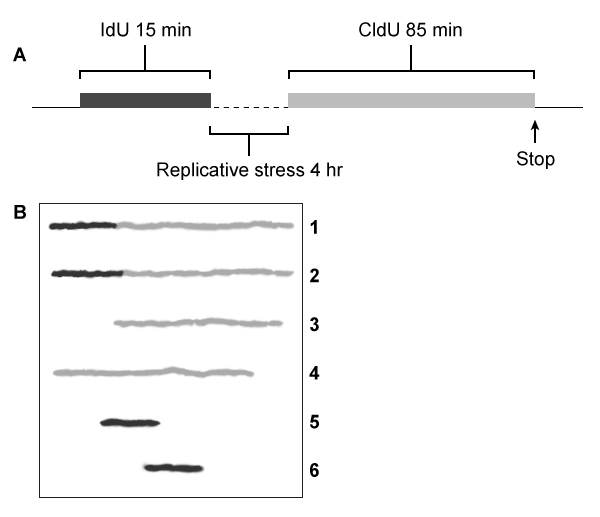 Figure 1 (A) Experimental protocol and (B) fluorescent imaging of a microscope slide showing incorporation of IdU (black lines) and CldU (gray lines) into DNA fibers isolated from a group of BLM+ and BLM− cells, with single fibers depicted in each row
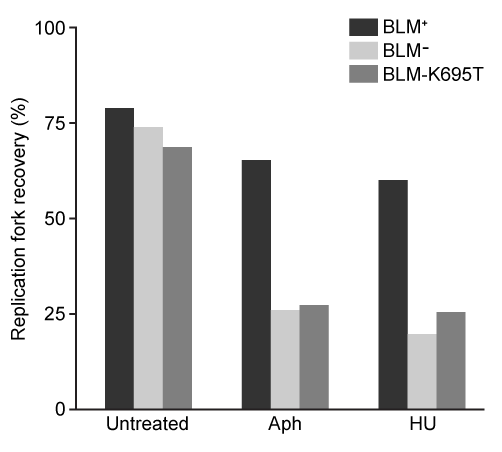 Figure 2 Replication fork recovery in cells expressing BLM+, BLM−, and the mutation BLM-K695T (antagonistic to wild-type)
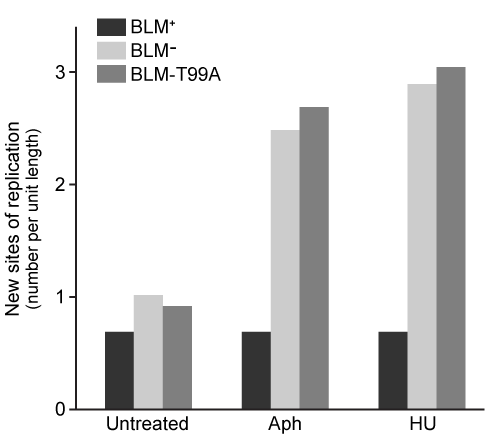 Figure 3 New sites of replication in cells expressing BLM+, BLM−, and the mutation BLM-T99A (T99 phosphorylated after replication arrest)
Adapted from Davies SL, North PS, Dart A, Lakin ND, Hickson ID. Mol Cell Biol. 2004;24(3) :1279-91.
-The BLM peptide sequence was used to search for similar peptides in various species using an amino acid sequence homology (similarity) database. BLM and other peptides were found to share similar amino acid sequences only in the DNA helicase domains. The results of sequence homology with BLM are shown in the table below. 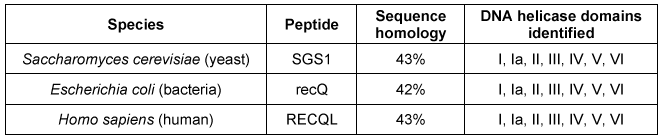 Which statement best explains the role of these peptides during replicative stress in the organisms studied?
A) SGS1 would be required to repair replication forks at one origin of replication.
B) recQ would be required to repair replication forks at one origin of replication.
C) BLM would be unable to repair replication forks at multiple origins of replication.
D) RECQL would be unable to repair replication forks at multiple origins of replication.
Correct Answer:

Verified
Correct Answer:
Verified
Q201: A woman carries an X-linked recessive allele
Q202: Passage<br>Each time a eukaryotic cell replicates its
Q203: Passage<br>Enterohemorrhagic Escherichia coli (EHEC) O157:H7 is a
Q204: Passage<br>Autosomal dominant polycystic kidney disease (ADPKD) is
Q205: The diagram below shows part of the
Q207: If a viral antigen were to bind
Q208: Passage<br>In the central nervous system, myelin produced
Q209: Passage<br>Adeno-associated virus 2 (AAV2) is a nonpathogenic,
Q210: Passage<br>Each time a eukaryotic cell replicates its
Q211: Passage<br>Enterohemorrhagic Escherichia coli (EHEC) O157:H7 is a