Multiple Choice
Passage
Whole grains have been shown to reduce the risk of cardiovascular disorders. A team of scientists discovered that the compound 5-aminovaleric acid betaine (5-AVAB) was present at high levels in cardiomyocytes of mice given a diet rich in whole grains and decided to investigate its role in metabolism. Preliminary evidence indicated that 5-AVAB did not alter the citric acid cycle in these cardiomyocytes, but that it did alter fatty acid metabolism.The plasma membrane transport protein organic cation/carnitine transporter 2 (OCTN2) transports extracellular L-carnitine into the cell against its concentration gradient using the energy provided by the simultaneous transport of Na+ into the cell. Cellular L-carnitine is required for the transport of fatty acids from the cytosol into the mitochondria. Based on the structures of 5-AVAB and L-carnitine (Figure 1) , scientists hypothesized that 5-AVAB may interfere with OCTN2-mediated transport of L-carnitine.
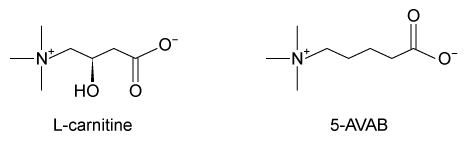 Figure 1 Structures of L-carnitine and 5-AVABTo test their hypothesis, scientists incubated mouse cardiomyocytes with various concentrations of 5-AVAB for 24 hours. Cells were then provided with the fatty acid palmitate for energy and were deprived of all other energy sources. The cardiomyocytes were also given 50 μM L-carnitine (endogenous extracellular concentration) or 2 mM L-carnitine, and the rate of oxygen consumption was monitored (Figure 2) .
 Figure 2 Oxygen consumption rate of cardiomyocytes at various concentrations of 5-AVAB and L-carnitineIn a follow-up experiment, the scientists used siRNA to silence expression of OCTN2 and found that intracellular L-carnitine levels were similarly depleted in siRNA-treated cells as in cells treated with 100 μM 5-AVAB.
Adapted from Kärkkäinen O, Tuomainen T, Koistinen V, et al. Whole grain intake associated molecule 5-aminovaleric acid betaine decreases ß-oxidation of fatty acids in mouse cardiomyocytes. Sci Rep. 2018;8(1) :13036.
-5-AVAB most likely alters fatty acid metabolism in cardiomyocytes through which mechanism?
A) Chelation of sodium ions
B) Allosteric inhibition of OCTN2
C) Irreversible binding to OCTN2 amino acid residues
D) Competition with L-carnitine for OCTN2 interactions
Correct Answer:

Verified
Correct Answer:
Verified
Q177: Passage<br>Upon entering muscle cells, glucose is immediately
Q178: Passage<br>The liver plays a central role in
Q179: The compound 5,10-methylene tetrahydrofolate (5,10mTHF) is derived
Q180: Fatty acid synthesis proceeds according to the
Q181: Passage<br>Upon entering muscle cells, glucose is immediately
Q183: A protein denatures as ionic interactions are
Q184: Passage<br>Although the structure of the cell membrane
Q185: Passage<br>Aldehyde dehydrogenase 2 (ALDH2) is essential for
Q186: A protein folds spontaneously in phosphate-buffered saline
Q187: A single-stranded DNA oligonucleotide composed of which