Multiple Choice
Passage
Aldehyde dehydrogenase 2 (ALDH2) is essential for the oxidation of toxic aldehydes, and uses NAD+ as the oxidizing agent. Mitochondrial ALDH2 exists as a 220-kD homotetrameric protein containing a catalytic, nucleotide-binding, and coenzyme-binding domain. The most prevalent ALDH2 mutation (ALDH2*2) involves an E to K (E478K) substitution in the catalytic domain that leads to decreased enzymatic activity.Scientists hypothesize that Asian populations have higher rates of ALDH2*2 incidence. The properties of ALDH2 variants in Caucasian and Japanese populations were analyzed in the following experiments.Experiment 1Mitochondrial extracts from both populations were combined in a single mixture and separated by native gel electrophoresis. Proteins 210-230 kD in size were removed from the agarose gel and further isolated using affinity columns with antibodies designed to separate wild-type ALDH2 from ALDH2*2 by binding the catalytic domain of the wild-type but not the mutant protein. Concentrated eluates E1 and E2 were produced by washing the affinity columns with buffers that remove unbound proteins and dislodge bound proteins from antibodies, respectively (Figure 1) .
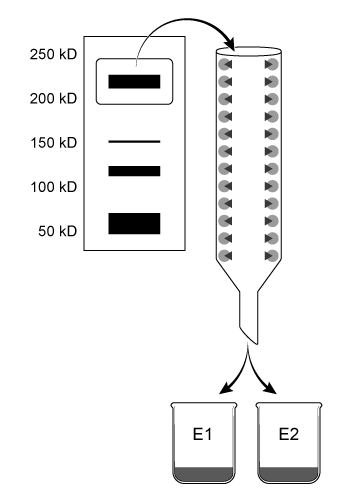 Figure 1 Purification of ALDH2 proteinsALDH2 activity in each eluate was quantified by adding acetaldehyde and NAD+, and then monitoring the rate of NADH production. The results are shown in Figure 2.
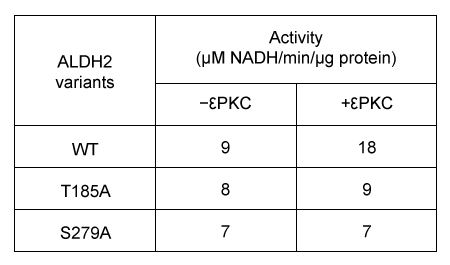
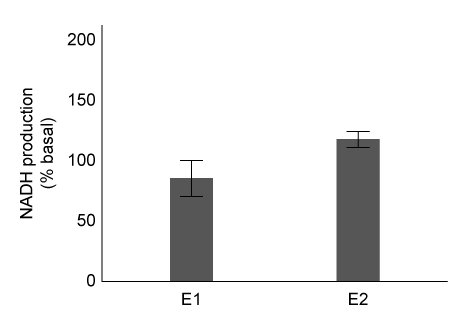 Figure 2 Enzymatic activity of E1 and E2 eluatesExperiment 2Researchers predict that mutations at conserved amino acid sites containing S or T may prevent ALDH2 from being phosphorylated by protein kinase C epsilon (εPKC) . The activity of wild-type ALDH2 (WT) and ALDH2 mutants with substitutions at positions T185 and S279 in the presence or absence of εPKC are summarized in Table 1.Table 1 Effect of εPKC on ALDH2 Variants
 Adapted from Chen CH, Ferreira JC, Gross ER, Mochly-rosen D. Targeting aldehyde dehydrogenase 2: new therapeutic opportunities. Physiol Rev. 2014;94(1) :1-34.
-The active site of wild-type ALDH2 most likely interacts with which of the following amino acid residues on the antibodies shown in Figure 1?
A) Aspartate
B) Phenylalanine
C) Isoleucine
D) Arginine
Correct Answer:

Verified
Correct Answer:
Verified
Q180: Fatty acid synthesis proceeds according to the
Q181: Passage<br>Upon entering muscle cells, glucose is immediately
Q182: Passage<br>Whole grains have been shown to reduce
Q183: A protein denatures as ionic interactions are
Q184: Passage<br>Although the structure of the cell membrane
Q186: A protein folds spontaneously in phosphate-buffered saline
Q187: A single-stranded DNA oligonucleotide composed of which
Q188: Passage<br>Leukocyte common antigen (LCA) enzymes play several
Q189: Passage<br>Human gamma-glutamyl transpeptidase (hGGT) is an enzyme
Q190: The reaction between UTP and glucose-1-phosphate (G1P)