Multiple Choice
Passage
NDPK is an enzyme in budding yeast that uses ATP to phosphorylate nucleotide diphosphates (NDPs and dNDPs) , yielding the triphosphate form of each (NTPs and dNTPs) . dNTPs are necessary for DNA synthesis, yet yeast cells that lack NDPK grow and divide at the same rate as wild-type yeast. Therefore, triphosphate generation is most likely carried out by one or more other enzymes.The enzyme TMPK converts deoxythymidine monophosphate (dTMP) to the diphosphate form (dTDP) by transferring the γ-phosphate of ATP to dTMP. Yeast cells that lack TMPK activity cannot synthesize DNA and become arrested during replication. It was proposed that TMPK may partially compensate for NDPK loss by phosphorylating dTDP as well as dTMP.To better understand the role of TMPK in nucleotide phosphorylation, wild-type TMPK and the inactive E75K variant were purified by affinity chromatography, and the following experiments were performed.Experiment 1After purification, a sample containing 3 μg of protein was added to a reaction mixture containing radiolabeled nucleotide monophosphates (NMPs or dNMPs) and unlabeled ATP. The reaction proceeded for 30 minutes, and products were separated by thin-layer chromatography (TLC) on a PEI-cellulose plate. PEI-cellulose separates nucleotides by charge (Figure 1) , and migration distance decreases with increasing negative charge. Spots were visualized by autoradiography, and it was determined that 0.30 nmol of dTMP and 0.15 nmol of uridine monophosphate (UMP) became phosphorylated, respectively.
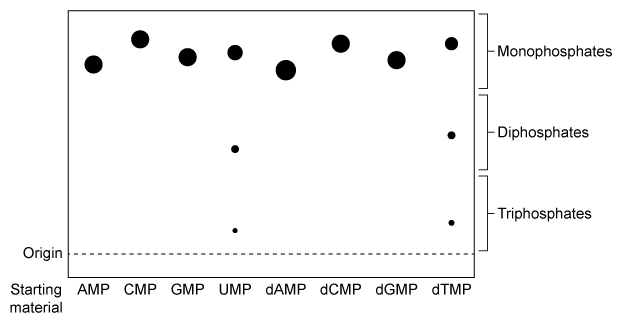 Figure 1 TLC analysis of nucleotide monophosphates after exposure to TMPK and ATP. (Note: Different nucleotides with the same phosphorylation level migrate different distances.) Experiment 2The experiment was repeated using radiolabeled dTDP as the starting material. The reaction proceeded in buffer only, in the presence of E75K TMPK, or in the presence of wild-type TMPK. Products were separated by TLC and visualized (Figure 2) .
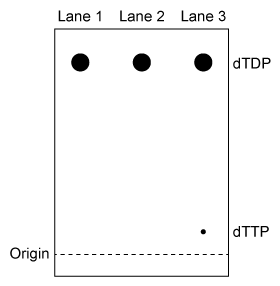 Figure 2 TLC analysis of dTDP phosphorylation with buffer only (Lane 1) , E75K TMPK (Lane 2) , or wild-type TMPK (Lane 3)
Adapted from Chien CY, Chen BR, Chou CK, Sclafani RA, Su JY. The yeast Cdc8 exhibits both deoxythymidine monophosphate and diphosphate kinase activities. FEBS Lett. 2009;583(13) :2281-6.
-Assuming the reaction in Experiment 2 is performed under saturating conditions, which of the following would cause an increase in the rate of phosphorylation?
A) Increasing the concentration of TMPK
B) Introducing a mutation to TMPK that increases its Km
C) Allowing the reaction to run for a longer period of time
D) Adding more dTDP to the reaction
Correct Answer:

Verified
Correct Answer:
Verified
Q135: Passage<br>NDPK is an enzyme in budding yeast
Q136: Passage<br>Aldehyde dehydrogenase 2 (ALDH2) is essential for
Q137: Passage<br>The innate immune system relies heavily on
Q138: Passage<br>The HIV-derived transactivator of transcription (Tat) is
Q139: Passage<br>The liver plays a central role in
Q141: Passage<br>A newborn girl is diagnosed with a
Q142: Passage<br>The influenza A virus is an enveloped
Q143: Passage<br>Many cephalopods can change color to blend
Q144: Phospholipases release arachidonic acid from cell membranes
Q145: Passage<br>The sirtuins are a class of enzymes