Multiple Choice
Passage
Many cephalopods can change color to blend in with their surroundings by altering the conformations of particular proteins within their skin cells. The reflectin proteins play a major role in this camouflage mechanism. Reflectins are a group of intrinsically disordered proteins that do not adopt clearly defined secondary or tertiary structures. Under certain conditions reflectins aggregate, allowing cells to reflect various wavelengths of light.Skin cells from the squid Doryteuthis opalescens were cultured and three reflectins-DoRA, DoRB, and DoRC-were purified and analyzed to determine amino acid composition. They were found to contain an abundance of arginine and serine but relatively few cysteine, leucine, isoleucine, valine, phenylalanine, or tryptophan residues. Figure 1 shows the relative hydrophobicity of each reflectin variant as a function of amino acid position.
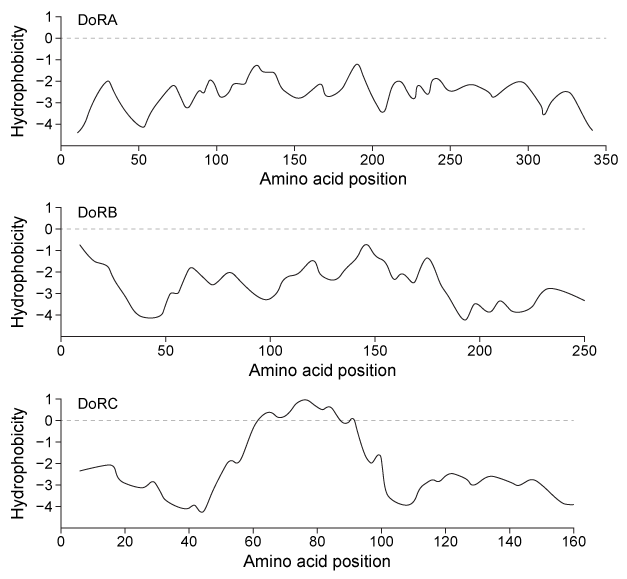 Figure 1 Hydrophobicity plots of three reflectins isolated from D. opalescens. (Note: Negative numbers indicate hydrophilic regions.) In D. opalescens skin cells (pH ≈ 7.8) , reflectins aggregate in response to acetylcholine (ACh) , which causes a signal cascade that changes the phosphorylation state of the proteins. Cells were incubated with or without ACh, and DoRA and DoRB were purified and assessed for phosphorylation by mass spectrometry. DoRA became phosphorylated in the presence of ACh whereas DoRB became dephosphorylated. After examining the isoelectric points of unmodified DoRA and DoRB, as shown in Figure 2, scientists proposed that reflectins aggregate upon charge neutralization.
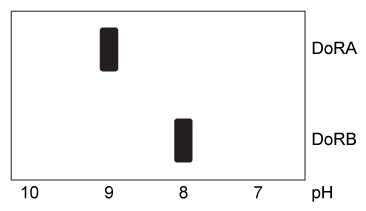 Figure 2 Isoelectric focusing of DoRA and DoRB
Adapted from Demartini DG, Izumi M, Weaver AT, Pandolfi E, Morse DE. Structures, Organization, and Function of Reflectin Proteins in Dynamically Tunable Reflective Cells. J Biol Chem. 2015;290(24) :15238-49.
-Which of the reflectin variants is most likely to be integrated into a membrane?
A) DoRA only
B) DoRB only
C) DoRC only
D) Both DoRA and DoRB
Correct Answer:

Verified
Correct Answer:
Verified
Q138: Passage<br>The HIV-derived transactivator of transcription (Tat) is
Q139: Passage<br>The liver plays a central role in
Q140: Passage<br>NDPK is an enzyme in budding yeast
Q141: Passage<br>A newborn girl is diagnosed with a
Q142: Passage<br>The influenza A virus is an enveloped
Q144: Phospholipases release arachidonic acid from cell membranes
Q145: Passage<br>The sirtuins are a class of enzymes
Q146: During protein folding, which of the following
Q147: Passage<br>The ABO blood groups are determined by
Q148: Passage<br>The sirtuins are a class of enzymes