Multiple Choice
Passage
The influenza A virus is an enveloped RNA virus with potential for zoonosis (transmission from animals to humans) . It obtains its plasma membrane from its host cell, but the composition of the viral envelope and vertebrate plasma membrane are distinct. The envelope of H6-G225D consists mostly of phosphatidylethanolamine as well as some negatively charged glycerophospholipids. The outer membrane contains hemagglutinin (HA) proteins that bind to the carbohydrate known as sialic acid (SA) on host cell receptor proteins, facilitating viral entry. It also contains neuraminidase enzymes that break the bond between SA and galactose in the host membrane glycans, allowing new virions to be released.Minute changes in the genes that code for HA proteins can alter the virulence, host, and attachment mechanism. In general, influenza A infects avian species by attaching to tracheal tissue, which displays SA groups bound to receptors through an α-2,3-glycosidic linkage to galactose (Figure 1) . Avian viruses generally cannot attack human cells, in which SA is linked to galactose through an α-2,6-glycosidic linkage instead of an α-2,3 linkage.
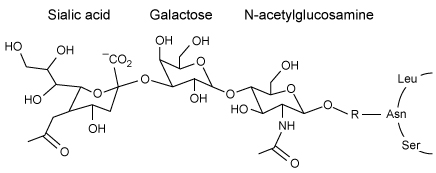 Figure 1 Structure of the influenza A receptor in avian cell membranesIn a recent study, however, a G225D substitution in HA, caused by a GGC to GAU codon mutation, enabled avian virions to infect human cells. The stability of G225D HA proteins was compared to that of H6-P186L, which is created by a single CCC to CUC mutation and exclusively infects avian cells, and H1N1, which targets only humans. The viral RNA of H6-P186L, H6-G225D, and H1N1 was cloned using cDNA and expressed in embryonic kidney cells. The melting curve of each purified HA protein was determined using differential scanning calorimetry, with peaks representing melting temperatures (Figure 2) .
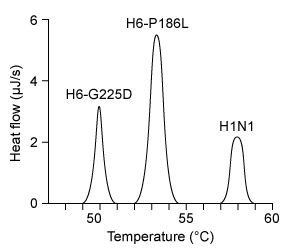 Figure 2 Hemagglutinin melting curves for H6N1 and H1N1 influenza A strains
Adapted from De vries RP, Tzarum N, Peng W, et al. A single mutation in Taiwanese H6N1 influenza hemagglutinin switches binding to human-type receptors. EMBO Mol Med. 2017;9(9) :1314-1325.
-Which statement best describes the structure of the avian receptor of influenza A shown in Figure 1?
A) It is a glycoprotein with the anomeric carbon of sialic acid bound to a nonreducing disaccharide
B) It is a glycolipid with three reducing sugars bound to each other through their anomeric carbons
C) It is a glycoprotein with sialic acid bound to the anomeric carbon of a reducing disaccharide
D) It is a glycolipid with three nonreducing sugars in which only one bond contains an anomeric carbon
Correct Answer:

Verified
Correct Answer:
Verified
Q137: Passage<br>The innate immune system relies heavily on
Q138: Passage<br>The HIV-derived transactivator of transcription (Tat) is
Q139: Passage<br>The liver plays a central role in
Q140: Passage<br>NDPK is an enzyme in budding yeast
Q141: Passage<br>A newborn girl is diagnosed with a
Q143: Passage<br>Many cephalopods can change color to blend
Q144: Phospholipases release arachidonic acid from cell membranes
Q145: Passage<br>The sirtuins are a class of enzymes
Q146: During protein folding, which of the following
Q147: Passage<br>The ABO blood groups are determined by