Multiple Choice
Passage
DNA polymerization is one of the most conserved mechanisms of genome replication. Synthesis of a complete DNA strand requires a template, primers, a polymerase enzyme, and sufficient deoxyribonucleotide triphosphates (dNTPs) . The DNA polymerase enzyme binds consecutive base pairs on the template strand and extends the double helix by adding dNTPs to the primer. The amino acid residues in the active site of DNA polymerase form hydrogen bonds with Watson-Crick donors and acceptors on incoming DNA nucleotides to facilitate base pairing.The formation of the DNA double helix creates opposing changes in entropy and enthalpy. Favorable bonding interactions via hydrogen bonds during Watson-Crick base pairing results in negative enthalpy, and restricted rotation and flexibility of the DNA backbone generates negative entropy. Scientists hypothesize that hydrogen bonding between bases not only stabilizes the double helix but is also crucial for selective and efficient replication.Analogs that are similar in size and shape to naturally occurring bases can be used to determine the influence of hydrogen bonding on base pair selectivity. To mimic the structure of deoxythymidine triphosphate (dTTP) , researchers synthesized dNTP derivatives of difluorotoluene (dFTP) , a nonpolar analog that lacks Watson-Crick hydrogen bonding. Klenow fragment (KF) polymerase, which has 3′-5′ but not 5′-3′ exonuclease activity, was incubated with a mixture of DNA template, primers, and dNTPs, including dFTP derivatives. The efficiency of dFTP and natural dTTP nucleotide incorporation into a growing primer strand by KF is shown in Figure 1.
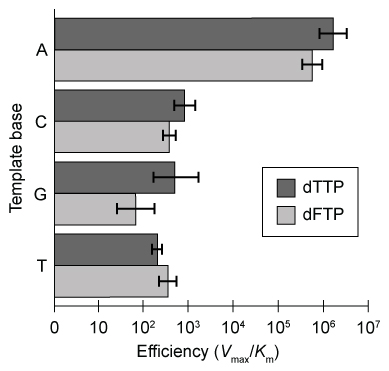 Figure 1 Template-specific selection of dFTP and dTTP by the KF enzyme
Adapted from Moran S, Ren RX, Kool ET. A thymidine triphosphate shape analog lacking Watson-Crick pairing ability is replicated with high sequence selectivity. Proc Natl Acad Sci USA. 1997;94(20) :10506-11.
-In the DNA polymerase active site, which nucleotide base would provide the most Watson-Crick donors for interactions with amino acid residues?
A) Adenine
B) Cytosine
C) Guanine
D) Thymine
Correct Answer:

Verified
Correct Answer:
Verified
Q68: Passage<br>Mitochondria are double membrane-bound cellular organelles that
Q69: Passage<br>The tumor suppressor p53 is a homotetrameric
Q70: Passage<br>Porphyrin biosynthesis is a multistep process that
Q71: Passage<br>Aldehyde dehydrogenase 2 (ALDH2) is essential for
Q72: The physical properties of two isoforms of
Q74: Passage<br>ATP synthase, also known as Complex V,
Q75: Passage<br>Antimicrobial peptides are an important component of
Q76: Studies on the catalytic activity of hexokinase
Q77: Passage<br>The Ankyrin repeat and SOCS box containing
Q78: Passage<br>The tumor suppressor p53 is a homotetrameric