Solved

Passage The K-Ras Gene Codes for a Small Guanine Nucleotide-Binding Protein

Question 270

Multiple Choice

Passage
The K-ras gene codes for a small guanine nucleotide-binding protein, which acts as a molecular activator in numerous signaling pathways that promote DNA replication along with cell growth and survival.  K-ras mutations at codons 12 and 13 function as biological markers for diagnosis of tumors.  The DNA of SW-480 cells, a line originating from a colon adenocarcinoma, is the standard positive control used to identify codon 12 mutations in K-ras testing.
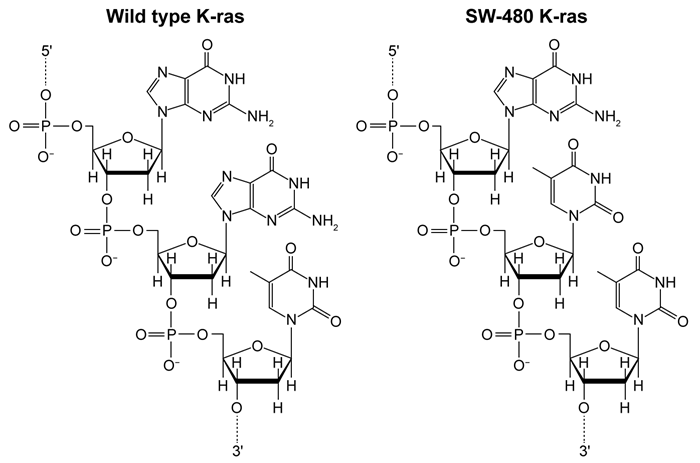
Passage The K-ras gene codes for a small guanine nucleotide-binding protein, which acts as a molecular activator in numerous signaling pathways that promote DNA replication along with cell growth and survival.  K-ras mutations at codons 12 and 13 function as biological markers for diagnosis of tumors.  The DNA of SW-480 cells, a line originating from a colon adenocarcinoma, is the standard positive control used to identify codon 12 mutations in K-ras testing.    <strong>Figure 1</strong>  Structural comparison of K-ras codon 12 in wild-type cells and SW-480 cellsPCR sequence analysis has been the preferred method for studying genetic mutations such as those in K-ras.  However, challenges in analyzing PCR amplicons have prompted the development of DNA melting curve analysis (MCA) .  In the MCA technique, DNA is extracted from clinical samples and amplified by PCR.  The amplified DNA is then melted (30-70°C)  and analyzed by assessing the fluorescence (at 640 nm)  of LC Green Plus, an intercalating dye that fluoresces when bound to double-stranded DNA (Figure 2) .    <strong>Figure 2</strong>  Melting curves of wild-type (WT)  and SW-480 K-ras DNA.To study K-ras activity in colorectal cancer cells, short tandem repeats (STRs)  were introduced into the K-ras gene.  STRs are short stretches of DNA with repeating nucleotides, and four different STR sequences were inserted into the K-ras gene and analyzed via MCA under different experimental conditions (Table 1) .<strong>Table 1</strong>  Sequences Studied in K-ras DNA MCA Analysis.    Liu YP, Wu HY, Yang X, et al. Diagnostic accuracy of high resolution melting analysis for detection of KRAS mutations: a systematic review and meta-analysis. Sci Rep. 2014;4:7521. -Which of the following is most likely to be identified in SW-480 cells? A) An activating mutation in at least one K-ras allele B) Inactivating mutations in both K-ras alleles C) Decreased expression of K-ras protein D) Increased expression of hypoactive K-ras protein Figure 1  Structural comparison of K-ras codon 12 in wild-type cells and SW-480 cellsPCR sequence analysis has been the preferred method for studying genetic mutations such as those in K-ras.  However, challenges in analyzing PCR amplicons have prompted the development of DNA melting curve analysis (MCA) .  In the MCA technique, DNA is extracted from clinical samples and amplified by PCR.  The amplified DNA is then melted (30-70°C) and analyzed by assessing the fluorescence (at 640 nm) of LC Green Plus, an intercalating dye that fluoresces when bound to double-stranded DNA (Figure 2) .
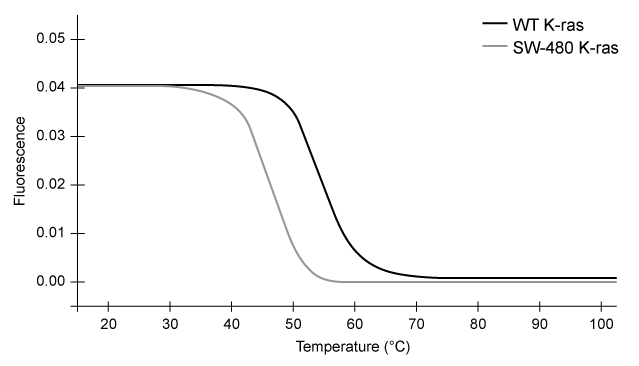
Passage The K-ras gene codes for a small guanine nucleotide-binding protein, which acts as a molecular activator in numerous signaling pathways that promote DNA replication along with cell growth and survival.  K-ras mutations at codons 12 and 13 function as biological markers for diagnosis of tumors.  The DNA of SW-480 cells, a line originating from a colon adenocarcinoma, is the standard positive control used to identify codon 12 mutations in K-ras testing.    <strong>Figure 1</strong>  Structural comparison of K-ras codon 12 in wild-type cells and SW-480 cellsPCR sequence analysis has been the preferred method for studying genetic mutations such as those in K-ras.  However, challenges in analyzing PCR amplicons have prompted the development of DNA melting curve analysis (MCA) .  In the MCA technique, DNA is extracted from clinical samples and amplified by PCR.  The amplified DNA is then melted (30-70°C)  and analyzed by assessing the fluorescence (at 640 nm)  of LC Green Plus, an intercalating dye that fluoresces when bound to double-stranded DNA (Figure 2) .    <strong>Figure 2</strong>  Melting curves of wild-type (WT)  and SW-480 K-ras DNA.To study K-ras activity in colorectal cancer cells, short tandem repeats (STRs)  were introduced into the K-ras gene.  STRs are short stretches of DNA with repeating nucleotides, and four different STR sequences were inserted into the K-ras gene and analyzed via MCA under different experimental conditions (Table 1) .<strong>Table 1</strong>  Sequences Studied in K-ras DNA MCA Analysis.    Liu YP, Wu HY, Yang X, et al. Diagnostic accuracy of high resolution melting analysis for detection of KRAS mutations: a systematic review and meta-analysis. Sci Rep. 2014;4:7521. -Which of the following is most likely to be identified in SW-480 cells? A) An activating mutation in at least one K-ras allele B) Inactivating mutations in both K-ras alleles C) Decreased expression of K-ras protein D) Increased expression of hypoactive K-ras protein Figure 2  Melting curves of wild-type (WT) and SW-480 K-ras DNA.To study K-ras activity in colorectal cancer cells, short tandem repeats (STRs) were introduced into the K-ras gene.  STRs are short stretches of DNA with repeating nucleotides, and four different STR sequences were inserted into the K-ras gene and analyzed via MCA under different experimental conditions (Table 1) .Table 1  Sequences Studied in K-ras DNA MCA Analysis.
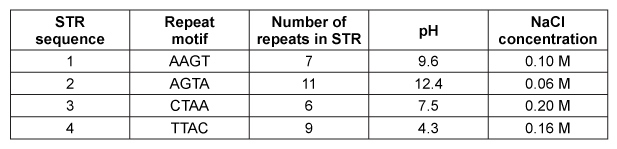
Passage The K-ras gene codes for a small guanine nucleotide-binding protein, which acts as a molecular activator in numerous signaling pathways that promote DNA replication along with cell growth and survival.  K-ras mutations at codons 12 and 13 function as biological markers for diagnosis of tumors.  The DNA of SW-480 cells, a line originating from a colon adenocarcinoma, is the standard positive control used to identify codon 12 mutations in K-ras testing.    <strong>Figure 1</strong>  Structural comparison of K-ras codon 12 in wild-type cells and SW-480 cellsPCR sequence analysis has been the preferred method for studying genetic mutations such as those in K-ras.  However, challenges in analyzing PCR amplicons have prompted the development of DNA melting curve analysis (MCA) .  In the MCA technique, DNA is extracted from clinical samples and amplified by PCR.  The amplified DNA is then melted (30-70°C)  and analyzed by assessing the fluorescence (at 640 nm)  of LC Green Plus, an intercalating dye that fluoresces when bound to double-stranded DNA (Figure 2) .    <strong>Figure 2</strong>  Melting curves of wild-type (WT)  and SW-480 K-ras DNA.To study K-ras activity in colorectal cancer cells, short tandem repeats (STRs)  were introduced into the K-ras gene.  STRs are short stretches of DNA with repeating nucleotides, and four different STR sequences were inserted into the K-ras gene and analyzed via MCA under different experimental conditions (Table 1) .<strong>Table 1</strong>  Sequences Studied in K-ras DNA MCA Analysis.    Liu YP, Wu HY, Yang X, et al. Diagnostic accuracy of high resolution melting analysis for detection of KRAS mutations: a systematic review and meta-analysis. Sci Rep. 2014;4:7521. -Which of the following is most likely to be identified in SW-480 cells? A) An activating mutation in at least one K-ras allele B) Inactivating mutations in both K-ras alleles C) Decreased expression of K-ras protein D) Increased expression of hypoactive K-ras protein Liu YP, Wu HY, Yang X, et al. Diagnostic accuracy of high resolution melting analysis for detection of KRAS mutations: a systematic review and meta-analysis. Sci Rep. 2014;4:7521.
-Which of the following is most likely to be identified in SW-480 cells?


A) An activating mutation in at least one K-ras allele
B) Inactivating mutations in both K-ras alleles
C) Decreased expression of K-ras protein
D) Increased expression of hypoactive K-ras protein

Correct Answer:

verifed

Verified

Unlock this answer now
Get Access to more Verified Answers free of charge

Related Questions