Multiple Choice
Passage
Myalgic encephalopathy (ME) , or chronic fatigue syndrome (CFS) , is a physiological disease that affects 0.15% of the human population. Compared with healthy individuals, persons with ME experience reduced phospholipid levels, muscular degeneration, urinary urgency, and other symptoms that contribute to a lower quality of life. Studies in resting subjects have yielded inconsistent data and failed to identify a unique metabolic defect in patients with ME.Analyzing the blood plasma of male and female patients with ME, physicians have observed that male patients display elevated levels of 3-methylhistidine, a marker of protein catabolism. Researchers expanded this finding by measuring the serum concentration of amino acids in blood samples obtained from nonfasting ME patients and healthy controls. Amino acids were classified into separate categories according to their metabolic intermediates.Table 1 Classification of Amino Acids in Blood Plasma
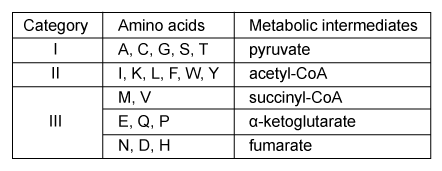
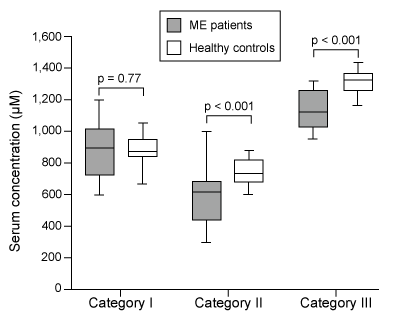 Figure 1 Serum concentrations of amino acids in patients with ME and healthy controls (HC) Next, researchers hypothesized that the inhibition of pyruvate dehydrogenase (PDH) and impairment of fatty acid oxidation were responsible for the fluctuations in amino acid levels. PDH function and lipid metabolism were studied in peripheral blood mononuclear cells (PBMCs) by measuring the gene expression of proteins within regulatory pathways. Researchers monitored the mRNA levels of the inhibitor pyruvate dehydrogenase kinase 1 (PDK1) and of sirtuin 4 (SIRT4) , which removes lipoic acid groups from the PDH complex. They also examined lipid metabolism by measuring the mRNA levels of peroxisome proliferator-activated receptor-α (PPARα) , a transcription factor that upregulates the uptake of fatty acids. The mRNA level of each protein in PBMCs of patients with ME was evaluated against healthy controls, as shown in Figure 2.
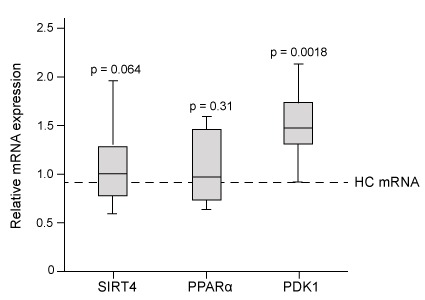 Figure 2 Gene expression of PDK1, SIRT4, and PPARα in PBMCs
Adapted from Fluge Ø, Mella O, Bruland O, et al.. JCI Insight. 2016;1(21) :e89376.
-Assuming that 3-methylhistidine is the only indicator of protein catabolism, which observation would best support the difference in the metabolism of amino acids in male and female patients with ME?
A) Male ME patients undergo fewer transamination reactions than female patients.
B) Female ME patients excrete more ammonia in their urine than male patients.
C) Male ME patients produce more glutamate in their liver cells than female patients.
D) Female ME patients produce more α-keto acids in their muscles than male patients.
Correct Answer:

Verified
Correct Answer:
Verified
Q117: Passage<br>Ribulose-1,5-bisphosphate carboxylase/oxygenase (rubisco) is one of the
Q118: Passage<br>Many cephalopods can change color to blend
Q119: Which of the following structures represents the
Q120: Passage<br>The influenza A virus is an enveloped
Q121: Passage<br>Diabetic nephropathy (kidney disease) is characterized in
Q123: Passage<br>Presynaptic nerve terminals release neurotransmitters via synaptic
Q124: Passage<br>Whole grains have been shown to reduce
Q125: Passage<br>Presynaptic nerve terminals release neurotransmitters via synaptic
Q126: An enzyme kinetics assay reveals that V<sub>max</sub>
Q127: Passage<br>DNA polymerization is one of the most