Passage Ribulose-1,5-Bisphosphate Carboxylase/oxygenase (Rubisco) Is One of the Most Abundant Enzymes
Multiple Choice
Passage
Ribulose-1,5-bisphosphate carboxylase/oxygenase (rubisco) is one of the most abundant enzymes on Earth. In carbon-fixing organisms, it consumes CO2 to carboxylate the sugar ribulose-1,5-bisphosphate (Ru1,5BP) , and forms two molecules of 3-phosphoglycerate (3PG) as a product. The functional form of rubisco from the bacterium Rhodospirillum rubrum is a noncovalent homodimer composed of two 51 kDa monomers. Each subunit requires a magnesium ion as a prosthetic group in the active site.Rubisco is often used as a model for protein folding studies. On their own, rubisco monomers typically cannot fold to completion and instead are trapped in a form known as a "kinetic intermediate." These kinetically trapped monomers cannot dimerize correctly and are prone to aggregation.Scientists interested in studying protein folding dynamics labeled the rubisco kinetic intermediate with a set of fluorophores known as a FRET (fluorescence resonance energy transfer) pair, with one fluorophore at the N-terminus and the other at the C-terminus. A FRET signal occurs when the emission spectrum of one fluorophore (the donor) overlaps with the excitation spectrum of the other (the acceptor) . When the two fluorophores are sufficiently close to each other, the donor can transfer energy from the light it absorbs directly to the acceptor, causing the acceptor to emit light when the donor absorbs light.The GroEL/ES complex is a chaperone protein that binds and releases misfolded proteins, hydrolyzing ATP each time the protein is released. A misfolded protein may undergo multiple rounds of binding and release before adopting its correct conformation, or it may never fold correctly and instead be targeted for destruction (Figure 1) .
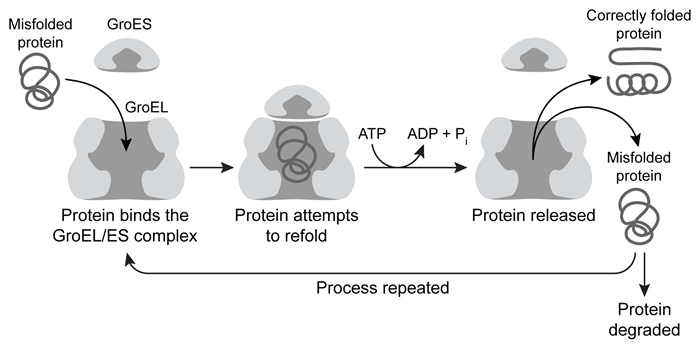 Figure 1 Representation of GroEL/ES-mediated protein foldingResearchers diluted the labeled kinetic intermediate into a refolding buffer in the presence or absence of 200 nM GroEL/ES and then monitored the FRET signal over time. The results are shown in Figure 2.
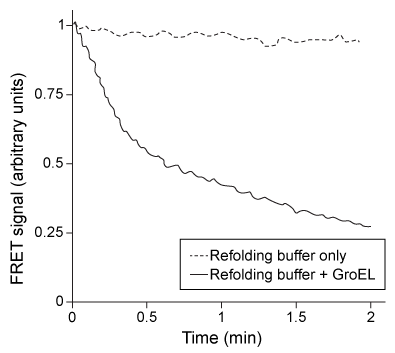 Figure 2 FRET signal of labeled rubisco with and without GroEL
Lin Z, Rye HS. Expansion and compression of a protein folding intermediate by GroEL. Mol Cell. 2004;16(1) :23-34.
-Based on the molecular weight of a rubisco monomer, approximately how many amino acids are present in a rubisco dimer?
A) 460
B) 690
C) 920
D) 5100
Correct Answer:

Verified
Correct Answer:
Verified
Q112: Passage<br>Aldehyde dehydrogenase 2 (ALDH2) is essential for
Q113: Passage<br>The K-ras gene codes for a small
Q114: Which of the following molecules could participate
Q115: Passage<br>The innate immune system relies heavily on
Q116: Passage<br>A newborn girl is diagnosed with a
Q118: Passage<br>Many cephalopods can change color to blend
Q119: Which of the following structures represents the
Q120: Passage<br>The influenza A virus is an enveloped
Q121: Passage<br>Diabetic nephropathy (kidney disease) is characterized in
Q122: Passage<br>Myalgic encephalopathy (ME), or chronic fatigue syndrome