Passage Presynaptic Nerve Terminals Release Neurotransmitters Via Synaptic Vesicle Exocytosis. This
Multiple Choice
Passage
Presynaptic nerve terminals release neurotransmitters via synaptic vesicle exocytosis. This action is mediated by the membrane-bound target-SNARE (t-SNARE) proteins syntaxin and SNAP-25, and the vesicle-associated SNARE (v-SNARE) protein synaptobrevin. Membrane fusion is initiated when the t-SNAREs and v-SNAREs form an α-helix bundle known as the core-trans-complex, achieved by zipping SNARE proteins together to form a more stable cis-complex (Figure 1) .
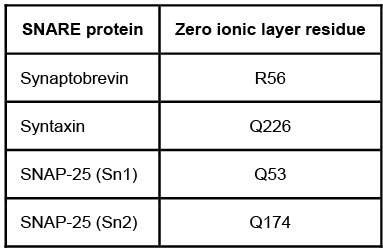
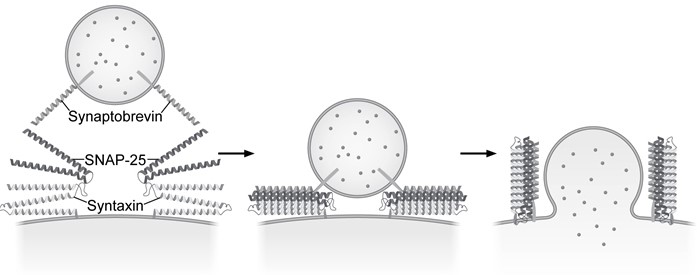 Figure 1 Formation of the core-trans-complex and subsequent membrane fusionThe cis-complex contains the zero ionic layer, the main site of interaction between complexed proteins. Within the zero ionic layer, arginine on synaptobrevin coordinates with carbonyl groups present on the other residues shown in Table 1. The zero ionic layer is buried within leucine zipper domains, which act as a shield to solvent molecules.Table 1 Composition of cis-Complex Zero Ionic Layer
 An early step in cis-complex disassembly is destabilization by the ATPase N-ethylmaleimide-sensitive factor (NSF) , which initiates unzipping by breaking flanking leucine zipper regions, leading to vesicle reuptake. Movement of NSF to the cell membrane is mediated by the cytoplasmic protein α-SNAP, which must first bind the N-terminal domain of syntaxin.To determine the effect of vesicle-bound synaptobrevin on the binding of α-SNAP to syntaxin, increasing amounts of recombinant His-tagged α-SNAP were added to a constant amount of syntaxin affixed to glutathione-agarose beads with or without synaptobrevin. After incubation, bound proteins were recovered and quantitatively analyzed by immunoblotting. Results are shown in Figure 2.
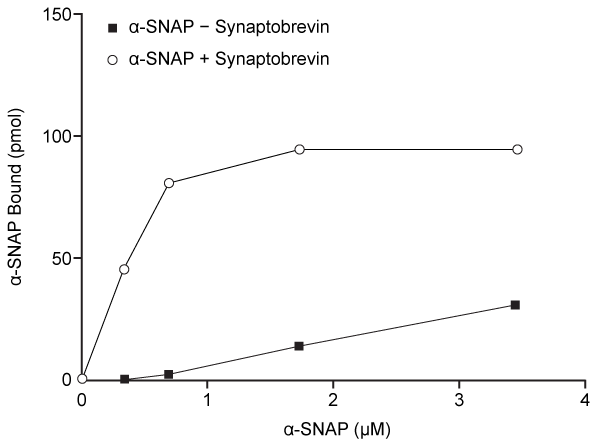 Figure 2 α-SNAP binding to syntaxin in the absence (square) or presence (circle) of synaptobrevin
Adapted from Mcmahon HT, Südhof TC. Synaptic core complex of synaptobrevin, syntaxin, and SNAP25 forms high affinity alpha-SNAP binding site. J Biol Chem. 1995;270(5) :2213-7.
-Which of the following amino acid substitutions is most likely to interrupt the interactions of the zero ionic layer?
A) R56K on synaptobrevin
B) Q53R on SNAP-25 (Sn1)
C) E224D on syntaxin
D) Q174N on SNAP-25 (Sn2)
Correct Answer:

Verified
Correct Answer:
Verified
Q120: Passage<br>The influenza A virus is an enveloped
Q121: Passage<br>Diabetic nephropathy (kidney disease) is characterized in
Q122: Passage<br>Myalgic encephalopathy (ME), or chronic fatigue syndrome
Q123: Passage<br>Presynaptic nerve terminals release neurotransmitters via synaptic
Q124: Passage<br>Whole grains have been shown to reduce
Q126: An enzyme kinetics assay reveals that V<sub>max</sub>
Q127: Passage<br>DNA polymerization is one of the most
Q128: Passage<br>Physical activity produces an increased energy requirement
Q129: Passage<br>Myalgic encephalopathy (ME), or chronic fatigue syndrome
Q130: An enzyme generates a Lineweaver-Burk plot with