Multiple Choice
Passage
Dystroglycan (Dg) is a transmembrane protein that mediates interactions between the cytoskeleton and the extracellular matrix (ECM) . It binds the ECM protein laminin in an interaction that is required for intercellular communication and muscle membrane structural stability. The Dg-laminin interaction is facilitated by a long carbohydrate chain called an O-mannosyl glycan, which is covalently linked to Dg (Figure 1) .
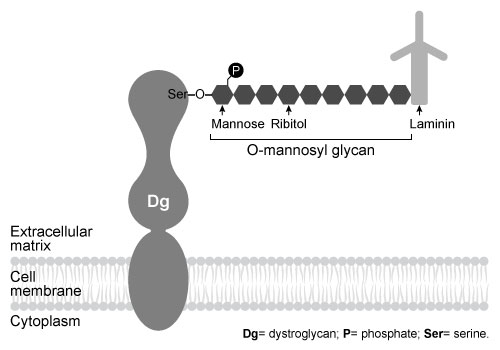 Figure 1 Schematic of interaction between Dg and laminin, mediated by the Dg-linked O-mannosyl glycanThe O-mannosyl glycan is added to Dg by a series of enzymes called glycosyltransferases. The first enzyme in this series, protein O-mannosyltransferase (POMT) , attaches D-mannose to the hydroxyl groups of serine and threonine residues in an α-linkage through the anomeric carbon. The next sugar in the chain then forms a β-1,4 linkage to the mannose residue, followed by several more steps to produce the full glycan. Genetic inactivation of any of the enzymes in the pathway results in an incomplete glycan and failure to bind laminin, and is the underlying cause of several severe forms of muscular dystrophy known as dystroglycanopathies.Researchers investigating dystroglycanopathies recently discovered the functions of two enzymes in the pathway: protein O-mannose kinase (POMK) and fukutin. POMK phosphorylates Dg-linked mannose at carbon 6, and fukutin adds the sugar ribitol 5-phosphate to the glycan chain. To assess the roles of POMK and fukutin relative to each other, scientists conducted experiments in which lysates from muscle cells deficient in either POMK or fukutin were incubated with 32P-labeled ATP or 3H-labeled activated ribitol 5-phosphate. Combined lysates containing both fukutin and POMK were also tested. Dg was then purified and detected by autoradiography and western blot using an antibody against Dg, as shown in Figure 2.
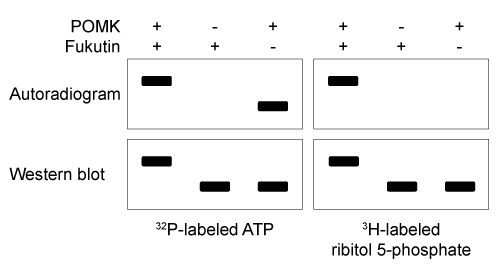 Figure 2 Autoradiograms and western blots of Dg purified from lysates incubated with 32P-labeled ATP or 3H-labeled ribitol 5-phosphate
Adapted from Kanagawa M, Kobayashi K, Tajiri M, et al. Identification of a Post-translational Modification with Ribitol-Phosphate and Its Defect in Muscular Dystrophy. Cell Rep. 2016;14(9) :2209-23.
-O-linked D-mannose can form a glycosidic bond with any sugar that has a free anomeric carbon. Therefore it could theoretically form a glycosidic bond with all of the following sugars EXCEPT:
A) galactose.
B) ribose.
C) lactose.
D) sucrose.
Correct Answer:

Verified
Correct Answer:
Verified
Q297: Passage<br>Destabilase, an enzyme found in the saliva
Q298: Passage<br>Tumor hypoxia is a marker of resistance
Q299: Activity assays were performed to determine the
Q300: Passage<br>DNA polymerization is one of the most
Q301: Passage<br>Antimicrobial peptides are an important component of
Q302: Passage<br>Interactions between positively charged histones and negatively
Q303: Passage<br>Ribulose-1,5-bisphosphate carboxylase/oxygenase (rubisco) is one of the
Q304: Passage<br>Although the structure of the cell membrane
Q305: Passage<br>Myalgic encephalopathy (ME), or chronic fatigue syndrome
Q307: Passage<br>Glycolysis and gluconeogenesis are tightly regulated, opposing