Multiple Choice
Passage
DNA polymerization is one of the most conserved mechanisms of genome replication. Synthesis of a complete DNA strand requires a template, primers, a polymerase enzyme, and sufficient deoxyribonucleotide triphosphates (dNTPs) . The DNA polymerase enzyme binds consecutive base pairs on the template strand and extends the double helix by adding dNTPs to the primer. The amino acid residues in the active site of DNA polymerase form hydrogen bonds with Watson-Crick donors and acceptors on incoming DNA nucleotides to facilitate base pairing.The formation of the DNA double helix creates opposing changes in entropy and enthalpy. Favorable bonding interactions via hydrogen bonds during Watson-Crick base pairing results in negative enthalpy, and restricted rotation and flexibility of the DNA backbone generates negative entropy. Scientists hypothesize that hydrogen bonding between bases not only stabilizes the double helix but is also crucial for selective and efficient replication.Analogs that are similar in size and shape to naturally occurring bases can be used to determine the influence of hydrogen bonding on base pair selectivity. To mimic the structure of deoxythymidine triphosphate (dTTP) , researchers synthesized dNTP derivatives of difluorotoluene (dFTP) , a nonpolar analog that lacks Watson-Crick hydrogen bonding. Klenow fragment (KF) polymerase, which has 3′-5′ but not 5′-3′ exonuclease activity, was incubated with a mixture of DNA template, primers, and dNTPs, including dFTP derivatives. The efficiency of dFTP and natural dTTP nucleotide incorporation into a growing primer strand by KF is shown in Figure 1.
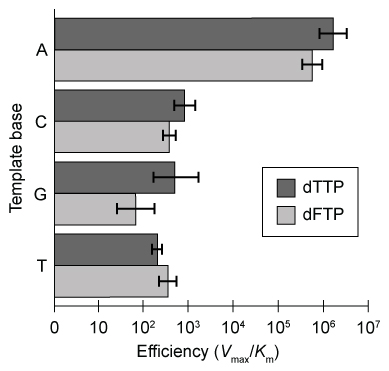 Figure 1 Template-specific selection of dFTP and dTTP by the KF enzyme
Adapted from Moran S, Ren RX, Kool ET. A thymidine triphosphate shape analog lacking Watson-Crick pairing ability is replicated with high sequence selectivity. Proc Natl Acad Sci USA. 1997;94(20) :10506-11.
-The Klenow fragment used in the experiment would be able to perform which of the following repair processes?
A) Excision of thymine dimers at the 5′ end of the growing strand
B) Replacement of nucleotides at the 3′ end of the growing strand
C) Correction of mismatched nucleotides in the middle of a completed strand
D) Removal of damaged bases from the middle of the template strand
Correct Answer:

Verified
Correct Answer:
Verified
Q295: Polyglutaraldehyde (PGA) can form linkages with amines.
Q296: Passage<br>Leukocyte common antigen (LCA) enzymes play several
Q297: Passage<br>Destabilase, an enzyme found in the saliva
Q298: Passage<br>Tumor hypoxia is a marker of resistance
Q299: Activity assays were performed to determine the
Q301: Passage<br>Antimicrobial peptides are an important component of
Q302: Passage<br>Interactions between positively charged histones and negatively
Q303: Passage<br>Ribulose-1,5-bisphosphate carboxylase/oxygenase (rubisco) is one of the
Q304: Passage<br>Although the structure of the cell membrane
Q305: Passage<br>Myalgic encephalopathy (ME), or chronic fatigue syndrome