Multiple Choice
Passage
Upon entering muscle cells, glucose is immediately phosphorylated by hexokinase to produce glucose 6-phosphate (G6P) . This phosphorylation event prevents glucose from exiting the cell. G6P may then enter one of three metabolic pathways, depending on the needs of the cell (Figure 1) .
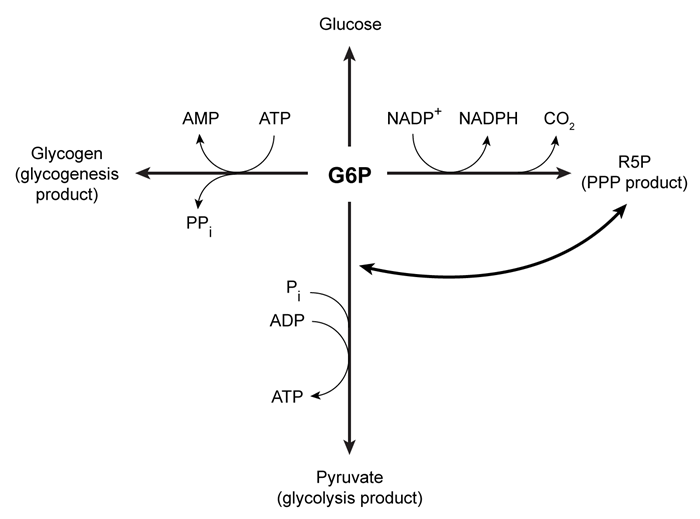 Figure 1 Three potential fates of G6P, determined by the needs of the cellUnder low ATP conditions, G6P enters glycolysis, where it is converted to two pyruvate molecules. The energy released in this process produces a net total of two ATP molecules per glucose molecule consumed. The resulting pyruvate molecules can then enter the mitochondria, where they participate in additional metabolic reactions that produce more ATP.When the cell experiences oxidative stress, G6P enters the pentose phosphate pathway (PPP) and produces NADPH, a reducing agent. During this process, G6P loses one carbon atom in the form of CO2 and is converted to ribose 5-phosphate (R5P) , which is required for nucleotide synthesis. In addition to low NADPH conditions, G6P may also enter the PPP during replication, when nucleotides are needed for DNA synthesis. If nucleotides are not needed but energy is, R5P can be converted back to glycolytic intermediates and reenter glycolysis. Each glucose molecule that is converted to R5P prior to glycolysis yields an average of 1.67 ATP molecules.When all the cell's metabolic requirements are met, additional G6P can enter glycogenesis and produce glycogen, which stores glucose for later use; this process consumes ATP. When signal molecules bind G protein-coupled receptors on muscle cells, glycogenolysis is activated to release individual monomers from glycogen, allowing them to enter the appropriate pathway.
-When the cell is in need of glucose, glycogenolysis is upregulated, beginning with the activation of glycogen phosphorylase. Glycogen phosphorylase catalyzes the production of which of the following molecules?
A) UDP-glucose
B) UDP-galactose
C) Glucose 1-phosphate
D) Glucose 6-phosphate
Correct Answer:

Verified
Correct Answer:
Verified
Q259: Consider the following reaction: <img src="https://d2lvgg3v3hfg70.cloudfront.net/MD0008/.jpg" alt="Consider
Q260: Passage<br>The liver plays a central role in
Q261: Passage<br>Tumor hypoxia is a marker of resistance
Q262: In order to transport long-chain fatty acids
Q263: Passage<br>Diabetic nephropathy (kidney disease) is characterized in
Q265: The pK<sub>a</sub> for the side chain of
Q266: Passage<br>Tumor hypoxia is a marker of resistance
Q267: Passage<br>Antimicrobial peptides are an important component of
Q268: Which type of molecule, primarily obtained from
Q269: Two possible mechanisms, shown below, were designed