Multiple Choice
Passage
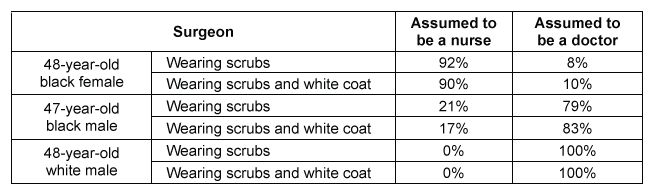
Numerous studies suggest that physicians make both conscious and unconscious assumptions about their patients, and these assumptions often impact patient care and outcomes. However, little research has focused on the assumptions patients make about their physicians.Researchers designed an observational study to investigate assumptions made by patients in health care settings. For this study, three different surgeons were asked to interact with pre-surgery patients whom they had never met using a standardized script. Each surgeon participated in 30 total interactions over the course of two weeks. The purpose of the study was to assess how the patient's assumptions regarding the surgeon's status were impacted by the surgeon's race, gender, and attire.According to the script, the surgeon did not introduce him- or herself upon entering the room. All three surgeons were in their late 40s; one surgeon was a black woman, one was a black man, and one was a white man. The surgeons wore either surgical scrubs alone or a white coat over their surgical scrubs. Researchers analyzed how patients addressed or referred to the surgeon to assess assumptions about the surgeon's role as a doctor or a nurse. The results are presented in Table 1.Table 1 Percentage of Patients Who Assumed the Surgeon Was a Doctor or a Nurse
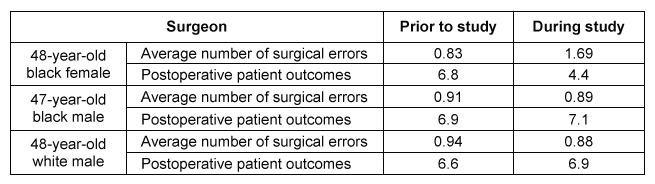
 The researchers also retrospectively analyzed minor (non-life-threatening) surgical errors and postoperative patient outcomes for one month prior to the study and during the study timeframe for each surgeon. The number of minor errors was averaged per surgery, and postoperative patient outcomes were quantified using a multifactor (eg, pain, infection, bleeding, other complications) assessment scale of 1 (worst outcome) to 12 (best outcome) .Table 2 Average Number of Minor Surgical Errors (Per Surgery) and Aggregated Postoperative Patient Outcome Scores
-Table 1 suggests that the patients' assumptions may have been influenced by which of the following?
A) Representativeness heuristic
B) Fundamental attribution error
C) Cognitive dissonance
D) Discrimination
Correct Answer:

Verified
Correct Answer:
Verified
Q333: Passage<br>Language is a skill acquired during early
Q334: Which statement best identifies the promotion of
Q335: A sociologist is interested in investigating leukemia
Q336: A patient repeatedly presents to his primary
Q337: Passage<br>Researchers conducted a pair of studies to
Q338: Passage<br>Human emotions play an important role in
Q339: Passage<br>Post-traumatic stress disorder (PTSD) and generalized anxiety
Q340: Passage<br>Bipolar disorder (BD), often characterized by periods
Q341: Passage<br>A common misconception in medicine is that
Q342: Passage<br>Religion establishes the beliefs and rituals surrounding