Multiple Choice
Passage
Language is a skill acquired during early childhood that continues to develop for many years. Communication using language involves multiple complex processes, including listening, speaking, comprehension, and cognition. Receptive language ("language input") involves language comprehension, while expressive language ("language output") involves the ability to produce intelligible language. In normally developing children, receptive language emerges first, followed by expressive language.To examine how age plays a role in the activation of the neurological networks involved in processing more complex language, researchers used functional magnetic resonance imaging (fMRI) to analyze how the use of receptive language generates metabolic activity in the brains of children. A total of 672 participants were divided into three groups by age: Age 4-6 (n = 219) , age 7-9 (n = 224) , and age 10-12 (n = 229) .Participants in each group were asked to listen to pre-recorded stories while undergoing fMRI of the brain to determine if an age-related difference could be found in activated brain tissue volume during the listening task. The recorded fMRI-monitored listening portion of the experiment lasted approximately 5 minutes. Immediately following this listening exercise, fMRI monitoring was discontinued and the children were administered tests to determine comprehension of the material. None of the children had been informed that they would be taking a comprehension test prior to its actual administration.
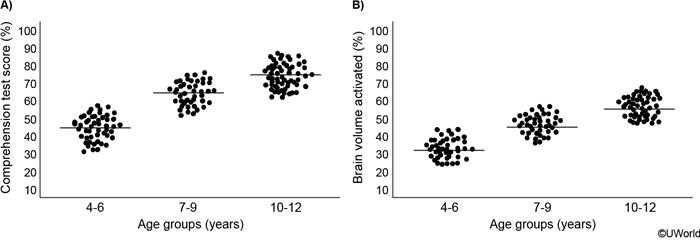 Figure 1 fMRI listening task analyzed per age group: (A) comprehension test scores, and (B) brain volume activated (Note: Solid lines represent the mean in each group.)
M. M. Berl, E. S. Duke, J. Mayo, L. R. Rosenberger, E. N. Moore, J. VanMeter, N. Bernstein Ratner, C. J. Vaidya, and W. D. Gaillard ©2010 by Elsevier, Inc.
-The observed correlations presented in Figure 1 suggest all of the following EXCEPT:
A) the age group with the best comprehension also showed the greatest volume of brain activation.
B) younger children were not able to comprehend the stories as effectively as older children.
C) activating a greater volume of the brain resulted in improved reading comprehension.
D) age is positively correlated with volume of brain activation in children listening to stories.
Correct Answer:

Verified
Correct Answer:
Verified
Q328: Passage<br>Across the lifespan, mental and physical health
Q329: If neuroimaging studies show that auditory hallucinations
Q330: Female S. beldingi ground squirrels tend to
Q331: Passage<br>Psychotic disorders are characterized by a loss
Q332: Which of the following is true, according
Q334: Which statement best identifies the promotion of
Q335: A sociologist is interested in investigating leukemia
Q336: A patient repeatedly presents to his primary
Q337: Passage<br>Researchers conducted a pair of studies to
Q338: Passage<br>Human emotions play an important role in