Multiple Choice
Passage
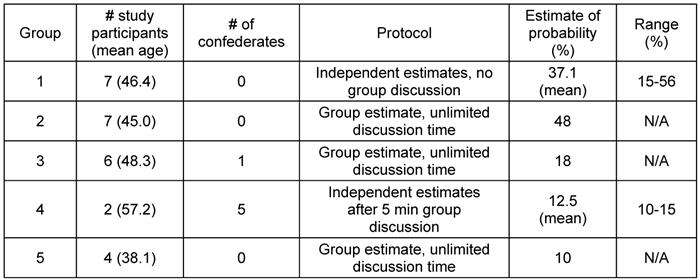
Twenty-two adults (mean age 49.5) were recruited to participate in a study they were told was to assess beliefs about cancer risk. All participants were in good health; neither they nor any first-degree relatives had been diagnosed with cancer.In the first phase of the study, participants viewed a brief video about the epidemiology and prevalence of cancer in the United States, and then were randomly assigned to one of four groups and asked to estimate the probability that they would develop cancer in their lifetimes. Group 1 consisted of seven study participants who each arrived at their estimates independently and without discussion. Group 2 consisted of seven study participants who were asked to agree on a group estimate after discussion (with unlimited time) . Group 3 contained seven members who were also asked to arrive at a consensus estimate after discussion (with unlimited time) : Six were study participants and the seventh was a confederate who suggested a very low estimate. Group 4 likewise contained seven members: Two were study participants and the other five were confederates who each suggested low estimates. Group 4 members were limited to 5 minutes of discussion and then asked to arrive at individual estimates.For the second phase of the study, four members of Group 1 who arrived at independent estimates of 20% or lower were put into a new group (Group 5) , then were given unlimited time to discuss their initial estimates and arrive at a group estimate (Table 1) .Table 1 Group Composition, Protocol, and Estimate of Developing Cancer in One's Lifetime
 S. E. Asch ©1956 American Psychological Association.
-If this study is repeated using the same procedure with a different set of subjects and produces similar results, this suggests that the study is:
A) reliable.
B) valid.
C) generalizable.
D) neutral.
Correct Answer:

Verified
Correct Answer:
Verified
Q286: Passage<br>Jake and his classmate Michael both grew
Q287: Passage<br>Epidemiologists now consider obesity to be a
Q288: Passage<br>For decades psychologists have known that people
Q289: Passage<br>Lucid dreaming occurs when a person becomes
Q290: Passage<br>Major depression is a mood disorder that
Q292: Passage<br>Until the middle of the twentieth century,
Q293: Passage<br>Korsakoff syndrome (KS) is caused by a
Q294: A pharmaceutical company is testing how much
Q295: Passage<br>The term "health disparities" describes a systematic
Q296: Passage<br>The diagnosis of a child with a