Multiple Choice
Passage
Lucid dreaming occurs when a person becomes consciously aware of a dream and uses executive decision-making skills to critically analyze the dream environment. Lucid dreamers are thus able to control certain aspects of their dreams, an ability that may occur intentionally, through practice, or unintentionally, usually after having noticed something bizarre or unrealistic in the dream. A lucid dreamer might choose to experience the sensation of flying, explore a custom-designed landscape, carry out a predetermined task, or practice a skill. Estimates suggest that about half the population has had a lucid dream, and about 10%-20% of people are considered frequent lucid dreamers experiencing such dreams regularly (at least once a month) .In one study, researchers asked participants to perform a difficult visuomotor task that involved throwing an object through a small moving target. Participants were organized into three groups, one group of frequent lucid dreamers and two groups of nonlucid dreamers. All three groups attempted the visuomotor task at midday in the research lab, before (pretest) and after (posttest) a single night's sleep at home. Lucid dreamers were asked to only practice the visuomotor task overnight during their lucid dream ("lucid practice" group) . One group of nonlucid dreamers practiced the task in the lab, right after the pretest ("waking practice" group) , and another group of nonlucid dreamers performed the pretest and posttest without practicing between the tests ("no practice" group) . The average improvement of hits (the number of times each participant successfully threw the object through the target) from pretest to posttest for each group is shown in Figure 1.
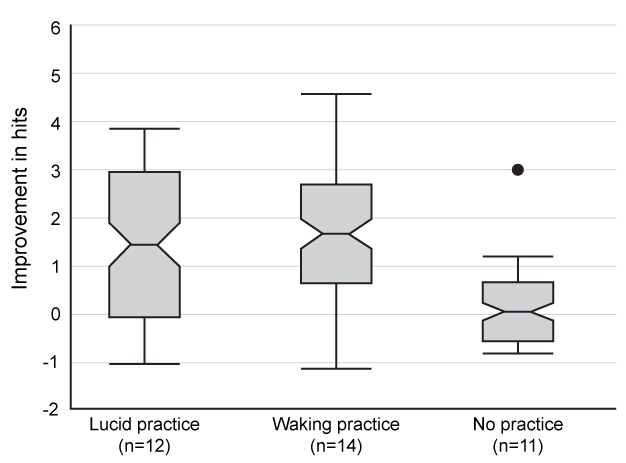 Figure 1 Median improvement in total hits for each group (Note: The notches represent the 95% confidence interval for the median.) The researchers proposed that a follow-up study be devised and conducted to control for any potential variability in each participant's sleep at home. The researchers suggested using the same study procedure except participants would sleep overnight for five consecutive nights in a sleep lab, where the timing and duration of sleep would be standardized. In order to eliminate any potential "first-night effects" (an initial reduction in sleep quality when sleeping in an unfamiliar environment) , researchers proposed that pretest and posttest measures each be taken before and after the third, fourth, and fifth night's sleep.
-If the researchers wanted to examine the role of sleep in memory consolidation, which of the following groups, if added to the current study design, would best accomplish this goal?
A) A group of lucid dreamers who practiced the task both while sleeping and while awake.
B) A group of nonlucid dreamers who practiced the task but did not sleep between the pretest and posttest.
C) A group of nonlucid dreamers who did not practice the task and did not sleep between the pretest and posttest.
D) No additional groups are needed; this can be accomplished by comparing the results of the "waking practice" group with the "no practice" group.
Correct Answer:

Verified
Correct Answer:
Verified
Q284: Passage<br>During the 19th century, the industrial revolution
Q285: Passage<br>Although the terms sex, sex category, and
Q286: Passage<br>Jake and his classmate Michael both grew
Q287: Passage<br>Epidemiologists now consider obesity to be a
Q288: Passage<br>For decades psychologists have known that people
Q290: Passage<br>Major depression is a mood disorder that
Q291: Passage<br>Twenty-two adults (mean age 49.5) were recruited
Q292: Passage<br>Until the middle of the twentieth century,
Q293: Passage<br>Korsakoff syndrome (KS) is caused by a
Q294: A pharmaceutical company is testing how much