Multiple Choice
Passage
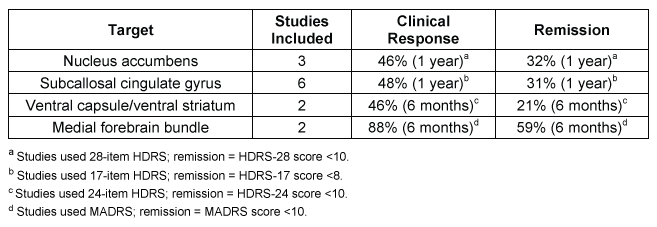
Major depression is a mood disorder that affects nearly 7% of the American population and is the most common cause of disability worldwide. Standard treatment typically involves antidepressant medication alone, although a combination of antidepressant medication and psychological treatment, such as psychotherapy or cognitive-behavioral therapy, is often more effective. However, because depression has genetic, environmental, and psychological contributing factors, treatment can be challenging. Approximately 10% of those suffering from depression have treatment-resistant depression (TRD) that does not respond to standard treatment.A number of treatment options for those with TRD target the functioning of the nervous system. Deep-brain stimulation (DBS) , which is used to treat Parkinson disease, has also been investigated as a treatment for TRD. DBS involves implanting a device in the brain that sends electrical impulses to a specific area. Although the mechanism by which DBS alleviates depressive symptoms is unclear, neurostimulation provided by DBS is thought to disrupt dysfunctional patterns of electrical activity in local areas and connected brain regions.A meta-analysis reviewed the data from several studies that used different brain regions as DBS targets in the treatment of TRD. Table 1 shows the percentage of TRD patients who underwent DBS and showed clinical responsiveness and remission of depression. Clinical response was defined as a 50% reduction in scores on a measure of depression. Various scales were used in the studies, including different versions of the Hamilton Depression Rating Scale (HDRS) and Montgomery-Asberg Depression Rating Scale (MADRS) . Remission of depression was defined as a score that fell below a predetermined threshold.Table 1 Percentage of TRD Patients Who Showed Clinical Response and Remission With DBS Treatment
-Which of the following is an inherent limitation in assessing the efficacy of DBS for controlling depression symptoms?
A) A placebo control group would be unethical.
B) Depressed patients are a vulnerable population.
C) The benefits do not outweigh the risks of the procedure.
D) The mechanism of action of DBS is unknown.
Correct Answer:

Verified
Correct Answer:
Verified
Q285: Passage<br>Although the terms sex, sex category, and
Q286: Passage<br>Jake and his classmate Michael both grew
Q287: Passage<br>Epidemiologists now consider obesity to be a
Q288: Passage<br>For decades psychologists have known that people
Q289: Passage<br>Lucid dreaming occurs when a person becomes
Q291: Passage<br>Twenty-two adults (mean age 49.5) were recruited
Q292: Passage<br>Until the middle of the twentieth century,
Q293: Passage<br>Korsakoff syndrome (KS) is caused by a
Q294: A pharmaceutical company is testing how much
Q295: Passage<br>The term "health disparities" describes a systematic