Multiple Choice
Passage
The highly addictive nature of cigarettes can be partly explained by how nicotine, the primary addictive ingredient, is administered. The fastest route of administration for most drugs is through inhalation; cigarette smoking results in the transmission of nicotine to the brain in about 15 seconds. In the brain, nicotine activates the nicotinic acetylcholine receptors, which stimulate the brain's reward pathway and produce mild feelings of euphoria. Those who quit smoking often relapse due to stress, weight gain, and withdrawal symptoms such as cravings and irritability. Of those who attempt to quit without formal treatment, only 3%-5% remain abstinent after a year.Research suggests that mindfulness meditation-based programs can be an effective strategy to quit smoking. Mindfulness is an aspect of meditation that involves cultivating a nonjudgmental awareness of the thoughts, emotions, and sensations arising in the present moment.For one study, researchers randomly assigned 88 smokers to either Mindfulness Training (MT) or the Freedom From Smoking (FFS) intervention developed by the American Lung Association. Both groups participated in 90-minute group training sessions twice a week for four weeks. The FFS intervention educated participants on the negative health consequences of smoking, coping strategies for cravings, and the development of healthy lifestyle habits. The MT intervention taught mindfulness meditation techniques as a way of gaining awareness and acceptance of the cognitive, emotional, and physical components of cravings. The number of cigarettes smoked per day and self-reported abstinence, as verified by exhaled carbon monoxide, were measured at the end of treatment and at a 17-week follow-up for participants in each group (Figure 1) .
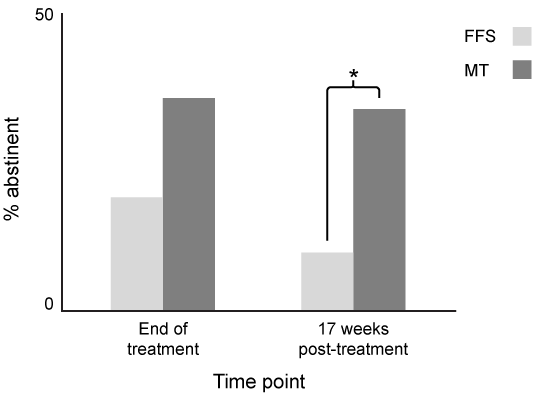 Figure 1 Percentage of participants in each group abstinent at the end of treatment and at 17-week follow-up (* indicates p < 0.05)
-Assuming that stress is a major contributing factor to smoking relapse rates, the benefit of meditation in smoking abstinence is best predicted by:
A) a decrease in cortisol release.
B) a decrease in melatonin production.
C) an increase in sympathetic activity.
D) an increase in epinephrine release.
Correct Answer:

Verified
Correct Answer:
Verified
Q183: Passage<br>Twenty-two adults (mean age 49.5) were recruited
Q184: Passage<br>Major depression is a mood disorder that
Q185: Passage<br>Before memories have been consolidated they are
Q186: Passage<br>The highly addictive nature of cigarettes can
Q187: Which of the following best illustrates a
Q189: Passage<br>People tend to believe that they are
Q190: Passage<br>Lucid dreaming occurs when a person becomes
Q191: Passage<br>Suicide is one of the leading causes
Q192: Passage<br>Twenty-two adults (mean age 49.5) were recruited
Q193: Some experts suggest that the benefits of