Multiple Choice
Passage
Lucid dreaming occurs when a person becomes consciously aware of a dream and uses executive decision-making skills to critically analyze the dream environment. Lucid dreamers are thus able to control certain aspects of their dreams, an ability that may occur intentionally, through practice, or unintentionally, usually after having noticed something bizarre or unrealistic in the dream. A lucid dreamer might choose to experience the sensation of flying, explore a custom-designed landscape, carry out a predetermined task, or practice a skill. Estimates suggest that about half the population has had a lucid dream, and about 10%-20% of people are considered frequent lucid dreamers experiencing such dreams regularly (at least once a month) .In one study, researchers asked participants to perform a difficult visuomotor task that involved throwing an object through a small moving target. Participants were organized into three groups, one group of frequent lucid dreamers and two groups of nonlucid dreamers. All three groups attempted the visuomotor task at midday in the research lab, before (pretest) and after (posttest) a single night's sleep at home. Lucid dreamers were asked to only practice the visuomotor task overnight during their lucid dream ("lucid practice" group) . One group of nonlucid dreamers practiced the task in the lab, right after the pretest ("waking practice" group) , and another group of nonlucid dreamers performed the pretest and posttest without practicing between the tests ("no practice" group) . The average improvement of hits (the number of times each participant successfully threw the object through the target) from pretest to posttest for each group is shown in Figure 1.
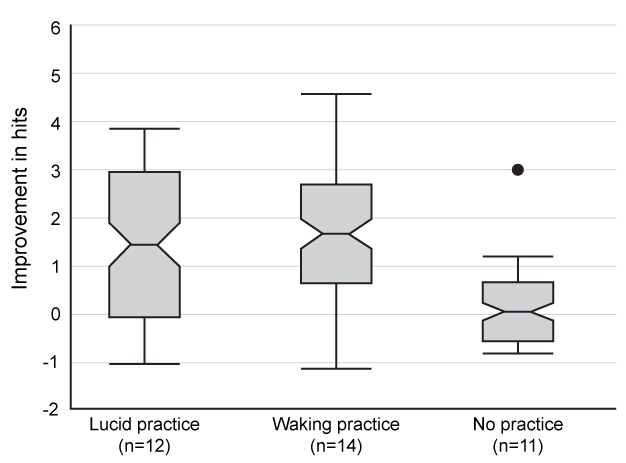 Figure 1 Median improvement in total hits for each group (Note: The notches represent the 95% confidence interval for the median.) The researchers proposed that a follow-up study be devised and conducted to control for any potential variability in each participant's sleep at home. The researchers suggested using the same study procedure except participants would sleep overnight for five consecutive nights in a sleep lab, where the timing and duration of sleep would be standardized. In order to eliminate any potential "first-night effects" (an initial reduction in sleep quality when sleeping in an unfamiliar environment) , researchers proposed that pretest and posttest measures each be taken before and after the third, fourth, and fifth night's sleep.
-If a lucid dreamer falls asleep at 10:00 PM and wakes up at 6:00 AM, during what period of sleep would this person have the greatest chance of lucid dreaming?
A) Between 10:00 PM and 11:30 PM
B) Between 1:00 AM and 3:00 AM
C) Between 4:00 AM and 6:00 AM
D) Chances of lucid dreaming are roughly equal throughout sleep
Correct Answer:

Verified
Correct Answer:
Verified
Q185: Passage<br>Before memories have been consolidated they are
Q186: Passage<br>The highly addictive nature of cigarettes can
Q187: Which of the following best illustrates a
Q188: Passage<br>The highly addictive nature of cigarettes can
Q189: Passage<br>People tend to believe that they are
Q191: Passage<br>Suicide is one of the leading causes
Q192: Passage<br>Twenty-two adults (mean age 49.5) were recruited
Q193: Some experts suggest that the benefits of
Q194: Passage<br>Trait theorists believe that all people have
Q195: Passage<br>Of the biological factors impacting color perception