Multiple Choice
A randomized controlled trial is conducted to compare transcatheter aortic valve replacement (TAVR) , using a self-expanding transcatheter aortic valve bioprosthesis, with surgical aortic valve replacement in patients with severe aortic stenosis. The objective is to determine the difference in risk of death from any cause. Seven hundred forty-seven patients with severe aortic stenosis who are at increased surgical risk are recruited and randomly assigned to groups for treatment with TAVR or surgical valve replacement. Follow-up assessments are performed at discharge and at 1 month, 6 months, and 1 year. The 1-year follow-up results are as follows: 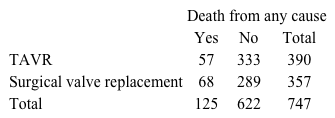 Which of the following best represents the absolute risk reduction for death from any cause in patients treated with TAVR compared to those treated with surgical replacement?
A) (68/357) − (57/390) = 0.044
B) [(68/357) − (57/390) ] / (68/357) = 0.233
C) (57/390) / (68/357) = 0.767
D) (68/357) / (57/390) = 1.303
E) 1 / [(68/357) − (57/390) ] = 22.562
Correct Answer:

Verified
Correct Answer:
Verified
Q54: A new biomarker has been shown to
Q55: A study compared drug A versus standard
Q56: Inflammatory biological markers are clinically useful in
Q57: A large study of serum folate levels
Q58: A study was conducted to assess the
Q60: In a reference sample of hundreds of
Q61: A study assessed the association between a
Q62: A study is conducted to assess whether
Q63: A group of researchers conducted a case-control
Q64: A new biomarker has been identified that