Multiple Choice
Use the following information to answer the question.
Canadian and Swiss researchers wanted to know if the diversity of arbuscular mycorrhizal fungi (AMF) was important to the productivity of grasslands (M.G.A. van der Heijden, J. N. Klironomos, M. Ursic, P. Moutoglis, R. Streitwolf-Engel, T. Boler, A. Wiemken, and I. R. Sanders. 1998. Mycorrhizal fungal diversity determines plant biodiversity, ecosystem variability, and productivity. Nature 396:69-72) . Specifically, they wanted to know if it mattered which specific AMF species were present, or just that some type of AMF was present. They grew various plants in combination with one of four AMF species (A, B, C, and D) , no AMF species (O) , or all four AMF species together (A + B + C + D) ; and they measured plant growth under each set of conditions. All plant species were grown in each plot, so they always competed with each other with the only difference being which AMF species were present.
On the graphs, the x-axis labels indicate the number and identity of AMF species (bar 0 = no fungi; bars A - D = individual AMF species; bar A + B + C + D = all AMF species together) . The y-axis indicates the amount (grams) of plant biomass for the species shown in italics above each graph. Graph e is the total biomass (grams) of all 11 plant species combined; graph f is the biomass of Bromus erectus plants only, separated from the total.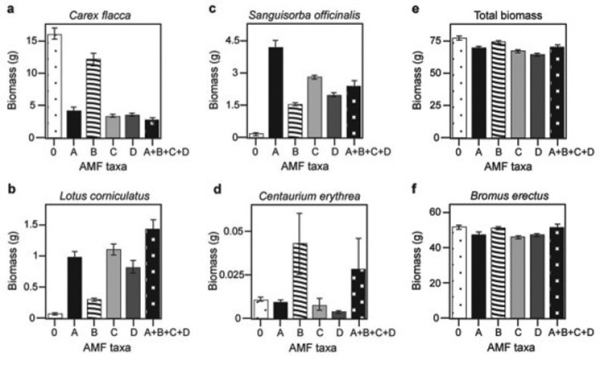
What is the major difference between Bromus erectus (graph f) and the other plant species (graphs a-d) included in the study?
A) Bromus erectus grows best with a diversity of fungal partners.
B) Bromus erectus is unaffected by AMF diversity.
C) Bromus erectus does not form mycorrhizal associations.
D) Bromus erectus produces very little biomass regardless of AMF.
Correct Answer:

Verified
Correct Answer:
Verified
Q26: Use the following information to answer the
Q27: Use the following information to answer the
Q28: Use the following information to answer
Q31: Why are mycorrhizal fungi superior to plants
Q32: Use the following information to answer the
Q33: Arrange the following in order from largest
Q54: Use the following information to answer the
Q56: Early fungi probably formed mutualistic associations with
Q61: Use the following information to answer the
Q68: After cytokinesis occurs in budding yeasts, the