Multiple Choice
Use the following information to answer the question.
Suzanne Simard and colleagues knew that the same mycorrhizal fungal species could colonize multiple types of trees. They wondered if the same fungal individual would colonize different trees, forming an underground network that potentially could transport carbon and nutrients from one tree to another (S. Simard et al. 1997. Net transfer of carbon between mycorrhizal tree species in the field. Nature 388:579-82) .
Pots containing seedlings of three different tree species were set up and grown under natural conditions for three years (Fig. A) . Two of the three species (Douglas fir, birch) could form ectomycorrhizal connections with the same fungal species, but the third species (cedar) could not form an ectomycorrhizal connection with the fungal species. In some of the pots, the researchers placed airtight bags over the Douglas fir and birch seedlings and injected carbon dioxide made from carbon-13 into the bags with the Douglas fir and carbon dioxide made from carbon-14 into the bags with the birch. (13C and 14C are different isotopes of carbon that can be detected and measured by researchers.) As the seedlings photosynthesized, the carbon dioxide was converted into sugars that could be tracked and measured by the researchers. The researchers measured whether the sugars in each plant contained only the carbon isotope that was in the air of their plastic bag or also the carbon isotope from the air around the other plant.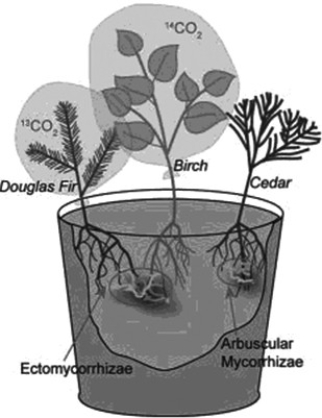
Figure A
Referring to Simard et al. (1997) , which design element is the control in this experiment and why?
A) the bags over the seedlings to contain the different types of carbon dioxide
B) the fact that all the seedlings are different species
C) the cedar seedling, because it is not bagged
D) the cedar seedling, because it does not form ectomycorrhizal connections with the tested fungus
Correct Answer:

Verified
Correct Answer:
Verified
Q23: Use the information to answer the following
Q27: Use the following information to answer the
Q28: Use the following information to answer
Q30: Use the following information to answer the
Q31: Why are mycorrhizal fungi superior to plants
Q46: The Neurospora genome is quite compact, lacking
Q56: Early fungi probably formed mutualistic associations with
Q57: Arrange the following in order from largest
Q68: After cytokinesis occurs in budding yeasts, the
Q69: Use the following information to answer the