Multiple Choice
Use the following information to answer the question.
Along with bacteria and protozoa, some chytrid fungi live in the digestive tracts of cattle and aid in the digestion of plant matter; thus, all three groups represent potential mutualists with cattle. In an experiment designed to test how much of a contribution to cell wall digestion was made by fungi in one part of the stomach (rumen) , Lee et al. fed grain to cattle and then removed samples of the rumen contents. They took these samples to the laboratory and experimentally treated them with various chemicals to produce fractions that contained (A) only fungi, (B) only bacteria, (C) only protozoa, and (D) all of the potential mutualists. They then measured the percent of the cell wall that was degraded (see the figure) .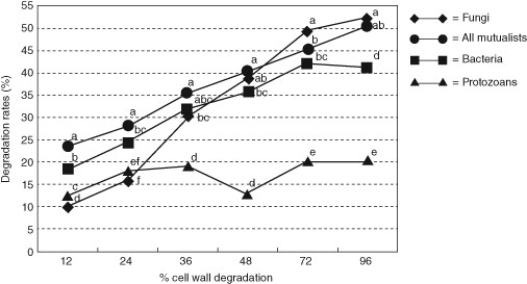
Degradation rates of cell walls extracted from Orchard grass by the monoculture system to assess the relative contributions of digestion by bacterial (square) , protozoan (triangle) , and fungal (diamond) systems, and all components (closed circle) as a control. The lowercase letters above the spots indicate statistical significance; mean values with different letters are significantly different (P < 0.05) .
Which of the following conclusions can be drawn correctly from the data?
A) Of all three potential mutualists, protozoa contribute the most to cell wall digestion.
B) Of all three potential mutualists, fungi contribute the least to cell wall digestion.
C) Fungi contribute as much to cell wall degradation as all the potential mutualists together.
D) The cattle did not benefit from the presence of fungi; therefore, the fungi are not mutualistic with the cattle.
Correct Answer:

Verified
Correct Answer:
Verified
Q27: Use the following information to answer the
Q28: Use the following information to answer
Q30: Use the following information to answer the
Q31: Why are mycorrhizal fungi superior to plants
Q33: Arrange the following in order from largest
Q41: A billionaire buys a sterile volcanic island
Q42: Use the following information to answer the
Q54: Use the following information to answer the
Q56: Early fungi probably formed mutualistic associations with
Q61: Use the following information to answer the