



 Chat with AI
Exam 4: Vision

Exam 1: An Invitation to Neurobiology18 Questions
Exam 2: Signaling Within Neurons45 Questions
Exam 3: Signaling Across Synapses53 Questions
Exam 4: Vision48 Questions
Exam 5: Wiring of the Visual System32 Questions
Exam 6: Olfaction, Taste, Audition, and Somatosensation43 Questions
Exam 7: Wiring of the Nervous System34 Questions
Exam 8: Motor and Regulatory Systems45 Questions
Exam 9: Sexual Behavior23 Questions
Exam 10: Memory, Learning, and Synaptic Plasticity41 Questions
Exam 11: Brain Disorders41 Questions
Exam 12: Evolution of the Nervous System33 Questions
Exam 13: Ways of Exploring43 Questions
Select questions type


There is a lot of research on visual prosthesis to help people recover some vision. Describe a target and how you could think about how the prosthesis would work. The details are not as important as the rationale for your idea. Include some of your assumptions.
(Essay)
4.8/5  (77)
(77) What would happen to ocular dominance columns if the input from one eye was reduced, for example if a patch was put over the left eye during development (the ocular dominance columns are formed during development of the cortex)?
(Multiple Choice)
4.9/5 (99)
(99) David Hubel has an interesting perspective on how our brains reconstruct visual scenes:
Many people, including myself, still have trouble accepting the idea that the interior of a form … does not itself excite cells in our brain … that our awareness of the interior as black or white … depends only on cells' sensitivity to the borders. The intellectual argument is that perception of an evenly lit interior depends on the activation of cells having fields at the borders and on the absence of activation of cells whose fields are within the borders, since such activation would indicate that the interior is not evenly lit. So our perception of the interior as black, white, gray or green has nothing to do with cells whose fields are in the interior-hard as that may be to swallow … What happens at the borders is the only information you need to know: the interior is boring.
That is, the borders of objects contain the important information and the interior is not critical for visual perception. Based on our understanding of how the retina and cortex process visual information, why do you think the borders of objects are the most important to perception??
(Essay)
4.8/5 (84)
(84) Figure Q4-14 shows the currents from a rod and a cone in response to increasing magnitude of light flashes. How do these responses contribute to the higher sensitivity in low light and higher acuity in daylight conditions? 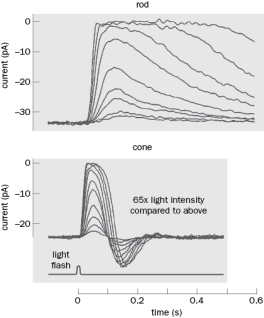 Figure Q4-14
 (Essay)
4.8/5 (79)
(79) What is the response of the photoreceptor in the center of the stimulus? Does it depolarize, hyperpolarize, or stay the same?
B. What is the response of the bipolar cell? Does it depolarize, hyperpolarize, or stay the same? Explain.
C. What type of bipolar cell is illustrated? Is it ON-center/OFF-surround, OFF-center/ON-surround, ON-center/ON-surround, or OFF-center/OFF-surround?
D. What type of neurotransmitter receptor is on the bipolar cell?
E. How does activation of this neurotransmitter receptor result in the graded potential response in this cell with the center light?
(Essay)
5.0/5 (83)
(83) Figure Q4-15 the spectral sensitivity of human cones. 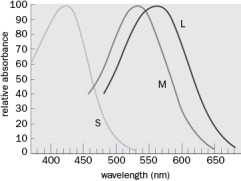 Figure Q4-15
A. What three wavelengths do we respond best to?
B. Which cones would respond to a very bright light whose wavelength was between 450 and 500 nm?
Figure Q4-15
A. What three wavelengths do we respond best to?
B. Which cones would respond to a very bright light whose wavelength was between 450 and 500 nm? (Essay)
4.9/5 (81)
(81) What is the known major flow of information through the visual cortex?
(Multiple Choice)
4.9/5 (74)
(74) How does the influence of horizontal cells help explain the optical illusion in the Mach bands in which the edge of a gray band appears darker on one side and lighter on the other?
(Essay)
4.9/5 (74)
(74) 
Filters
- Essay(0)
- Multiple Choice(0)
- Short Answer(0)
- True False(0)
- Matching(0)