



 Chat with AI
Exam 4: Vision

Exam 1: An Invitation to Neurobiology18 Questions
Exam 2: Signaling Within Neurons45 Questions
Exam 3: Signaling Across Synapses53 Questions
Exam 4: Vision48 Questions
Exam 5: Wiring of the Visual System32 Questions
Exam 6: Olfaction, Taste, Audition, and Somatosensation43 Questions
Exam 7: Wiring of the Nervous System34 Questions
Exam 8: Motor and Regulatory Systems45 Questions
Exam 9: Sexual Behavior23 Questions
Exam 10: Memory, Learning, and Synaptic Plasticity41 Questions
Exam 11: Brain Disorders41 Questions
Exam 12: Evolution of the Nervous System33 Questions
Exam 13: Ways of Exploring43 Questions
Select questions type


There are many tools available to target specific cell types in the brain. If you could specifically target midget ganglion cells in the retina for inhibition, what do you think would happen to vision?
(Multiple Choice)
4.7/5  (75)
(75) In order to return to the dark state, a photoreceptor must undergo recovery. Recovery involves many steps. How does each step of phototransduction return to the dark state?
A. cGMP increase
B. Inactivation of transducin
C. Deactivation of rhodopsin
D. Retinal configuration
(Essay)
4.8/5 (65)
(65) Strabismus is a childhood eye disease in which children cannot align their eyes properly (it is also called 'lazy eye'). Children with this condition typically stop using one of their eyes to avoid double vision. What would this do to representation of input in the visual cortex and what would happen if the disease was not corrected?
(Essay)
4.7/5 (76)
(76) What would happen if the surround of the light source now changed from being completely black to gray?
A. How would the photoreceptors in the surround respond? Would it be more hyperpolarized or more depolarized than in the previous question?
B. How would the center photoreceptor respond? Would it be more hyperpolarized or more depolarized than in the previous question? Why?
C. What is the response of the center bipolar cell? Would it be more hyperpolarized or more depolarized than in the previous question? Explain your answer.
D. What is the response of the retinal ganglion cell? Explain your answer.
(Essay)
4.8/5 (96)
(96) Macular degeneration is damage to the macular, or center, of the retina. Why is loss of this area so devastating to vision?
(Essay)
5.0/5 (75)
(75) There are the two major components of the visual pathway from the retina to V1: P and M. What information is NOT carried through the M pathway, with large receptive fields?
(Multiple Choice)
5.0/5 (85)
(85) Indicate whether the following is associated with either the ventral stream or the dorsal stream.
Correct Answer: Verified
Premises:
Responses:
(Matching)
5.0/5 (88)
(88) What is the outermost layer of the cortex (nearest the surface)?
(Multiple Choice)
4.7/5 (76)
(76) What is the basic mechanism that allows us to see blue-yellow contrast?
(Essay)
4.7/5 (77)
(77) Which cell types in the retina produce action potentials? Choose all that are correct.
(Multiple Choice)
4.8/5 (85)
(85) The M and L opsins are most similar in their amino acid structure. What does that suggest about their evolution?
(Essay)
4.8/5 (80)
(80) Besides rods and cones, what is the third type of photoreceptor in the retina?
(Essay)
4.8/5 (90)
(90) In Figure Q4-46, the middle temporal visual area (MT) was stimulated and the monkey indicated the direction of movement of dots in either the preferred or null direction. Below are the effects of MT stimulation from one animal. What was the effect of stimulation and how is that depicted on the graph? 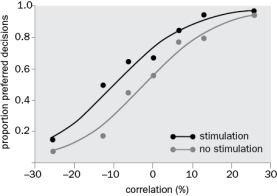 Figure Q4-46
 (Essay)
4.9/5 (74)
(74) The responses of a single rod to light flashes were recorded in Figure Q4-7. 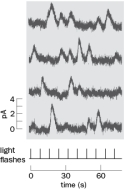 Figure Q4-7
A. What happened to the rod when it was stimulated with flashes of light?
B. Why is the lack of responses so important?
Figure Q4-7
A. What happened to the rod when it was stimulated with flashes of light?
B. Why is the lack of responses so important? (Essay)
4.8/5 (98)
(98) Based on the known cortical circuitry and the response of complex cells, in which cortical layer is it likely you would find complex cells? Choose all that apply.
(Multiple Choice)
4.8/5 (72)
(72) What is the difference between ocular dominance columns and orientation columns?
(Essay)
4.9/5 (77)
(77) What is the advantage of the retina using graded potentials? Explain.
(Essay)
4.8/5 (76)
(76) 
Filters
- Essay(0)
- Multiple Choice(0)
- Short Answer(0)
- True False(0)
- Matching(0)