



 Chat with AI
Exam 5: Constraint Management

Exam 1: Using Operations to Create Value100 Questions
Exam 2: Process Strategy and Analysis245 Questions
Exam 3: Quality and Performance195 Questions
Exam 4: Capacity Planning108 Questions
Exam 5: Constraint Management136 Questions
Exam 6: Lean Systems164 Questions
Exam 7: Project Management140 Questions
Exam 8: Forecasting150 Questions
Exam 9: Inventory Management207 Questions
Exam 10: Operations Planning and Scheduling149 Questions
Exam 11: Resource Planning125 Questions
Exam 12: Supply Chain Design77 Questions
Exam 13: Supply Chain Logistic Networks114 Questions
Exam 14: Supply Chain Integration111 Questions
Exam 15: Supply Chain Sustainability73 Questions
Exam 16: Decision Making107 Questions
Exam 17: Waiting Lines108 Questions
Exam 18: Special Inventory Models53 Questions
Exam 19: Linear Programming86 Questions
Exam 20: Simulation54 Questions
Exam 21: Financial Analysis55 Questions
Exam 22: Acceptance Sampling Plans87 Questions
Exam 23: Measuring Output Rates106 Questions
Exam 24: Learning Curve Analysis51 Questions
Exam 25: Operations Scheduling120 Questions
Exam 26: Layout36 Questions
Select questions type


The fifth step in Theory of Constraints application,"do not let inertia set in," means that the analyst should:
(Multiple Choice)
5.0/5  (82)
(82) ________ is a planning and control system that regulates the flow of work-in-process materials at the bottleneck or the capacity constrained resource in a productive system.
(Essay)
4.8/5 (71)
(71) Table 5.7
The Terminal Company is attempting to balance its assembly line of high-voltage electrical connectors.The desired output for the line is 50 connectors per hour,and the information on the work elements for this assembly line is as follows.
 -Use the information from Table 5.7 and the most efficient line balance possible.What work elements are included in the first station?
 (Multiple Choice)
4.8/5 (85)
(85) Table 5.1
A company makes four products that have the following characteristics: Product A sells for $50 but needs $10 of materials and $15 of labor to produce;Product B sells for $75 but needs $30 of materials and $15 of labor to produce;Product C sells for $100 but needs $50 of materials and $30 of labor to produce;Product D sells for $150 but needs $75 of materials and $40 of labor to produce.The processing requirements for each product on each of the four machines are shown in the table.  Work centers W,X,Y,and Z are available for 40 hours per week and have no setup time when switching between products.Market demand for each product is 80 units per week.In the questions that follow,the traditional method refers to maximizing the contribution margin per unit for each product,and the bottleneck method refers to maximizing the contribution margin per minute at the bottleneck for each product.
-Use the information in Table 5.1.Using the traditional method,in what sequence should products be scheduled for production?
Work centers W,X,Y,and Z are available for 40 hours per week and have no setup time when switching between products.Market demand for each product is 80 units per week.In the questions that follow,the traditional method refers to maximizing the contribution margin per unit for each product,and the bottleneck method refers to maximizing the contribution margin per minute at the bottleneck for each product.
-Use the information in Table 5.1.Using the traditional method,in what sequence should products be scheduled for production? (Multiple Choice)
4.9/5 (72)
(72) Figure 5.2  The figure above shows the process for customers arriving at Pierre's Spa and Salon.After signing in,customers are routed to different locations in the Spa for the two different services provided.The numbers in parentheses are the time in minutes for each step of the process.
-Use the information in Figure 5.2.What is the throughput time for the A-B-E-F-G-H routing?
The figure above shows the process for customers arriving at Pierre's Spa and Salon.After signing in,customers are routed to different locations in the Spa for the two different services provided.The numbers in parentheses are the time in minutes for each step of the process.
-Use the information in Figure 5.2.What is the throughput time for the A-B-E-F-G-H routing? (Multiple Choice)
4.9/5 (74)
(74) Figure 5.2 The figure above shows the process for customers arriving at Pierre's Spa and Salon.After signing in,customers are routed to different locations in the Spa for the two different services provided.The numbers in parentheses are the time in minutes for each step of the process.
-Use the information in Figure 5.2.What is the process bottleneck?
The figure above shows the process for customers arriving at Pierre's Spa and Salon.After signing in,customers are routed to different locations in the Spa for the two different services provided.The numbers in parentheses are the time in minutes for each step of the process.
-Use the information in Figure 5.2.What is the process bottleneck? (Multiple Choice)
4.8/5 (79)
(79) Figure 5.4  -Use the information in Figure 5.4.If each task has a work time of one minute and there are 8 hours in a day,what is the minimum number of stations if 240 units should be produced each day?
 (Multiple Choice)
4.8/5 (78)
(78) Table 5.2
A company makes four products that have the following characteristics: Product A sells for $75 but needs $20 of materials and $20 of labor to produce;Product B sells for $90 but needs $45 of materials and $20 of labor to produce;Product C sells for $110 but needs $50 of materials and $30 of labor to produce;Product D sells for $135 but needs $75 of materials and $40 of labor to produce.The processing requirements for each product on each of the four machines are shown in the table.  Work centers W,X,Y,and Z are available for 40 hours per week and have no setup time when switching between products.Market demand is 50 As,60 Bs,70 Cs,and 80 Ds per week.In the questions that follow,the traditional method refers to maximizing the contribution margin per unit for each product,and the bottleneck method refers to maximizing the contribution margin per minute at the bottleneck for each product.
-Use the information in Table 5.2.Using the bottleneck method,which product should be scheduled first?
Work centers W,X,Y,and Z are available for 40 hours per week and have no setup time when switching between products.Market demand is 50 As,60 Bs,70 Cs,and 80 Ds per week.In the questions that follow,the traditional method refers to maximizing the contribution margin per unit for each product,and the bottleneck method refers to maximizing the contribution margin per minute at the bottleneck for each product.
-Use the information in Table 5.2.Using the bottleneck method,which product should be scheduled first? (Multiple Choice)
4.7/5 (84)
(84) Balance the assembly line using the following task information contained in the table.The desired output is 360 units per day.Available production time per day is 480 minutes.What is the efficiency for the balanced assembly line?
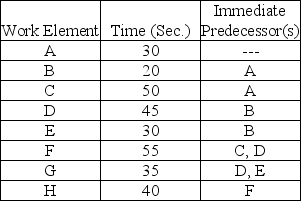
(Essay)
4.9/5 (84)
(84) A(n)________ is an operation that has the lowest effective capacity of any operation in the process,and thus limits the system's output.
(Essay)
4.8/5 (85)
(85) Table 5.1
A company makes four products that have the following characteristics: Product A sells for $50 but needs $10 of materials and $15 of labor to produce;Product B sells for $75 but needs $30 of materials and $15 of labor to produce;Product C sells for $100 but needs $50 of materials and $30 of labor to produce;Product D sells for $150 but needs $75 of materials and $40 of labor to produce.The processing requirements for each product on each of the four machines are shown in the table. Work centers W,X,Y,and Z are available for 40 hours per week and have no setup time when switching between products.Market demand for each product is 80 units per week.In the questions that follow,the traditional method refers to maximizing the contribution margin per unit for each product,and the bottleneck method refers to maximizing the contribution margin per minute at the bottleneck for each product.
-Use the information in Table 5.1.Using the bottleneck method,what is the profit if the company manufactures the optimal product mix (consider variable costs only-overhead is not included in this profit calculation)?
Work centers W,X,Y,and Z are available for 40 hours per week and have no setup time when switching between products.Market demand for each product is 80 units per week.In the questions that follow,the traditional method refers to maximizing the contribution margin per unit for each product,and the bottleneck method refers to maximizing the contribution margin per minute at the bottleneck for each product.
-Use the information in Table 5.1.Using the bottleneck method,what is the profit if the company manufactures the optimal product mix (consider variable costs only-overhead is not included in this profit calculation)? (Multiple Choice)
4.8/5 (65)
(65) There are three consecutive steps in a customer service process.The first two steps are each capable of serving 25 customers per hour while the third step can process only 20 customers per hour.Which of the following statements regarding this system is TRUE?
(Multiple Choice)
4.7/5 (86)
(86) The balance delay is the amount by which efficiency falls short of 100 percent.
(True/False)
4.8/5 (76)
(76) According to the Theory of Constraints,all the money invested in a system in purchasing things that it intends to sell is ________.
(Essay)
4.8/5 (73)
(73) The second step in Theory of Constraints application,"exploit the bottleneck(s)," means that the analyst should:
(Multiple Choice)
4.9/5 (76)
(76) Table 5.1
A company makes four products that have the following characteristics: Product A sells for $50 but needs $10 of materials and $15 of labor to produce;Product B sells for $75 but needs $30 of materials and $15 of labor to produce;Product C sells for $100 but needs $50 of materials and $30 of labor to produce;Product D sells for $150 but needs $75 of materials and $40 of labor to produce.The processing requirements for each product on each of the four machines are shown in the table. Work centers W,X,Y,and Z are available for 40 hours per week and have no setup time when switching between products.Market demand for each product is 80 units per week.In the questions that follow,the traditional method refers to maximizing the contribution margin per unit for each product,and the bottleneck method refers to maximizing the contribution margin per minute at the bottleneck for each product.
-Use the information in Table 5.1.Using the traditional method,what is the profit if the company manufactures the optimal product mix (consider variable costs only-overhead is not included in this profit calculation)?
Work centers W,X,Y,and Z are available for 40 hours per week and have no setup time when switching between products.Market demand for each product is 80 units per week.In the questions that follow,the traditional method refers to maximizing the contribution margin per unit for each product,and the bottleneck method refers to maximizing the contribution margin per minute at the bottleneck for each product.
-Use the information in Table 5.1.Using the traditional method,what is the profit if the company manufactures the optimal product mix (consider variable costs only-overhead is not included in this profit calculation)? (Multiple Choice)
4.8/5 (71)
(71) Figure 5.2 The figure above shows the process for customers arriving at Pierre's Spa and Salon.After signing in,customers are routed to different locations in the Spa for the two different services provided.The numbers in parentheses are the time in minutes for each step of the process.
-Use the information in Figure 5.2.What is the throughput time for the A-B-C-D -H routing?
The figure above shows the process for customers arriving at Pierre's Spa and Salon.After signing in,customers are routed to different locations in the Spa for the two different services provided.The numbers in parentheses are the time in minutes for each step of the process.
-Use the information in Figure 5.2.What is the throughput time for the A-B-C-D -H routing? (Multiple Choice)
4.9/5 (68)
(68) The wages paid to workers on the line are categorized as ________ in the Theory of Constraints.
(Essay)
4.8/5 (82)
(82) 
Filters
- Essay(0)
- Multiple Choice(0)
- Short Answer(0)
- True False(0)
- Matching(0)