



 Chat with AI
Exam 13: Supply Chain Sustainability and Humanitarian Logistics

Exam 1: Using Operations to Compete107 Questions
Exam 2: Project Management151 Questions
Exam 3: Process Strategy149 Questions
Exam 4: Process Analysis192 Questions
Exam 5: Quality and Performance223 Questions
Exam 6: Capacity Planning133 Questions
Exam 7: Constraint Management160 Questions
Exam 8: Lean Systems179 Questions
Exam 9: Supply Chain Inventory Management216 Questions
Exam 10: Supply Chain Design93 Questions
Exam 11: Supply Chain Location Decisions126 Questions
Exam 12: Supply Chain Integration130 Questions
Exam 13: Supply Chain Sustainability and Humanitarian Logistics77 Questions
Exam 14: Forecasting183 Questions
Exam 15: Operations Planning and Scheduling191 Questions
Exam 16: Resource Planning149 Questions
Exam 17: Decision Making118 Questions
Exam 18: Waiting Line127 Questions
Exam 19: Special Inventory Models53 Questions
Exam 20: Linear Programming84 Questions
Exam 21: Simulation61 Questions
Exam 22: Financial Analysis60 Questions
Exam 23: Acceptance Sampling Plans88 Questions
Exam 24: Measuring Output Rates103 Questions
Exam 25: Learning Curve Analysis56 Questions
Exam 26: Operations Scheduling131 Questions
Select questions type


In what ways is reverse logistics management more difficult than the management of more typical supply chain flows?
(Essay)
4.9/5  (70)
(70) What pressures do organizational leaders feel in the area of sustainability?
(Essay)
4.8/5 (86)
(86) Use Figure 13.1 to answer the questions below. 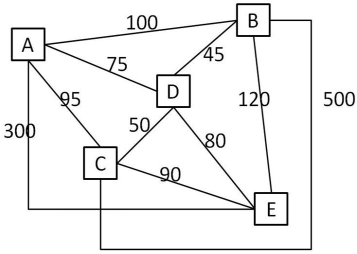 -Refer to Figure 13.1.The starting point for the traveling salesman is location E,which is the first city in the visited city set.Use the nearest neighbor heuristic to determine the fourth city in the visited city set.
 (Multiple Choice)
4.7/5 (83)
(83) First aid kits are packed and staged at distribution hubs in the:
(Multiple Choice)
4.9/5 (79)
(79) A corporate recycling program takes obsolete models and reuses some basic components in the next generation of products is an example of:
(Multiple Choice)
4.7/5 (72)
(72) Worker turnover is typically very low in disaster relief operations.
(True/False)
4.8/5 (82)
(82) ________ is the total amount of greenhouse gasses produced to support a firm's operations.
(Essay)
4.8/5 (75)
(75) ________ as measured in pounds per cubic foot,is one means of determining how energy efficient a firm is behaving.
(Essay)
4.9/5 (75)
(75) The two important by-products of the reverse logistics process are:
(Multiple Choice)
4.8/5 (72)
(72) An increase in freight density results in a decrease in carbon footprint.
(True/False)
4.7/5 (86)
(86) Some original equipment manufacturers (OEMs)that participate in remanufacturing attempt to limit the cannibalization of new product sales by:
(Multiple Choice)
4.7/5 (78)
(78) The management of products from the customer back to the point of origin is an element of:
(Multiple Choice)
4.9/5 (83)
(83) Which of these is an appropriate measurement of freight density?
(Multiple Choice)
4.9/5 (73)
(73) The so-called carbon footprint for a process is a myth,similar in concept to the British thermal unit (Btu).
(True/False)
4.9/5 (84)
(84) What reason is cited by the authors for the difficulty is receiving approval for sustainability as a strategy?
(Multiple Choice)
4.9/5 (83)
(83) What are the four managerial levers that can be used to decrease the carbon footprint of a supply chain?
(Essay)
4.8/5 (79)
(79) ________ addresses the moral,ethical,and philanthropic expectations that society has of an organization.
(Essay)
4.8/5 (75)
(75) A shipment that is transported using two or more modes during its journey is said to be:
(Multiple Choice)
4.9/5 (79)
(79) A recent survey of CEOs of major corporations revealed that many believe that sustainability issues are critical to the future success of their companies.About what percentage surveyed expressed the opinion that sustainability had been achieved by their supply chain?
(Multiple Choice)
4.7/5 (70)
(70) 
Filters
- Essay(0)
- Multiple Choice(0)
- Short Answer(0)
- True False(0)
- Matching(0)