



 Chat with AI
Exam 4: Activity-Based Costing

Exam 1: Introduction to Cost Management151 Questions
Exam 2: Basic Cost Management Concepts199 Questions
Exam 3: Cost Behavior193 Questions
Exam 4: Activity-Based Costing198 Questions
Exam 5: Product and Service Costing: Job-Order System149 Questions
Exam 6: Process Costing181 Questions
Exam 7: Allocating Costs of Support Departments and Joint Products171 Questions
Exam 8: Budgeting for Planning and Control202 Questions
Exam 9: Standard Costing: a Functional-Based Control Approach125 Questions
Exam 10: Decentralization: Responsibility, Accounting, Performance Evaluation, and Transfer Pricing134 Questions
Exam 11: Strategic Cost Management148 Questions
Exam 12: Activity-Based Management146 Questions
Exam 13: The Balanced Scorecard: Strategic-Based Control124 Questions
Exam 14: Quality and Environmental Cost Management199 Questions
Exam 15: Lean Accounting and Productivity Measurement161 Questions
Exam 16: Cost-Volume-Profit Analysis128 Questions
Exam 17: Activity Resource Usage Model and Tactical Decision Making121 Questions
Exam 18: Pricing and Profitability Analysis159 Questions
Exam 19: Capital Investment125 Questions
Exam 20: Inventory Management: Economic Order Quantity, Jit, and the Theory of Constraints127 Questions
Select questions type


Figure 4-16
Samson Company recently installed an activity-based relational database. Using the information contained in the activity relational table, the following pool rates were computed:
$400 per purchase order
$24 per machine hour, Process 1
$30 per machine hour, Process 2
$80 per engineering hour
Two products are produced by Special Products: L and M. The plant has two manufacturing processes, Process 1 and Process 2. Other processes include engineering, product handling, and procurement. Product L goes through Process 1 while Product M goes through Process 2. The product relational table for Special Products is as follows:
Product L
 Product M
 -Refer to Figure 4-16. How much engineering overhead cost will be assigned to Product M using engineering hours?
Product M
-Refer to Figure 4-16. How much engineering overhead cost will be assigned to Product M using engineering hours? (Multiple Choice)
5.0/5  (79)
(79) The formula Budgeted annual overhead/Budgeted annual driver level is used to calculate a __________ rate.
(Short Answer)
4.9/5 (84)
(84) Figure 4-21
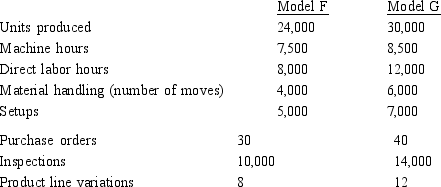
Appleby Manufacturing uses an activity-based costing system. The company produces Model F and Model G. Information relating to the two products is as follows:
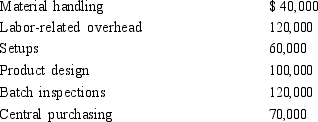
 The following overhead costs are reported for the following activities of the production process:
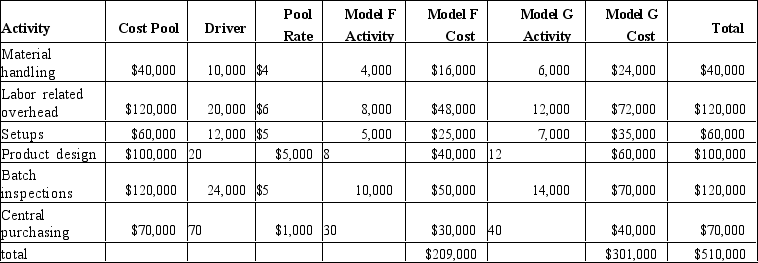
 Jones manufacturing has used activity based costing to assign costs to Models F and G as given in the table below:
 Appleby Manufacturing wants to implement an approximately relevant ABC system by using the two most expensive activities for cost assignment.
-Refer to Figure 4-21. Under equally accurate reduced ABC system, using consumption ratios for labor related and batch inspections, the overhead cost assigned to Model F would be? (round to 5 decimal places)
The following overhead costs are reported for the following activities of the production process:
Jones manufacturing has used activity based costing to assign costs to Models F and G as given in the table below:
Appleby Manufacturing wants to implement an approximately relevant ABC system by using the two most expensive activities for cost assignment.
-Refer to Figure 4-21. Under equally accurate reduced ABC system, using consumption ratios for labor related and batch inspections, the overhead cost assigned to Model F would be? (round to 5 decimal places) (Multiple Choice)
4.9/5 (68)
(68) Material amounts of underapplied or overapplied overhead should be
(Multiple Choice)
4.8/5 (80)
(80) Figure 4-20
Quasi-Tech Corporation produces specially machined parts. The parts are produced in batches in one continuous manufacturing process. Each part is custom produced and requires special engineering design activity (based on customer specifications). Once the design is completed, the equipment can be set up for batch production. Once the batch is completed, a sample is taken and inspected to see if the parts are within the tolerances allowed. Thus, the manufacturing process has four activities: engineering, setups, machining, and inspecting. Costs have been assigned to each activity using direct tracing and resource drivers:
 Owens produces two models: Model X and Model Y. The following table shows how the two products consume activity.
 -Refer to Figure 4-20. Using the activity ratios for engineering and machining, what is the overhead cost assigned to the engineering pool? (round to two decimal places)
Owens produces two models: Model X and Model Y. The following table shows how the two products consume activity.
-Refer to Figure 4-20. Using the activity ratios for engineering and machining, what is the overhead cost assigned to the engineering pool? (round to two decimal places) (Multiple Choice)
4.9/5 (76)
(76) Refer to Figure 4-22. What is the activity rate for treating patients?
(Multiple Choice)
4.8/5 (67)
(67) Product classification attributes define and describe activities and are the basis for product classification.
(True/False)
4.9/5 (86)
(86) A predetermined overhead rate is calculated using which of the following formulas?
(Multiple Choice)
4.8/5 (83)
(83) Figure 4-4
Mannitou Company made the following predictions for 2016:  Job A2 (which was started and completed in June) used 3,000 direct labor hours, 2,000 machine hours, and $57,000 of prime costs.
-The Magnanimous Company uses a predetermined overhead rate of $12 per direct labor hour to apply overhead. During the year, 30,000 direct labor hours were worked. Actual overhead costs for the year were $320,000. The overhead variance is
Job A2 (which was started and completed in June) used 3,000 direct labor hours, 2,000 machine hours, and $57,000 of prime costs.
-The Magnanimous Company uses a predetermined overhead rate of $12 per direct labor hour to apply overhead. During the year, 30,000 direct labor hours were worked. Actual overhead costs for the year were $320,000. The overhead variance is (Multiple Choice)
4.8/5 (79)
(79) Figure 4-11
Longview Manufacturing Company manufactures two products (I and II). The overhead costs ($58,000) have been divided into three cost pools that use the following activity drivers:
 -Which of the following quantities is an example of an activity driver in activity-based costing?
 (Multiple Choice)
4.7/5 (81)
(81) If operations run on less than full capacity, what is the result on cost driver rates?
(Multiple Choice)
4.7/5 (76)
(76) Figure 4-12
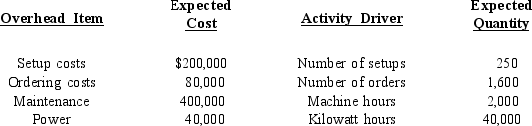
The Gardenview Corporation has identified the following overhead costs and activity drivers for next year:
 The following are two of the jobs completed during the year:
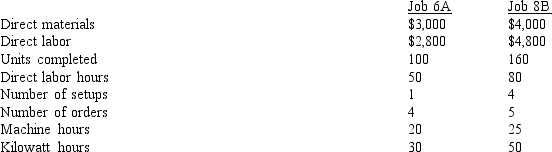 The company's normal activity is 2,000 direct labor hours.
-Refer to Figure 4-12. If kilowatt hours are used to assign power costs, the amount of power costs assigned to Job 6A would be
The following are two of the jobs completed during the year:
The company's normal activity is 2,000 direct labor hours.
-Refer to Figure 4-12. If kilowatt hours are used to assign power costs, the amount of power costs assigned to Job 6A would be (Multiple Choice)
4.9/5 (80)
(80) Lavender Company has decided to use a predetermined rate to assign factory overhead to production. The following predictions have been made for 2016:
 Required:
a. Compute the predetermined factory overhead rate under three different bases: (1) direct labor hours, (2) direct labor costs, and (3) machine hours.
b. Assume that actual factory overhead was $152,500 and that Lavender elected to apply factory overhead to Work in Process based on direct labor hours. If actual direct labor was 42,000 hours for 2016, was factory overhead overapplied or underapplied? By how much?
c. Lavender Company follows the policy of writing off any under- or overapplied factory overhead balance to Cost of Goods Sold at the end of the year. Make the entry necessary at the end of 2016 to dispose of the factory overhead balance determined in Part (b).
Required:
a. Compute the predetermined factory overhead rate under three different bases: (1) direct labor hours, (2) direct labor costs, and (3) machine hours.
b. Assume that actual factory overhead was $152,500 and that Lavender elected to apply factory overhead to Work in Process based on direct labor hours. If actual direct labor was 42,000 hours for 2016, was factory overhead overapplied or underapplied? By how much?
c. Lavender Company follows the policy of writing off any under- or overapplied factory overhead balance to Cost of Goods Sold at the end of the year. Make the entry necessary at the end of 2016 to dispose of the factory overhead balance determined in Part (b). (Essay)
5.0/5 (94)
(94) Figure 4-20
Quasi-Tech Corporation produces specially machined parts. The parts are produced in batches in one continuous manufacturing process. Each part is custom produced and requires special engineering design activity (based on customer specifications). Once the design is completed, the equipment can be set up for batch production. Once the batch is completed, a sample is taken and inspected to see if the parts are within the tolerances allowed. Thus, the manufacturing process has four activities: engineering, setups, machining, and inspecting. Costs have been assigned to each activity using direct tracing and resource drivers:
Owens produces two models: Model X and Model Y. The following table shows how the two products consume activity.
-Refer to Figure 4-20. Using the activity ratios for engineering and machining, what is the overhead rate for machining? (round to two decimal places)
Owens produces two models: Model X and Model Y. The following table shows how the two products consume activity.
-Refer to Figure 4-20. Using the activity ratios for engineering and machining, what is the overhead rate for machining? (round to two decimal places) (Multiple Choice)
4.9/5 (87)
(87) Figure 4-6
The Fast & Furious Company produces two products: toy planes and toy race cars. They use departmental overhead rates for the two production departments: molding and finishing. Molding uses machine hours to assign overhead and Finishing uses direct labor hours. 50,000 planes and 250,000 race cars are produced. Please find the following data:
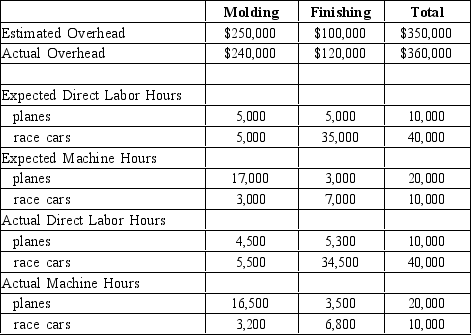 -Refer to Figure 4-6. How much was overhead over or underapplied?
 (Multiple Choice)
4.8/5 (87)
(87) Figure 4-4
Mannitou Company made the following predictions for 2016: Job A2 (which was started and completed in June) used 3,000 direct labor hours, 2,000 machine hours, and $57,000 of prime costs.
-Refer to Figure 4-4. If factory overhead is applied based on direct labor hours, the cost of Job A2 for the Mannitou Company is
Job A2 (which was started and completed in June) used 3,000 direct labor hours, 2,000 machine hours, and $57,000 of prime costs.
-Refer to Figure 4-4. If factory overhead is applied based on direct labor hours, the cost of Job A2 for the Mannitou Company is (Multiple Choice)
4.9/5 (87)
(87) The first step in designing an activity-based costing system is to identify activities.
(True/False)
4.9/5 (75)
(75) Figure 4-16
Samson Company recently installed an activity-based relational database. Using the information contained in the activity relational table, the following pool rates were computed:
$400 per purchase order
$24 per machine hour, Process 1
$30 per machine hour, Process 2
$80 per engineering hour
Two products are produced by Special Products: L and M. The plant has two manufacturing processes, Process 1 and Process 2. Other processes include engineering, product handling, and procurement. Product L goes through Process 1 while Product M goes through Process 2. The product relational table for Special Products is as follows:
Product L
Product M
-Refer to Figure 4-16. How much machine overhead cost will be assigned to Product L using Process 1?
Product M
-Refer to Figure 4-16. How much machine overhead cost will be assigned to Product L using Process 1? (Multiple Choice)
4.9/5 (82)
(82) Figure 4-21
Appleby Manufacturing uses an activity-based costing system. The company produces Model F and Model G. Information relating to the two products is as follows:
The following overhead costs are reported for the following activities of the production process:
Jones manufacturing has used activity based costing to assign costs to Models F and G as given in the table below:
Appleby Manufacturing wants to implement an approximately relevant ABC system by using the two most expensive activities for cost assignment.
-Refer to Figure 4-21. Under this new approach using the new rates, what are the overhead costs assigned to Model G in this approximately relevant ABC system?
The following overhead costs are reported for the following activities of the production process:
Jones manufacturing has used activity based costing to assign costs to Models F and G as given in the table below:
Appleby Manufacturing wants to implement an approximately relevant ABC system by using the two most expensive activities for cost assignment.
-Refer to Figure 4-21. Under this new approach using the new rates, what are the overhead costs assigned to Model G in this approximately relevant ABC system? (Multiple Choice)
4.9/5 (82)
(82) 
Filters
- Essay(0)
- Multiple Choice(0)
- Short Answer(0)
- True False(0)
- Matching(0)