



 Chat with AI
Exam 3: Cost Behavior

Exam 1: Introduction to Cost Management151 Questions
Exam 2: Basic Cost Management Concepts199 Questions
Exam 3: Cost Behavior193 Questions
Exam 4: Activity-Based Costing198 Questions
Exam 5: Product and Service Costing: Job-Order System149 Questions
Exam 6: Process Costing181 Questions
Exam 7: Allocating Costs of Support Departments and Joint Products171 Questions
Exam 8: Budgeting for Planning and Control202 Questions
Exam 9: Standard Costing: a Functional-Based Control Approach125 Questions
Exam 10: Decentralization: Responsibility, Accounting, Performance Evaluation, and Transfer Pricing134 Questions
Exam 11: Strategic Cost Management148 Questions
Exam 12: Activity-Based Management146 Questions
Exam 13: The Balanced Scorecard: Strategic-Based Control124 Questions
Exam 14: Quality and Environmental Cost Management199 Questions
Exam 15: Lean Accounting and Productivity Measurement161 Questions
Exam 16: Cost-Volume-Profit Analysis128 Questions
Exam 17: Activity Resource Usage Model and Tactical Decision Making121 Questions
Exam 18: Pricing and Profitability Analysis159 Questions
Exam 19: Capital Investment125 Questions
Exam 20: Inventory Management: Economic Order Quantity, Jit, and the Theory of Constraints127 Questions
Select questions type


Resources are categorized as flexible, which are supplied as needed, and committed, which are supplied in advance of usage.
(True/False)
4.8/5  (73)
(73) Variable costs are defined as costs that, in total, are constant regardless of change in an activity driver.
(True/False)
4.9/5 (84)
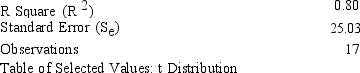
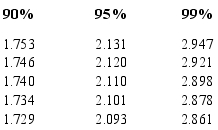
(84) The following data is available of estimated overhead costs using linear regression: 
 Degrees of Freedom 15


 16
17
18
19
What is the interval around Y if 95 percent confidence is desired?
Degrees of Freedom 15
16
17
18
19
What is the interval around Y if 95 percent confidence is desired? (Multiple Choice)
4.9/5 (82)
(82) The average unit cost at a monthly volume of 9,000 units is $3, and the average unit cost at a monthly volume of 22,500 units is $2.10.
Required:
Develop an equation for total monthly costs.
(Essay)
4.8/5 (85)
(85) The three quantitative methods of separating a mixed cost into its fixed and variable components are: the high-low method, the scatter plot method and the method of .
(Short Answer)
4.8/5 (70)
(70) The plot of data points showing the relationship between materials handling costs and activity output is called a scattergraph.
(True/False)
4.9/5 (76)
(76) Which of the following statements is TRUE about the learning curve?
(Multiple Choice)
4.8/5 (79)
(79) Resources, such as direct materials, direct labor, electricity, equipment, and so on, are economic elements that enable one to perform activities.
(True/False)
4.8/5 (86)
(86) The expenses that result when organizations acquire many multiperiod service capacities by paying cash up front or by entering into an explicit contract that requires periodic cash payments are called:
(Multiple Choice)
4.8/5 (71)
(71) Spokane Corporation found its maintenance cost and sales dollars to be somewhat correlated. Last year's high and low observations were as follows:  What is the fixed portion of the maintenance cost?
 (Multiple Choice)
4.8/5 (84)
(84) An alternative measure of goodness of fit is the coefficient of determination.
(True/False)
4.8/5 (77)
(77) The account analysis method can be used to estimate costs by classifying accounts in the general ledger as variable.
(True/False)
4.8/5 (80)
(80) The most widely used method to determine cost behavior is managerial judgement.
(True/False)
4.9/5 (86)
(86) analysis focuses on how costs react to changes in activity levels.
(Short Answer)
4.8/5 (77)
(77) Which of the following is an example of a committed fixed expense?
(Multiple Choice)
4.8/5 (79)
(79) If all the activity capacity acquired is not used, this is an example of
(Multiple Choice)
4.9/5 (89)
(89) explain changes in cost factors other than changes in units produced.
(Short Answer)
4.9/5 (83)
(83) Alamo, Inc., is beginning the production of a new product. Management believes that 500 labor hours will be required to complete the new unit. An 80 percent incremental unit-time learning curve model for direct labor hours is assumed to be valid. Assume the q = -0.3219. Data on costs are as follows:  Required:
a. Set up a table with columns for cumulative number of units showing the cumulative total time in hours using the incremental unit-time learning curve. Complete the table for 1, 2, 3, and 4 units given the individual unit time for the nth unit as 500, 400, 351, and 320 for 1 to 4 units respectively.
b. Set up a similar table assuming a 90 percent with the incremental unit-time learning curve with the individual unit time for the nth unit as 500, 450, 430, 405 for 1 to 4 units respectively.
c. What is the difference in variable cost of producing four units?
Required:
a. Set up a table with columns for cumulative number of units showing the cumulative total time in hours using the incremental unit-time learning curve. Complete the table for 1, 2, 3, and 4 units given the individual unit time for the nth unit as 500, 400, 351, and 320 for 1 to 4 units respectively.
b. Set up a similar table assuming a 90 percent with the incremental unit-time learning curve with the individual unit time for the nth unit as 500, 450, 430, 405 for 1 to 4 units respectively.
c. What is the difference in variable cost of producing four units?
(Essay)
4.9/5 (88)
(88) 
Filters
- Essay(0)
- Multiple Choice(0)
- Short Answer(0)
- True False(0)
- Matching(0)