



 Chat with AI
Exam 8: LP Sensitivity Analysis

Exam 1: Introduction61 Questions
Exam 2: Introduction to Probability54 Questions
Exam 3: Probability Distributions84 Questions
Exam 4: Decision Analysis69 Questions
Exam 5: Utility Game Theory56 Questions
Exam 6: Time Series Analysis Forecasting46 Questions
Exam 7: Intro to Linear Programming49 Questions
Exam 8: LP Sensitivity Analysis59 Questions
Exam 9: LP Applications60 Questions
Exam 10: Distribution Network Models68 Questions
Exam 11: Integer Linear Programming61 Questions
Exam 12: Advanced Optimization Applications56 Questions
Exam 13: Project Scheduling58 Questions
Exam 14: Inventory Models68 Questions
Exam 15: Waiting Line Models66 Questions
Exam 16: Simulation62 Questions
Exam 17: Markov Processes41 Questions
Select questions type


Describe each of the sections of output that come from The Management Scientist and how you would use each.
(Essay)
4.8/5  (76)
(76) The dual price for a percentage constraint provides a direct answer to questions about the effect of increases or decreases in that percentage.
(True/False)
4.8/5 (74)
(74) Consider the following linear program:
The Management Scientist provided the following solution output:
OPTIMAL SOLUTION
Objective Function Value = 27.000
MIN cost
s.t.
+2 \leq8 10+7.5 \geq30 \geq2 , \geq0
Variable Value Reduced Cost 1 1.500 0.000 2 2.000 0.000 OBJECTIVE COEFFICIENT RANGES
Constraint Slack/Surplus Dual Price 1 2.500 0.000 2 0.000 -0.600 3 0.000 -4.500 RIGHT HAND SIDE RANGES
Variable Lower Limit Current Value Upper Limit 1 0.000 6.000 12.000 2 4.500 9.000 No Upper Limit
Constraint Lower Limit Current Value Upper Limit 1 5.500 8.000 No Upper Limit 2 15.000 30.000 55.000 3 0.000 2.000 4.000
a.What is the optimal solution including the optimal value of the objective function?
b.Suppose the unit cost of x1 is decreased to $4.Is the above solution still optimal? What is the value of the objective function when this unit cost is decreased to $4?
c.How much can the unit cost of x2 be decreased without concern for the optimal solution changing?
d.If simultaneously the cost of x1 was raised to $7.5 and the cost of x2 was reduced to $6,would the current solution still remain optimal?
e.If the right-hand side of constraint 3 is increased by 1,what will be the effect on the optimal solution?
(Essay)
4.9/5 (79)
(79) The binding constraints for this problem are the first and second.
Min
s.t.
a.Keeping c2 fixed at 2,over what range can c1 vary before there is a change in the optimal solution point?
b.Keeping c1 fixed at 1,over what range can c2 vary before there is a change in the optimal solution point?
c.If the objective function becomes Min 1.5x1 + 2x2,what will be the optimal values of x1,x2,and the objective function?
d.If the objective function becomes Min 7x1 + 6x2,what constraints will be binding?
e.Find the dual price for each constraint in the original problem.
(Essay)
4.8/5 (83)
(83) If the dual price for the right-hand side of a ≤ constraint is zero,there is no upper limit on its range of feasibility.
(True/False)
4.9/5 (99)
(99) Excel's Solver tool has been used in the spreadsheet below to solve a linear programming problem with a maximization objective function and all ≤ constraints.
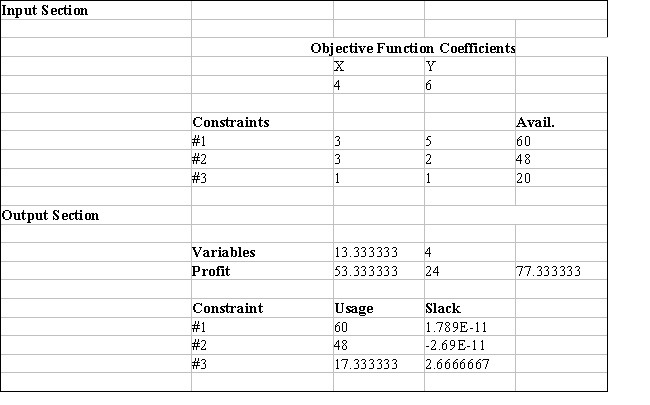 a.Give the original linear programming problem.
b.Give the complete optimal solution.
a.Give the original linear programming problem.
b.Give the complete optimal solution. (Essay)
4.7/5 (87)
(87) A negative dual price indicates that increasing the right-hand side of the associated constraint would be detrimental to the objective.
(True/False)
4.9/5 (78)
(78) The 100% Rule does not imply that the optimal solution will necessarily change if the percentage exceeds 100%.
(True/False)
5.0/5 (81)
(81) Classical sensitivity analysis provides no information about changes resulting from a change in the coefficient of a variable in a constraint.
(True/False)
4.9/5 (79)
(79) If the range of feasibility for b1 is between 16 and 37,then if b1 = 22 the optimal solution will not change from the original optimal solution.
(True/False)
4.8/5 (93)
(93) Consider the following linear program:
The Management Scientist provided the following solution output:
OPTIMAL SOLUTION
Objective Function Value = 20.000
MIAX Profit
s.t.
Variable Value Reduced Cost 1 2.400 0.000 2 3.200 0.000 OBJECTIVE COEFFICIENT RANGES
Constraint Slack/Surplus Dual Price 1 0.000 1.000 2 0.000 1.000 3 0.600 0.000 RIGHT HAND SIDE RANGES
Variable Lower Limit Current Value Upper Limit X1 1.333 3.000 8.000 2 1.500 4.000 9.000 Constraint Lower Limit Current Value Upper Limit 1 9.000 12.000 24.000 2 4.000 8.000 9.000 3 2.400 3.000 No Upper Limit
a.What is the optimal solution including the optimal value of the objective function?
b.Suppose the profit on x1 is increased to $7.Is the above solution still optimal? What is the value of the objective function when this unit profit is increased to $7?
c.If the unit profit on x2 was $10 instead of $4,would the optimal solution change?
d.If simultaneously the profit on x1 was raised to $5.5 and the profit on x2 was reduced to $3,would the current solution still remain optimal?
(Essay)
4.7/5 (65)
(65) When the cost of a resource is sunk,then the dual price can be interpreted as the
(Multiple Choice)
4.8/5 (81)
(81) Relevant costs should be reflected in the objective function,but sunk costs should not.
(True/False)
4.8/5 (86)
(86) To solve a linear programming problem with thousands of variables and constraints
(Multiple Choice)
4.9/5 (84)
(84) Explain the connection between reduced costs and the range of optimality,and between dual prices and the range of
feasibility.
(Short Answer)
4.8/5 (75)
(75) Decreasing the objective function coefficient of a variable to its lower limit will create a revised problem that is unbounded.
(True/False)
4.7/5 (75)
(75) The 100 percent rule can be applied to changes in both objective function coefficients and right-hand sides at the same time.
(True/False)
4.9/5 (71)
(71) 
Filters
- Essay(0)
- Multiple Choice(0)
- Short Answer(0)
- True False(0)
- Matching(0)