



 Chat with AI
Exam 8: LP Sensitivity Analysis

Exam 1: Introduction61 Questions
Exam 2: Introduction to Probability54 Questions
Exam 3: Probability Distributions84 Questions
Exam 4: Decision Analysis69 Questions
Exam 5: Utility Game Theory56 Questions
Exam 6: Time Series Analysis Forecasting46 Questions
Exam 7: Intro to Linear Programming49 Questions
Exam 8: LP Sensitivity Analysis59 Questions
Exam 9: LP Applications60 Questions
Exam 10: Distribution Network Models68 Questions
Exam 11: Integer Linear Programming61 Questions
Exam 12: Advanced Optimization Applications56 Questions
Exam 13: Project Scheduling58 Questions
Exam 14: Inventory Models68 Questions
Exam 15: Waiting Line Models66 Questions
Exam 16: Simulation62 Questions
Exam 17: Markov Processes41 Questions
Select questions type


For any constraint,either its slack/surplus value must be zero or its dual price must be zero.
(True/False)
4.9/5  (83)
(83) Excel's Solver tool has been used in the spreadsheet below to solve a linear programming problem with a minimization objective function and all ≥ constraints.
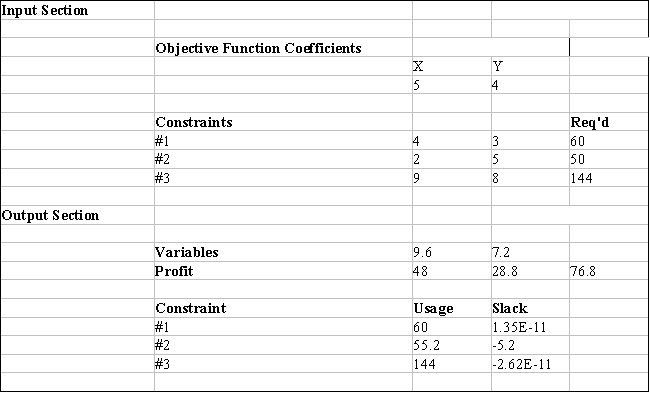 a.Give the original linear programming problem.
b.Give the complete optimal solution.
a.Give the original linear programming problem.
b.Give the complete optimal solution. (Essay)
4.9/5 (85)
(85) Use the following Management Scientist output to answer the questions.
MIN 4X1+5X2+6X3
S.T.
Objective Function Value = 400.000
1)
2)
3) Variable Value Reduced Cost 1 0.000 1.500 2 80.000 0.000 3 0.000 1.000 OBJECTIVE COEFFICIENT RANGES
Constraint Slack/Surplus Dual Price 1 5.000 0.000 2 40.000 0.000 3 0.000 -1.250 RIGHT HAND SIDE RANGES
Variable Lower Limit Current Value Upper Limit X1 2.500 4.000 No Upper Limit X2 0.000 5.000 6.000 X3 5.000 6.000 No Upper Limit Constraint Lower Limit Current Value Upper Limit 1 80.000 85.000 No Upper Limit 2 No Lower Limit 280.000 320.000 3 280.000 320.000 340.000
a.What is the optimal solution,and what is the value of the profit contribution?
b.Which constraints are binding?
c.What are the dual prices for each resource? Interpret.
d.Compute and interpret the ranges of optimality.
e.Compute and interpret the ranges of feasibility.
(Essay)
4.8/5 (70)
(70) A section of output from The Management Scientist is shown here. What will happen to the solution if the objective function coefficient for variable 1 decreases by 20?
Variable Lower Limit Current Value Upper Limit 1 60 100 120
(Multiple Choice)
4.8/5 (66)
(66) If a decision variable is not positive in the optimal solution,its reduced cost is
(Multiple Choice)
4.8/5 (76)
(76) The cost that varies depending on the values of the decision variables is a
(Multiple Choice)
4.8/5 (71)
(71) How can the interpretation of dual prices help provide an economic justification for new technology?
(Short Answer)
4.9/5 (93)
(93) The dual price measures,per unit increase in the right hand side of the constraint,
(Multiple Choice)
4.9/5 (85)
(85) The amount by which an objective function coefficient can change before a different set of values for the decision variables becomes optimal is the
(Multiple Choice)
4.8/5 (87)
(87) The amount of a sunk cost will vary depending on the values of the decision variables.
(True/False)
4.8/5 (79)
(79) Which of the following is not a question answered by standard sensitivity analysis information?
(Multiple Choice)
4.8/5 (74)
(74) Given the following linear program:
The graphical solution to the problem is shown below.From the graph we see that the optimal solution occurs at x1 = 5,x2 = 3,and z = 46.
s.t
x1 \leq6 2+3 \leq19 + \leq8 , \geq0 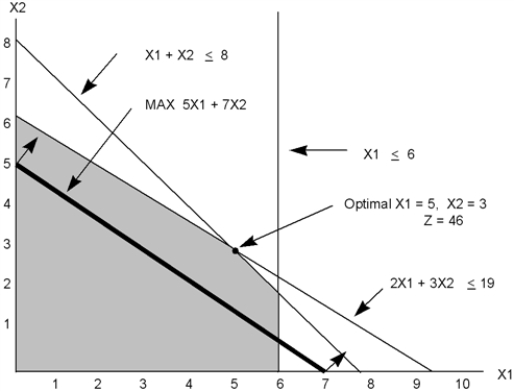 a.Calculate the range of optimality for each objective function coefficient.
b.Calculate the dual price for each resource.
a.Calculate the range of optimality for each objective function coefficient.
b.Calculate the dual price for each resource. (Essay)
4.8/5 (76)
(76) Explain the two interpretations of dual prices based on the accounting assumptions made in calculating the objective
function coefficients.
(Essay)
4.7/5 (95)
(95) A cost that is incurred no matter what values the decision variables assume is
(Multiple Choice)
4.8/5 (67)
(67) The amount the objective function coefficient of a decision variable would have to improve before that variable would have a positive value in the solution is the
(Multiple Choice)
4.7/5 (83)
(83) In order to tell the impact of a change in a constraint coefficient,the change must be made and then the model resolved.
(True/False)
4.8/5 (74)
(74) 
Filters
- Essay(0)
- Multiple Choice(0)
- Short Answer(0)
- True False(0)
- Matching(0)