



 Chat with AI
Exam 7: Accounting for Receivables

Exam 1: An Introduction to Accounting148 Questions
Exam 2: Accounting for Accruals and Deferrals151 Questions
Exam 3: The Double-Entry Accounting System156 Questions
Exam 4: Accounting for Merchandising Businesses157 Questions
Exam 5: Accounting for Inventories142 Questions
Exam 6: Internal Control and Accounting for Cash140 Questions
Exam 7: Accounting for Receivables145 Questions
Exam 8: Accounting for Long-Term Operational Assets159 Questions
Exam 9: Accounting for Current Liabilities and Payroll130 Questions
Exam 10: Accounting for Long-Term Debt158 Questions
Exam 11: Proprietorships, Partnerships, and Corporations153 Questions
Exam 12: Statement of Cash Flows134 Questions
Exam 13: Financial Statement Analysis Available Online in the Connect Library139 Questions
Select questions type


The Angle Corporation accepted a credit card for a sale of $2,000 on December 16, 2013. The credit card company charges a fee of 4%. On January 5, 2014, Angle received payment from the credit card company. Indicate whether each of the following statements is true or false.
_____ a) Angle should record the $2,000 revenue in 2013 when the sale is made.
_____ b) Angle should record a credit card receivable account receivable of $2,000 on 12/16/13.
_____ c) The sale has no impact on the statement of cash flows in 2013.
_____ d) The collection of cash increases total assets in 2014.
_____ e) The entry on 12/16/13 increases total revenues and total expenses on the 2013 income statement.
(Short Answer)
4.9/5  (69)
(69) Making a loan to another party is considered an investing activity on the statement of cash flows.
(True/False)
4.8/5 (81)
(81) Which of the following businesses would most likely have the longest operating cycle?
(Multiple Choice)
4.9/5 (81)
(81) How do the percent of revenue method and the percent of receivables method to estimate uncollectible accounts expense differ?
(Essay)
4.8/5 (78)
(78) The practice of reporting the net realizable value of receivables in the financial statements is commonly called:
(Multiple Choice)
4.9/5 (76)
(76) Lowe Company has the following account balances: 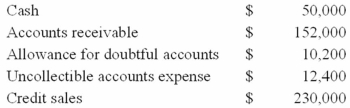 Compute the net realizable value of Lowe's accounts receivable.
 (Short Answer)
4.8/5 (86)
(86) Which of the following answers correctly describes the effect of the collection of cash from the credit card company on the financial statements of Yancey Corporation? 
(Multiple Choice)
4.8/5 (83)
(83) The direct write-off method of accounting for uncollectible accounts overstates assets on the balance sheet.
(True/False)
4.9/5 (77)
(77) Karma's entry to recognize the write-off of the uncollectible accounts will
(Multiple Choice)
4.7/5 (85)
(85) Which of the following answers correctly states the effect of recording the reestablishment of the receivable on April 4, 2013? 
(Multiple Choice)
4.8/5 (86)
(86) After the accounts are adjusted at the end of the year, Accounts Receivable has a balance of $450,000, Uncollectible Accounts Expense for the year was $35,000, and Allowance for Doubtful Accounts has a balance of $25,000. What is the net realizable value of the accounts receivable?
(Short Answer)
4.9/5 (79)
(79) After the accounts are adjusted at the end of the year, Accounts Receivable has a balance of $225,000, Uncollectible Accounts Expense has a balance of $17,500, and Allowance for Doubtful Accounts has a balance of $12,500. What is the net realizable value of the accounts receivable?
(Short Answer)
4.8/5 (68)
(68) Harvey Company uses the allowance method to account for uncollectible accounts. An account that had been previously written-off as uncollectible was recovered. How would the recovery affect the company's accounting equation?
(Multiple Choice)
4.8/5 (70)
(70) The year-end adjusting entry to accrue interest on a note receivable is an asset source transaction.
(True/False)
4.8/5 (94)
(94) Barnes Corporation uses the percent of receivables method of accounting for uncollectible accounts. As of December 31, 2013, prior to estimating uncollectible accounts expense, Barnes's balance of accounts receivable was $68,900, the balance of allowance for doubtful accounts was $2,500, and total credit sales for 2013 were $875,000. On December 31, Barnes aged its receivables and determined the following: 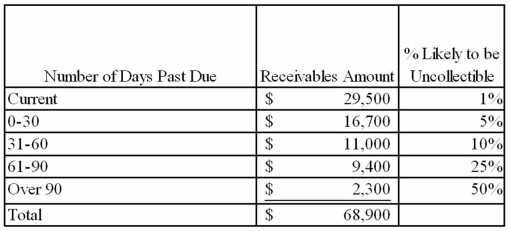 Indicate whether each of the following statements is true or false.
_____ a) Barnes will report Net Realizable Value of Accounts Receivable equal to $63,170 on its December 31, 2013 balance sheet.
_____ b) Barnes will report Uncollectible Accounts Expense of $5,730 on its 2013 income statement.
_____ c) The December 31 adjusting entry related to uncollectible accounts will decrease assets and equity by $3,230.
_____ d) The method Barnes uses to account for uncollectible accounts is known as the balance sheet approach.
_____ e) Write-offs of uncollectible accounts in 2014 will reduce Barnes' net realizable value of receivables.
Indicate whether each of the following statements is true or false.
_____ a) Barnes will report Net Realizable Value of Accounts Receivable equal to $63,170 on its December 31, 2013 balance sheet.
_____ b) Barnes will report Uncollectible Accounts Expense of $5,730 on its 2013 income statement.
_____ c) The December 31 adjusting entry related to uncollectible accounts will decrease assets and equity by $3,230.
_____ d) The method Barnes uses to account for uncollectible accounts is known as the balance sheet approach.
_____ e) Write-offs of uncollectible accounts in 2014 will reduce Barnes' net realizable value of receivables. (Short Answer)
4.8/5 (76)
(76) Accepting credit cards is usually more costly to a business than offering credit directly to customers.
(True/False)
4.8/5 (73)
(73) Which of the following is not an advantage of accepting credit cards from retail customers?
(Multiple Choice)
5.0/5 (90)
(90) The direct write-off method does a better job of matching revenues and expenses than does the allowance method.
(True/False)
5.0/5 (83)
(83) Robinson Corporation accepted credit cards for $36,200 of services performed in October 2013. The credit card company charged a 3 ½% service fee and paid Robinson as soon as it received the credit card receipts.
Required:
a) Prepare the general journal entry to record performance of the services.
b) Prepare the general journal entry for collection of the receivable from the credit card company.
(Essay)
4.9/5 (76)
(76) Using the allowance method of accounting for uncollectible receivables requires an estimate of the amount of receivables that will not be collected.
(True/False)
4.9/5 (88)
(88) 
Filters
- Essay(0)
- Multiple Choice(0)
- Short Answer(0)
- True False(0)
- Matching(0)