



 Chat with AI
Exam 10: Accounting for Long-Term Debt

Exam 1: An Introduction to Accounting148 Questions
Exam 2: Accounting for Accruals and Deferrals151 Questions
Exam 3: The Double-Entry Accounting System156 Questions
Exam 4: Accounting for Merchandising Businesses157 Questions
Exam 5: Accounting for Inventories142 Questions
Exam 6: Internal Control and Accounting for Cash140 Questions
Exam 7: Accounting for Receivables145 Questions
Exam 8: Accounting for Long-Term Operational Assets159 Questions
Exam 9: Accounting for Current Liabilities and Payroll130 Questions
Exam 10: Accounting for Long-Term Debt158 Questions
Exam 11: Proprietorships, Partnerships, and Corporations153 Questions
Exam 12: Statement of Cash Flows134 Questions
Exam 13: Financial Statement Analysis Available Online in the Connect Library139 Questions
Select questions type


Brennan's Company experienced an accounting event that was recorded in the company's general journal as indicated below:  Which of the following choices accurately reflects how this event would affect Brennan's financial statements.
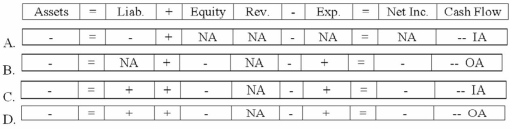
Which of the following choices accurately reflects how this event would affect Brennan's financial statements. (Multiple Choice)
4.7/5  (65)
(65) Madison Company issues $12,500 of bonds at face value on January 1. The bonds carry an 8% annual stated rate of interest. Interest is payable in cash on December 31 of each year. Which of the following reflects the financial statement effects of the first interest payment? 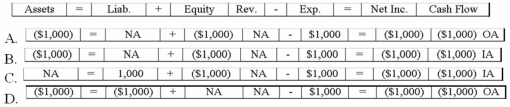
(Multiple Choice)
4.8/5 (79)
(79) If a bond issuer's bond ratings drop, the company probably will have to pay higher interest rates on bonds that have already been issued.
(True/False)
4.9/5 (75)
(75) On December 31, 2013, Fairmont Corporation had a balance of $20,000 on a line-of-credit with Community Bank. Fairmont made a payment of $11,200, which included $10,000 on the principal and $1,200 interest. Show the effects of this transaction on Fairmont's financial statements. 
(Short Answer)
5.0/5 (84)
(84) On December 31, 2013, Crown Co. paid cash for interest on bonds it had issued on January 1, 2013 at 98, and amortized part of the discount on bonds. Crown Co. uses the effective interest method of amortizing bond discounts. Indicate the effects of the amortization of the discount only. 
(Short Answer)
5.0/5 (83)
(83) Which of the following is one of the main advantages of using long-term debt financing instead of equity financing?
(Multiple Choice)
4.9/5 (72)
(72) Assuming Winfield issued the bond for 105, the amount of interest expense appearing on the 2013 income statement would be:
(Multiple Choice)
4.9/5 (73)
(73) On January 1, 2013 Bluefield Co. issued $100,000 of 10%, 20-year bonds. If Bluefield's tax rate is 40%, the after-tax cost of borrowing related to these bonds for 2013 is:
(Multiple Choice)
4.8/5 (80)
(80) Name some of the restrictive covenants often included in bond indentures.
(Essay)
4.8/5 (78)
(78) Scooby Corporation issued $200,000 of five-year 6% bonds at face value on August 1, 2013. Interest is paid annually on July 31.
a) Prepare Scooby's journal entry to record the issuance of the bonds.
b) Prepare Scooby's adjusting entry required on 12/31/13.
c) Prepare Scooby's entry to record the first interest payment on 7/31/14.
(Essay)
4.8/5 (87)
(87) A line of credit typically has an interest rate that is fixed (constant) for the length of the agreement.
(True/False)
4.8/5 (81)
(81) On January 1, 2014, Potter Corporation called the bonds payable at a price of $2,545. Which of the following answers shows the effect of this transaction on the financial statements? 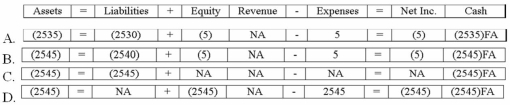
(Multiple Choice)
4.9/5 (79)
(79) On January 1, 2013, Monmouth Co. issued $100,000 of bonds at the face value. Indicate the effects of issuing these bonds. 
(Short Answer)
4.8/5 (80)
(80) Indicate whether each of the following statements regarding effective interest amortization is true or false.
_____ a) The effective interest method of bond premium amortization matches interest expense with the declining carrying value of the bond.
_____ b) Interest expense on a bond issued at a discount will be lower in the bond's first year than if the company had used straight-line amortization.
_____ c) The carrying value of a bond issued at a premium will decrease by smaller and smaller amounts each year.
_____ d) Interest expense is calculated by multiplying the beginning carrying value of the bond by the stated rate of interest.
_____ e) Effective interest amortization can only be used on bonds that pay interest annually.
(Short Answer)
4.8/5 (85)
(85) Jansen Company issued bonds with $150,000 face value on January 1, 2013. The bonds were issued at 102 and carried a 5-year term to maturity. They had a 9% stated rate of interest that was payable in cash on December 31st of each year. Jansen uses the straight-line method of amortization. Based on this information alone, the recognition of interest expense on December 31, 2013 would act to:
(Multiple Choice)
4.9/5 (83)
(83) Bonds that mature at specified intervals throughout the life of the issuance are called:
(Multiple Choice)
4.8/5 (85)
(85) A five-year, $500,000 bond was issued on 1/1/13. The stated rate of interest was 8%, and the effective rate of interest was 10%. The interest is paid semiannually. Which of the following statements is correct?
(Multiple Choice)
4.9/5 (84)
(84) Norris Company has a line of credit with the Everett State Bank. Norris agreed to pay interest at an annual rate equal to 2% above the bank's prime rate. Funds are borrowed or repaid on the first day of each month and interest is paid in cash on the last day of each month. Activity to date is given as follows:  The amount of interest paid at the end of March would be:
 (Multiple Choice)
4.9/5 (78)
(78) Park Enterprises issued bonds with a term of 5 years and a face value of $500,000, receiving cash of $508,000. The bonds pay interest once a year, with an annual rate of 7%. Assuming straight-line amortization, the amount of interest expense for the first year would be $31,600.
(True/False)
4.9/5 (69)
(69) 
Filters
- Essay(0)
- Multiple Choice(0)
- Short Answer(0)
- True False(0)
- Matching(0)