
Exam 17: The Theory of Linear Regression With One Regressor

arrow
  • Select Tags
search iconSearch Question
flashcardsStudy Flashcards
  • Select Tags

Consider the model Yi = β1Xi + ui,where ui = c Consider the model Yi = β1Xi + ui,where ui = c   ei and all of the X's and e's are i.i.d.and distributed N(0,1). (a)Which of the Extended Least Squares Assumptions are satisfied here? Prove your assertions. (b)Would an OLS estimator of β1 be efficient here? (c)How would you estimate β1 by WLS? ei and all of the X's and e's are i.i.d.and distributed N(0,1). (a)Which of the Extended Least Squares Assumptions are satisfied here? Prove your assertions. (b)Would an OLS estimator of β1 be efficient here? (c)How would you estimate β1 by WLS?

(Essay)
4.8/5
(79)

(Requires Appendix material)State and prove the Cauchy-Schwarz Inequality.

(Essay)
4.9/5
(78)

"One should never bother with WLS.Using OLS with robust standard errors gives correct inference,at least asymptotically." True,false,or a bit of both? Explain carefully what the quote means and evaluate it critically.

(Essay)
4.7/5
(75)

(Requires Appendix material)If the Gauss-Markov conditions hold,then OLS is BLUE.In addition,assume here that X is nonrandom.Your textbook proves the Gauss-Markov theorem by using the simple regression model Yi = β0 + β1Xi + ui and assuming a linear estimator (Requires Appendix material)If the Gauss-Markov conditions hold,then OLS is BLUE.In addition,assume here that X is nonrandom.Your textbook proves the Gauss-Markov theorem by using the simple regression model Yi = β0 + β1Xi + ui and assuming a linear estimator   .Substitution of the simple regression model into this expression then results in two conditions for the unbiasedness of the estimator:   = 0 and   = 1. The variance of the estimator is var(     X1,…,Xn)=     . Different from your textbook,use the Lagrangian method to minimize the variance subject to the two constraints.Show that the resulting weights correspond to the OLS weights. .Substitution of the simple regression model into this expression then results in two conditions for the unbiasedness of the estimator: (Requires Appendix material)If the Gauss-Markov conditions hold,then OLS is BLUE.In addition,assume here that X is nonrandom.Your textbook proves the Gauss-Markov theorem by using the simple regression model Yi = β0 + β1Xi + ui and assuming a linear estimator   .Substitution of the simple regression model into this expression then results in two conditions for the unbiasedness of the estimator:   = 0 and   = 1. The variance of the estimator is var(     X1,…,Xn)=     . Different from your textbook,use the Lagrangian method to minimize the variance subject to the two constraints.Show that the resulting weights correspond to the OLS weights. = 0 and (Requires Appendix material)If the Gauss-Markov conditions hold,then OLS is BLUE.In addition,assume here that X is nonrandom.Your textbook proves the Gauss-Markov theorem by using the simple regression model Yi = β0 + β1Xi + ui and assuming a linear estimator   .Substitution of the simple regression model into this expression then results in two conditions for the unbiasedness of the estimator:   = 0 and   = 1. The variance of the estimator is var(     X1,…,Xn)=     . Different from your textbook,use the Lagrangian method to minimize the variance subject to the two constraints.Show that the resulting weights correspond to the OLS weights. = 1. The variance of the estimator is var( (Requires Appendix material)If the Gauss-Markov conditions hold,then OLS is BLUE.In addition,assume here that X is nonrandom.Your textbook proves the Gauss-Markov theorem by using the simple regression model Yi = β0 + β1Xi + ui and assuming a linear estimator   .Substitution of the simple regression model into this expression then results in two conditions for the unbiasedness of the estimator:   = 0 and   = 1. The variance of the estimator is var(     X1,…,Xn)=     . Different from your textbook,use the Lagrangian method to minimize the variance subject to the two constraints.Show that the resulting weights correspond to the OLS weights. (Requires Appendix material)If the Gauss-Markov conditions hold,then OLS is BLUE.In addition,assume here that X is nonrandom.Your textbook proves the Gauss-Markov theorem by using the simple regression model Yi = β0 + β1Xi + ui and assuming a linear estimator   .Substitution of the simple regression model into this expression then results in two conditions for the unbiasedness of the estimator:   = 0 and   = 1. The variance of the estimator is var(     X1,…,Xn)=     . Different from your textbook,use the Lagrangian method to minimize the variance subject to the two constraints.Show that the resulting weights correspond to the OLS weights. X1,…,Xn)= (Requires Appendix material)If the Gauss-Markov conditions hold,then OLS is BLUE.In addition,assume here that X is nonrandom.Your textbook proves the Gauss-Markov theorem by using the simple regression model Yi = β0 + β1Xi + ui and assuming a linear estimator   .Substitution of the simple regression model into this expression then results in two conditions for the unbiasedness of the estimator:   = 0 and   = 1. The variance of the estimator is var(     X1,…,Xn)=     . Different from your textbook,use the Lagrangian method to minimize the variance subject to the two constraints.Show that the resulting weights correspond to the OLS weights. (Requires Appendix material)If the Gauss-Markov conditions hold,then OLS is BLUE.In addition,assume here that X is nonrandom.Your textbook proves the Gauss-Markov theorem by using the simple regression model Yi = β0 + β1Xi + ui and assuming a linear estimator   .Substitution of the simple regression model into this expression then results in two conditions for the unbiasedness of the estimator:   = 0 and   = 1. The variance of the estimator is var(     X1,…,Xn)=     . Different from your textbook,use the Lagrangian method to minimize the variance subject to the two constraints.Show that the resulting weights correspond to the OLS weights. . Different from your textbook,use the Lagrangian method to minimize the variance subject to the two constraints.Show that the resulting weights correspond to the OLS weights.

(Essay)
4.9/5
(76)

What does the Gauss-Markov theorem prove? Without giving mathematical details,explain how the proof proceeds.What is its importance?

(Essay)
4.8/5
(76)

If,in addition to the least squares assumptions made in the previous chapter on the simple regression model,the errors are homoskedastic,then the OLS estimator is

(Multiple Choice)
4.8/5
(75)

One of the earlier textbooks in econometrics,first published in 1971,compared "estimation of a parameter to shooting at a target with a rifle.The bull's-eye can be taken to represent the true value of the parameter,the rifle the estimator,and each shot a particular estimate." Use this analogy to discuss small and large sample properties of estimators.How do you think the author approached the n → ∞ condition? (Dependent on your view of the world,feel free to substitute guns with bow and arrow,or missile. )

(Essay)
4.9/5
(72)

In order to use the t-statistic for hypothesis testing and constructing a 95% confidence interval as In order to use the t-statistic for hypothesis testing and constructing a 95% confidence interval as   1.96 standard errors,the following three assumptions have to hold: 1.96 standard errors,the following three assumptions have to hold:

(Multiple Choice)
4.7/5
(82)

Suppose that the conditional variance is var(ui|Xi)= λh(Xi)where λ is a constant and h is a known function.The WLS estimator is

(Multiple Choice)
4.8/5
(78)

(Requires Appendix material)If X and Y are jointly normally distributed and are uncorrelated,

(Multiple Choice)
4.7/5
(84)

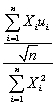
Consider the model Yi - β1Xi + ui,where the Xi and ui the are mutually independent i.i.d.random variables with finite fourth moment and E(ui)= 0. (a)Let Consider the model Yi - β1Xi + ui,where the Xi and ui the are mutually independent i.i.d.random variables with finite fourth moment and E(ui)= 0. (a)Let   1 denote the OLS estimator of β1.Show that   (   1- β1)=   . (b)What is the mean and the variance of   ? Assuming that the Central Limit Theorem holds,what is its limiting distribution? (c)Deduce the limiting distribution of   (   1 - β1)? State what theorems are necessary for your deduction. 1 denote the OLS estimator of β1.Show that Consider the model Yi - β1Xi + ui,where the Xi and ui the are mutually independent i.i.d.random variables with finite fourth moment and E(ui)= 0. (a)Let   1 denote the OLS estimator of β1.Show that   (   1- β1)=   . (b)What is the mean and the variance of   ? Assuming that the Central Limit Theorem holds,what is its limiting distribution? (c)Deduce the limiting distribution of   (   1 - β1)? State what theorems are necessary for your deduction. ( Consider the model Yi - β1Xi + ui,where the Xi and ui the are mutually independent i.i.d.random variables with finite fourth moment and E(ui)= 0. (a)Let   1 denote the OLS estimator of β1.Show that   (   1- β1)=   . (b)What is the mean and the variance of   ? Assuming that the Central Limit Theorem holds,what is its limiting distribution? (c)Deduce the limiting distribution of   (   1 - β1)? State what theorems are necessary for your deduction. 1- β1)= Consider the model Yi - β1Xi + ui,where the Xi and ui the are mutually independent i.i.d.random variables with finite fourth moment and E(ui)= 0. (a)Let   1 denote the OLS estimator of β1.Show that   (   1- β1)=   . (b)What is the mean and the variance of   ? Assuming that the Central Limit Theorem holds,what is its limiting distribution? (c)Deduce the limiting distribution of   (   1 - β1)? State what theorems are necessary for your deduction. . (b)What is the mean and the variance of Consider the model Yi - β1Xi + ui,where the Xi and ui the are mutually independent i.i.d.random variables with finite fourth moment and E(ui)= 0. (a)Let   1 denote the OLS estimator of β1.Show that   (   1- β1)=   . (b)What is the mean and the variance of   ? Assuming that the Central Limit Theorem holds,what is its limiting distribution? (c)Deduce the limiting distribution of   (   1 - β1)? State what theorems are necessary for your deduction. ? Assuming that the Central Limit Theorem holds,what is its limiting distribution? (c)Deduce the limiting distribution of Consider the model Yi - β1Xi + ui,where the Xi and ui the are mutually independent i.i.d.random variables with finite fourth moment and E(ui)= 0. (a)Let   1 denote the OLS estimator of β1.Show that   (   1- β1)=   . (b)What is the mean and the variance of   ? Assuming that the Central Limit Theorem holds,what is its limiting distribution? (c)Deduce the limiting distribution of   (   1 - β1)? State what theorems are necessary for your deduction. ( Consider the model Yi - β1Xi + ui,where the Xi and ui the are mutually independent i.i.d.random variables with finite fourth moment and E(ui)= 0. (a)Let   1 denote the OLS estimator of β1.Show that   (   1- β1)=   . (b)What is the mean and the variance of   ? Assuming that the Central Limit Theorem holds,what is its limiting distribution? (c)Deduce the limiting distribution of   (   1 - β1)? State what theorems are necessary for your deduction. 1 - β1)? State what theorems are necessary for your deduction.
(Essay)
4.7/5
(91)

The class of linear conditionally unbiased estimators consists of

(Multiple Choice)
4.8/5
(80)

You need to adjust You need to adjust   by the degrees of freedom to ensure that   is by the degrees of freedom to ensure that You need to adjust   by the degrees of freedom to ensure that   is is

(Multiple Choice)
4.7/5
(95)

The following is not part of the extended least squares assumptions for regression with a single regressor:

(Multiple Choice)
4.8/5
(91)

Homoskedasticity means that

(Multiple Choice)
4.9/5
(90)

Your textbook states that an implication of the Gauss-Markov theorem is that the sample average, Your textbook states that an implication of the Gauss-Markov theorem is that the sample average,   ,is the most efficient linear estimator of E(Yi)when Y1,... ,Yn are i.i.d.with E(Yi)= μY and var(Yi)=   .This follows from the regression model with no slope and the fact that the OLS estimator is BLUE. Provide a proof by assuming a linear estimator in the Y's,   (a)State the condition under which this estimator is unbiased. (b)Derive the variance of this estimator. (c)Minimize this variance subject to the constraint (condition)derived in (a)and show that the sample mean is BLUE. ,is the most efficient linear estimator of E(Yi)when Y1,... ,Yn are i.i.d.with E(Yi)= μY and var(Yi)= Your textbook states that an implication of the Gauss-Markov theorem is that the sample average,   ,is the most efficient linear estimator of E(Yi)when Y1,... ,Yn are i.i.d.with E(Yi)= μY and var(Yi)=   .This follows from the regression model with no slope and the fact that the OLS estimator is BLUE. Provide a proof by assuming a linear estimator in the Y's,   (a)State the condition under which this estimator is unbiased. (b)Derive the variance of this estimator. (c)Minimize this variance subject to the constraint (condition)derived in (a)and show that the sample mean is BLUE. .This follows from the regression model with no slope and the fact that the OLS estimator is BLUE. Provide a proof by assuming a linear estimator in the Y's, Your textbook states that an implication of the Gauss-Markov theorem is that the sample average,   ,is the most efficient linear estimator of E(Yi)when Y1,... ,Yn are i.i.d.with E(Yi)= μY and var(Yi)=   .This follows from the regression model with no slope and the fact that the OLS estimator is BLUE. Provide a proof by assuming a linear estimator in the Y's,   (a)State the condition under which this estimator is unbiased. (b)Derive the variance of this estimator. (c)Minimize this variance subject to the constraint (condition)derived in (a)and show that the sample mean is BLUE. (a)State the condition under which this estimator is unbiased. (b)Derive the variance of this estimator. (c)Minimize this variance subject to the constraint (condition)derived in (a)and show that the sample mean is BLUE.

(Essay)
4.8/5
(74)

The extended least squares assumptions are of interest,because

(Multiple Choice)
4.7/5
(87)

The WLS estimator is called infeasible WLS estimator when

(Multiple Choice)
4.9/5
(74)

Consider the simple regression model Yi = β0 + β1Xi + ui where Xi > 0 for all i,and the conditional variance is var(ui Consider the simple regression model Yi = β0 + β1Xi + ui where Xi > 0 for all i,and the conditional variance is var(ui   Xi)= θX   where θ is a known constant with θ > 0. (a)Write the weighted regression as   i = β0   0i + β1   1i +   i.How would you construct   i,   0i and   1i? (b)Prove that the variance of is   i homoskedastic. (c)Which coefficient is the intercept in the modified regression model? Which is the slope? (d)When interpreting the regression results,which of the two equations should you use,the original or the modified model? Xi)= θX Consider the simple regression model Yi = β0 + β1Xi + ui where Xi > 0 for all i,and the conditional variance is var(ui   Xi)= θX   where θ is a known constant with θ > 0. (a)Write the weighted regression as   i = β0   0i + β1   1i +   i.How would you construct   i,   0i and   1i? (b)Prove that the variance of is   i homoskedastic. (c)Which coefficient is the intercept in the modified regression model? Which is the slope? (d)When interpreting the regression results,which of the two equations should you use,the original or the modified model? where θ is a known constant with θ > 0. (a)Write the weighted regression as Consider the simple regression model Yi = β0 + β1Xi + ui where Xi > 0 for all i,and the conditional variance is var(ui   Xi)= θX   where θ is a known constant with θ > 0. (a)Write the weighted regression as   i = β0   0i + β1   1i +   i.How would you construct   i,   0i and   1i? (b)Prove that the variance of is   i homoskedastic. (c)Which coefficient is the intercept in the modified regression model? Which is the slope? (d)When interpreting the regression results,which of the two equations should you use,the original or the modified model? i = β0 Consider the simple regression model Yi = β0 + β1Xi + ui where Xi > 0 for all i,and the conditional variance is var(ui   Xi)= θX   where θ is a known constant with θ > 0. (a)Write the weighted regression as   i = β0   0i + β1   1i +   i.How would you construct   i,   0i and   1i? (b)Prove that the variance of is   i homoskedastic. (c)Which coefficient is the intercept in the modified regression model? Which is the slope? (d)When interpreting the regression results,which of the two equations should you use,the original or the modified model? 0i + β1 Consider the simple regression model Yi = β0 + β1Xi + ui where Xi > 0 for all i,and the conditional variance is var(ui   Xi)= θX   where θ is a known constant with θ > 0. (a)Write the weighted regression as   i = β0   0i + β1   1i +   i.How would you construct   i,   0i and   1i? (b)Prove that the variance of is   i homoskedastic. (c)Which coefficient is the intercept in the modified regression model? Which is the slope? (d)When interpreting the regression results,which of the two equations should you use,the original or the modified model? 1i + Consider the simple regression model Yi = β0 + β1Xi + ui where Xi > 0 for all i,and the conditional variance is var(ui   Xi)= θX   where θ is a known constant with θ > 0. (a)Write the weighted regression as   i = β0   0i + β1   1i +   i.How would you construct   i,   0i and   1i? (b)Prove that the variance of is   i homoskedastic. (c)Which coefficient is the intercept in the modified regression model? Which is the slope? (d)When interpreting the regression results,which of the two equations should you use,the original or the modified model? i.How would you construct Consider the simple regression model Yi = β0 + β1Xi + ui where Xi > 0 for all i,and the conditional variance is var(ui   Xi)= θX   where θ is a known constant with θ > 0. (a)Write the weighted regression as   i = β0   0i + β1   1i +   i.How would you construct   i,   0i and   1i? (b)Prove that the variance of is   i homoskedastic. (c)Which coefficient is the intercept in the modified regression model? Which is the slope? (d)When interpreting the regression results,which of the two equations should you use,the original or the modified model? i, Consider the simple regression model Yi = β0 + β1Xi + ui where Xi > 0 for all i,and the conditional variance is var(ui   Xi)= θX   where θ is a known constant with θ > 0. (a)Write the weighted regression as   i = β0   0i + β1   1i +   i.How would you construct   i,   0i and   1i? (b)Prove that the variance of is   i homoskedastic. (c)Which coefficient is the intercept in the modified regression model? Which is the slope? (d)When interpreting the regression results,which of the two equations should you use,the original or the modified model? 0i and Consider the simple regression model Yi = β0 + β1Xi + ui where Xi > 0 for all i,and the conditional variance is var(ui   Xi)= θX   where θ is a known constant with θ > 0. (a)Write the weighted regression as   i = β0   0i + β1   1i +   i.How would you construct   i,   0i and   1i? (b)Prove that the variance of is   i homoskedastic. (c)Which coefficient is the intercept in the modified regression model? Which is the slope? (d)When interpreting the regression results,which of the two equations should you use,the original or the modified model? 1i? (b)Prove that the variance of is Consider the simple regression model Yi = β0 + β1Xi + ui where Xi > 0 for all i,and the conditional variance is var(ui   Xi)= θX   where θ is a known constant with θ > 0. (a)Write the weighted regression as   i = β0   0i + β1   1i +   i.How would you construct   i,   0i and   1i? (b)Prove that the variance of is   i homoskedastic. (c)Which coefficient is the intercept in the modified regression model? Which is the slope? (d)When interpreting the regression results,which of the two equations should you use,the original or the modified model? i homoskedastic. (c)Which coefficient is the intercept in the modified regression model? Which is the slope? (d)When interpreting the regression results,which of the two equations should you use,the original or the modified model?

(Essay)
5.0/5
(70)

The following is not one of the Gauss-Markov conditions:

(Multiple Choice)
4.7/5
(85)
Showing 21 - 40 of 49
close modal

Filters

  • Essay(0)
  • Multiple Choice(0)
  • Short Answer(0)
  • True False(0)
  • Matching(0)