



 Chat with AI
Exam 15: International Corporate Governance and Control

Exam 1: Multinational Financial Management: an Overview79 Questions
Exam 2: International Flow of Funds75 Questions
Exam 3: International Financial Markets102 Questions
Exam 4: Exchange Rate Determination74 Questions
Exam 5: Currency Derivatives163 Questions
Exam 6: Government Influence on Exchange Rates117 Questions
Exam 7: International Arbitrage and Interest Rate Parity97 Questions
Exam 8: Relationships Among Inflation, Interest Rates, and Exchange Rates62 Questions
Exam 9: Forecasting Exchange Rates92 Questions
Exam 10: Measuring Exposure to Exchange Rate Fluctuations90 Questions
Exam 11: Managing Transaction Exposure92 Questions
Exam 12: Managing Economic Exposure and Translation Exposure63 Questions
Exam 13: Direct Foreign Investment62 Questions
Exam 14: Multinational Capital Budgeting63 Questions
Exam 15: International Corporate Governance and Control74 Questions
Exam 16: Country Risk Analysis57 Questions
Exam 17: Multinational Cost of Capital and Capital Structure71 Questions
Exam 18: Long-Term Debt Financing54 Questions
Exam 19: Financing International Trade73 Questions
Exam 20: Short-Term Financing55 Questions
Exam 21: International Cash Management49 Questions
Select questions type


An MNC that plans to acquire a target would prefer to time its bid for the target when the local stock market prices in the target's country are generally high.
(True/False)
4.8/5  (73)
(73) Privatization involves the sale of previously government-owned businesses by the government.
(True/False)
5.0/5 (66)
(66) A simple method of valuing a private company is to apply the price-earnings ratios of publicly traded firms in the same industry to the private company's earnings.
(True/False)
4.9/5 (68)
(68) Even if an existing business adds value to an MNC, it may be worthwhile to assess whether the business would generate more value to the MNC if it was restructured.
(True/False)
4.8/5 (82)
(82) A foreign target's expected future cash flows generally vary among different MNCs valuing the target.
(True/False)
4.7/5 (67)
(67) At present, U.S. firms acquire more targets in the former Soviet Union than in any other country.
(True/False)
4.8/5 (77)
(77) An international acquisition will typically require that the acquirer pay a premium of 30 percent or more for a public target.
(True/False)
4.8/5 (92)
(92) According to your text, U.S. firms pursue more international acquisitions in ____ than in other countries.
(Multiple Choice)
4.8/5 (79)
(79) An acquirer based in a low-tax country may be able to generate higher cash flows from acquiring a foreign target than an acquirer based in a high-tax country.
(True/False)
4.7/5 (87)
(87) An international acquisition is different from the establishment of a new subsidiary in that the MNC can immediately expand its international business since the target is already in place.
(True/False)
4.8/5 (87)
(87) The stock price of a target may decrease if investors anticipate that the target will be acquired, since they are aware that stock prices of targets fall abruptly after a bid by the acquiring firm.
(True/False)
4.9/5 (78)
(78) Potential targets in countries where economic conditions are ____ are more likely to experience strong demand for their products in the future and may generate ____ cash flows.
(Multiple Choice)
4.7/5 (74)
(74) If an MNC targets a successful foreign company with plans to continue the target's local business in a more efficient manner, the risk of the business will be relatively ____, and therefore the MNC's required return from acquiring the target will be relatively ____.
(Multiple Choice)
4.9/5 (70)
(70) If potential acquirers are based in different countries, their required rates of return when considering a specific target will only vary if the desired use of the target is different.
(True/False)
4.9/5 (85)
(85) Which of the following is not true regarding a target's previous cash flows?
(Multiple Choice)
4.8/5 (83)
(83) Which of the following is not a reason why the valuation of a foreign target may vary among MNCs?
(Multiple Choice)
4.9/5 (74)
(74) The valuation of newly privatized businesses is generally more difficult than the valuation of a foreign target that has operated privately for several years.
(True/False)
4.8/5 (77)
(77) Which of the following tax-related factors need not be considered in assessing a foreign target?
(Multiple Choice)
4.9/5 (68)
(68) If a target is privately held, general stock market conditions will not affect the amount that an acquirer has to pay for a foreign target.
(True/False)
4.9/5 (66)
(66) Exhibit 15-1
Klimewsky, Inc., a U.S.-based MNC, has screened several targets. Based on economic and political considerations, only one eligible target remains in Malaysia. Klimewsky would like you to value this target and has provided you with the following information:
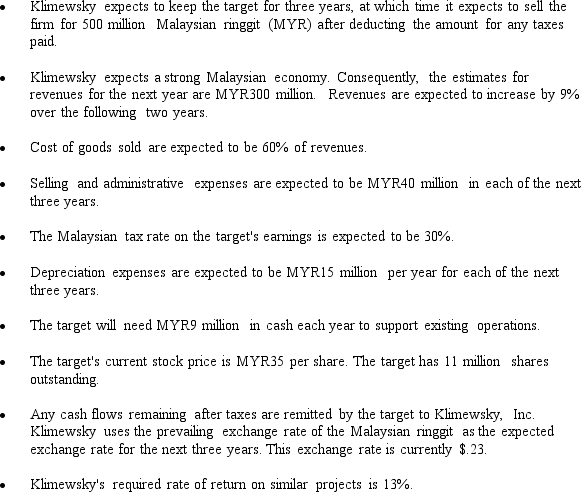 -Refer to Exhibit 15-1. The Malaysian target's value based on its stock price is $____ million.
 (Multiple Choice)
4.7/5 (79)
(79) 
Filters
- Essay(0)
- Multiple Choice(0)
- Short Answer(0)
- True False(0)
- Matching(0)