



 Chat with AI
Exam 10: Economic Growth, the Financial System, and Business Cycles

Exam 1: Economics: Foundations and Models213 Questions
Exam 2: Trade-Offs, comparative Advantage, and the Market System237 Questions
Exam 3: Where Prices Come From: the Interaction of Demand and Supply234 Questions
Exam 4: Economic Efficiency,government Price Setting,and Taxes212 Questions
Exam 5: The Economics of Health Care166 Questions
Exam 6: Firms, the Stock Market, and Corporate Governance258 Questions
Exam 7: Comparative Advantage and the Gains From International Trade188 Questions
Exam 8: Gdp: Measuring Total Production and Income261 Questions
Exam 9: Unemployment and Inflation291 Questions
Exam 10: Economic Growth, the Financial System, and Business Cycles253 Questions
Exam 11: Long-Run Economic Growth: Sources and Policies262 Questions
Exam 12: Aggregate Expenditure and Output in the Short Run299 Questions
Exam 13: Aggregate Demand and Aggregate Supply Analysis286 Questions
Exam 14: Money,banks,and the Federal Reserve System281 Questions
Exam 15: Monetary Policy275 Questions
Exam 16: Fiscal Policy306 Questions
Exam 17: Inflation,unemployment,and Federal Reserve Policy257 Questions
Exam 18: Macroeconomics in an Open Economy278 Questions
Exam 19: The International Financial System258 Questions
Select questions type


Economists have not found a way to predict when recessions will begin and end.
(True/False)
5.0/5  (85)
(85) Table 10-2
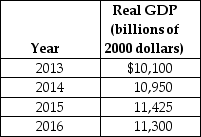 -Refer to Table 10-2.Using the table above,what is the approximate average annual growth rate from 2013 to 2016?
 (Multiple Choice)
4.8/5 (78)
(78) When the economy enters a recessionary phase of the business cycle,unemployment tends to
(Multiple Choice)
4.8/5 (82)
(82) Figure 10-4 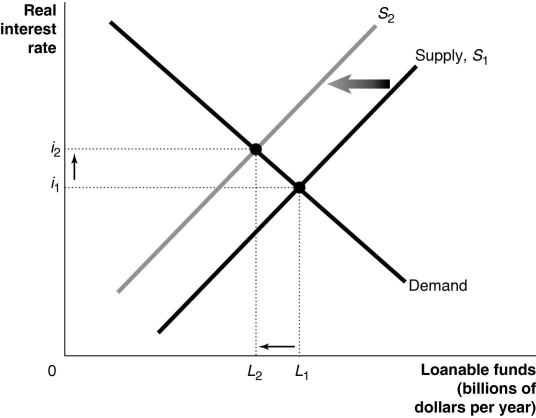 -Refer to Figure 10-4.Which of the following is consistent with the graph depicted?
 (Multiple Choice)
4.8/5 (86)
(86) Empirical evidence shows that the impact of government budget deficits and surpluses on the equilibrium interest rate is quite large.
(True/False)
4.7/5 (78)
(78) Suppose that real GDP for 2015 was $10,000 billion and real GDP for 2016 was $9,500 billion.What is the rate of growth of real GDP between 2015 and 2016?
(Multiple Choice)
4.9/5 (89)
(89) If real GDP per capita doubles between 2005 and 2020,what is the average annual growth rate of real GDP per capita?
(Multiple Choice)
4.7/5 (91)
(91) Explain and show graphically how an increase in household saving affects the equilibrium interest rate and the equilibrium quantity of loanable funds.
(Essay)
4.7/5 (80)
(80) Between 1950 and 2009,the average length of recessions in the United States was
(Multiple Choice)
4.9/5 (81)
(81) ________ is the ease with which a financial security can be exchanged for money.
(Multiple Choice)
4.7/5 (88)
(88) In a closed economy,private saving is equal to which of the following? (Y = GDP,C = Consumption,G = Government purchases,T = Taxes,and TR = Transfers)
(Multiple Choice)
4.7/5 (76)
(76) Which of the following would you expect to increase the equilibrium interest rate?
(Multiple Choice)
4.9/5 (64)
(64) If you invest $10,000 in a bond that earns 8% interest per year,how many years will it take to double your money?
(Multiple Choice)
4.9/5 (73)
(73) Figure 10-6  -Refer to Figure 10-6.The market is in equilibrium.If the government budget deficit rises,which of the following would you expect to see?
 (Multiple Choice)
5.0/5 (84)
(84) The Congressional Budget Office reported that federal budget deficits in the United States were likely to increase in future years,and these higher deficits might "pose a threat to the economy by crowding out business investment and threatening a spike in interest rates." This crowding out of business investment would be represented graphically by
(Multiple Choice)
4.8/5 (85)
(85) Explain why increasing the government budget deficit can decrease investment spending.
(Essay)
4.8/5 (84)
(84) 
Filters
- Essay(0)
- Multiple Choice(0)
- Short Answer(0)
- True False(0)
- Matching(0)