



 Chat with AI
Exam 10: Economic Growth, the Financial System, and Business Cycles

Exam 1: Economics: Foundations and Models213 Questions
Exam 2: Trade-Offs, comparative Advantage, and the Market System237 Questions
Exam 3: Where Prices Come From: the Interaction of Demand and Supply234 Questions
Exam 4: Economic Efficiency,government Price Setting,and Taxes212 Questions
Exam 5: The Economics of Health Care166 Questions
Exam 6: Firms, the Stock Market, and Corporate Governance258 Questions
Exam 7: Comparative Advantage and the Gains From International Trade188 Questions
Exam 8: Gdp: Measuring Total Production and Income261 Questions
Exam 9: Unemployment and Inflation291 Questions
Exam 10: Economic Growth, the Financial System, and Business Cycles253 Questions
Exam 11: Long-Run Economic Growth: Sources and Policies262 Questions
Exam 12: Aggregate Expenditure and Output in the Short Run299 Questions
Exam 13: Aggregate Demand and Aggregate Supply Analysis286 Questions
Exam 14: Money,banks,and the Federal Reserve System281 Questions
Exam 15: Monetary Policy275 Questions
Exam 16: Fiscal Policy306 Questions
Exam 17: Inflation,unemployment,and Federal Reserve Policy257 Questions
Exam 18: Macroeconomics in an Open Economy278 Questions
Exam 19: The International Financial System258 Questions
Select questions type


Table 10-2
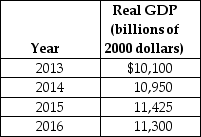 -Refer to Table 10-2.Using the table above,what is the approximate growth rate of real GDP from 2015 to 2016?
 (Multiple Choice)
4.8/5  (68)
(68) Which of the following indicates that the U.S.economy has become more stable since 1950?
(Multiple Choice)
4.9/5 (83)
(83) Explain why a centrally-planned economy might not grow as rapidly as a market economy.
(Essay)
4.9/5 (74)
(74) Which of the following will increase investment spending in the economy,holding everything else constant?
(Multiple Choice)
4.9/5 (67)
(67) Explain what happens to inflation during the business cycle.Give an intuitive explanation as to why inflation changes the way it does over the business cycle.
(Essay)
4.9/5 (86)
(86) During the expansion phase of the business cycle,which of the following eventually increases?
(Multiple Choice)
4.8/5 (95)
(95) Inflation tends to ________ during the expansion phase of the business cycle and ________ during the recession phase of the business cycle.
(Multiple Choice)
4.9/5 (83)
(83) Retained earnings are always sufficient to finance a firm's rapid expansion in a high-growth economy.
(True/False)
4.8/5 (75)
(75) The demand for loanable funds is downward sloping because the ________ the interest rate,the ________ the number of profitable investment projects a firm can undertake,and the ________ the quantity demanded of loanable funds.
(Multiple Choice)
5.0/5 (73)
(73) In a closed economy,which of the following components of GDP is not included?
(Multiple Choice)
4.8/5 (82)
(82) Figure 10-1 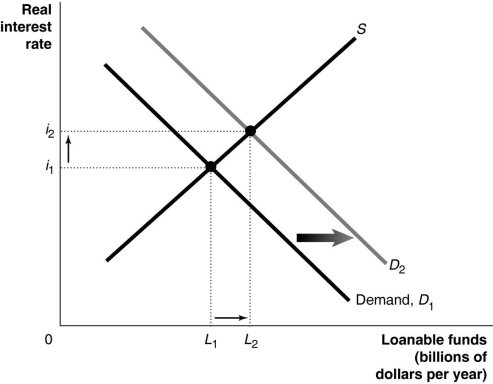 -Refer to Figure 10-1.Which of the following is consistent with the graph depicted above?
 (Multiple Choice)
4.9/5 (86)
(86) The Congressional Budget Office reported that federal budget deficits in the United States were likely to increase in future years,and these higher deficits might "pose a threat to the economy by crowding out business investment and threatening a spike in interest rates." This higher budget deficit would be represented graphically by
(Multiple Choice)
4.8/5 (78)
(78) Which of the following will result in an increase in labor productivity?
(Multiple Choice)
4.8/5 (82)
(82) 
Filters
- Essay(0)
- Multiple Choice(0)
- Short Answer(0)
- True False(0)
- Matching(0)