



 Chat with AI
Exam 15: Monetary Policy

Exam 1: Economics: Foundations and Models213 Questions
Exam 2: Trade-Offs, comparative Advantage, and the Market System237 Questions
Exam 3: Where Prices Come From: the Interaction of Demand and Supply234 Questions
Exam 4: Economic Efficiency,government Price Setting,and Taxes212 Questions
Exam 5: The Economics of Health Care166 Questions
Exam 6: Firms, the Stock Market, and Corporate Governance258 Questions
Exam 7: Comparative Advantage and the Gains From International Trade188 Questions
Exam 8: Gdp: Measuring Total Production and Income261 Questions
Exam 9: Unemployment and Inflation291 Questions
Exam 10: Economic Growth, the Financial System, and Business Cycles253 Questions
Exam 11: Long-Run Economic Growth: Sources and Policies262 Questions
Exam 12: Aggregate Expenditure and Output in the Short Run299 Questions
Exam 13: Aggregate Demand and Aggregate Supply Analysis286 Questions
Exam 14: Money,banks,and the Federal Reserve System281 Questions
Exam 15: Monetary Policy275 Questions
Exam 16: Fiscal Policy306 Questions
Exam 17: Inflation,unemployment,and Federal Reserve Policy257 Questions
Exam 18: Macroeconomics in an Open Economy278 Questions
Exam 19: The International Financial System258 Questions
Select questions type


Inflation targeting has been adopted by the central banks of several countries including the European Central Bank.
(True/False)
4.9/5  (72)
(72) The smaller the fraction of an investment financed by borrowing,
(Multiple Choice)
4.9/5 (70)
(70) Between September 2007 and March 2008 there was a substantial reduction in the demand for housing.What action did the Fed take in response to the reduction in the demand for housing?
(Multiple Choice)
4.7/5 (83)
(83) The interest rate that banks charge other banks for overnight loans is the
(Multiple Choice)
4.8/5 (75)
(75) Expansionary monetary policy refers to the Fed's increasing the money supply and increasing interest rates to increase real GDP.
(True/False)
4.8/5 (89)
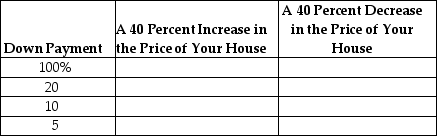
(89) In the following table,fill in the columns for your return on investment if the price of your house increased or decreased by 40 percent,based on the down payments specified in the first column.
Return on Your Investment From
(Essay)
4.7/5 (75)
(75) Figure 15-15 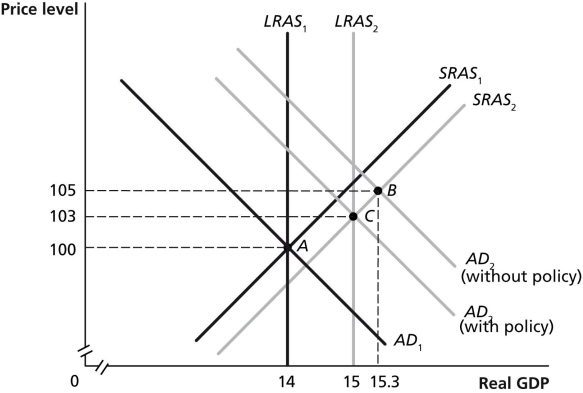 -Refer to Figure 15-15.In the figure above,suppose the economy in Year 1 is at point A and is expected in Year 2 to be at point B.Which of the following policies could the Federal Reserve use to move the economy to point C?
 (Multiple Choice)
4.9/5 (77)
(77) When housing prices fell as they did beginning in 2006 following the housing market bubble,most banks and other lenders ________ the requirement for borrowers,making it ________ for potential home buyers to obtain mortgages.
(Multiple Choice)
4.9/5 (84)
(84) Would the Federal Reserve respond more aggressively with interest rate cuts in a recession caused by a decrease in spending,as in the 2001 recession,than in a recession caused by an increase in oil prices,as in the 1974-75 recession?
(Essay)
4.8/5 (92)
(92) In 2008,the Treasury and Federal Reserve took action to save large financial firms such as Bear Stearns and AIG from failing.Which of the following is one reason why these measures were taken?
(Multiple Choice)
5.0/5 (75)
(75) Although the Federal Reserve had traditionally made discount loans only to ________,in response to the financial crisis in 2008 the Fed made primary dealers eligible for discount loans as well.
(Multiple Choice)
4.9/5 (79)
(79) Using the money demand and money supply model,an open market sale of Treasury securities by the Federal Reserve would cause the equilibrium interest rate to
(Multiple Choice)
4.8/5 (66)
(66) Under the monetary growth rule proposed by the monetarists,the money supply would grow each year at a constant rate equal to the long-run rate of growth of
(Multiple Choice)
5.0/5 (76)
(76) Since World War II,the Federal Reserve has not been involved in carrying out monetary policy.
(True/False)
4.8/5 (90)
(90) For purposes of monetary policy,the Federal Reserve has targeted the interest rate known as the
(Multiple Choice)
4.8/5 (73)
(73) If the Fed orders an expansionary monetary policy,describe what will happen to the following variables relative to what would have happened without the policy:
a.The money supply
b.Interest rates
c.Investment
d.Consumption
e.Net Exports
f.The aggregate demand curve
g.Real GDP
h.The price level
(Essay)
4.9/5 (73)
(73) 
Filters
- Essay(0)
- Multiple Choice(0)
- Short Answer(0)
- True False(0)
- Matching(0)