



 Chat with AI
Exam 15: Monetary Policy

Exam 1: Economics: Foundations and Models213 Questions
Exam 2: Trade-Offs, comparative Advantage, and the Market System237 Questions
Exam 3: Where Prices Come From: the Interaction of Demand and Supply234 Questions
Exam 4: Economic Efficiency,government Price Setting,and Taxes212 Questions
Exam 5: The Economics of Health Care166 Questions
Exam 6: Firms, the Stock Market, and Corporate Governance258 Questions
Exam 7: Comparative Advantage and the Gains From International Trade188 Questions
Exam 8: Gdp: Measuring Total Production and Income261 Questions
Exam 9: Unemployment and Inflation291 Questions
Exam 10: Economic Growth, the Financial System, and Business Cycles253 Questions
Exam 11: Long-Run Economic Growth: Sources and Policies262 Questions
Exam 12: Aggregate Expenditure and Output in the Short Run299 Questions
Exam 13: Aggregate Demand and Aggregate Supply Analysis286 Questions
Exam 14: Money,banks,and the Federal Reserve System281 Questions
Exam 15: Monetary Policy275 Questions
Exam 16: Fiscal Policy306 Questions
Exam 17: Inflation,unemployment,and Federal Reserve Policy257 Questions
Exam 18: Macroeconomics in an Open Economy278 Questions
Exam 19: The International Financial System258 Questions
Select questions type


Use the money demand and money supply model to show the money market in equilibrium with an interest rate of 5 percent and the quantity of money of $800 billion.Suppose the Federal Reserve increases the money supply to $850 billion.At the previous equilibrium interest rate of 5 percent,will households and firms now be holding more money or less money than they want to hold,and will they be buying or selling short-term financial assets? At the new equilibrium interest rate,households and firms will desire to hold the entire $850 billion of the money supply.What causes households and firms to want to hold the additional $50 billion of the money supply?
(Essay)
4.8/5  (78)
(78) Which of the following is true about the Federal Reserve and its ability to prevent recessions? The Federal Reserve
(Multiple Choice)
4.9/5 (82)
(82) Figure 15-10 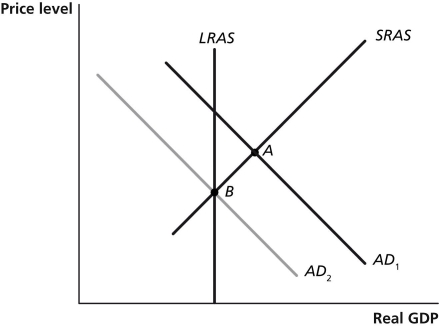 -Refer to Figure 15-10.In the figure above,suppose the economy is initially at point A.The movement of the economy to point B as shown in the graph illustrates the effect of which of the following policy actions by the Federal Reserve?
 (Multiple Choice)
4.8/5 (91)
(91) The Federal Reserve System's four monetary policy goals are
(Multiple Choice)
4.9/5 (96)
(96) The rate of interest banks charge other banks for overnight loans of reserves is the
(Multiple Choice)
5.0/5 (85)
(85) Suppose the equilibrium real federal funds rate is 3 percent,the target rate of inflation is 3 percent,the current inflation rate is 1 percent,and real GDP is 8 percent below potential real GDP.If the weights for the inflation gap and the output gap are both 1/2,then according to the Taylor rule the federal funds target rate equals
(Multiple Choice)
4.8/5 (85)
(85) Monetarists think that the Fed should use ________ as a target when conducting monetary policy.
(Multiple Choice)
4.8/5 (80)
(80) A borrower defaults on a loan when he stops making payments on the loan.
(True/False)
4.9/5 (72)
(72) If the Fed raises its target for the federal fund rate,this indicates that
(Multiple Choice)
4.8/5 (76)
(76) By the 2000s,an important change in the mortgage market had occurred when ________ became significant participants in the secondary market for mortgages.
(Multiple Choice)
5.0/5 (72)
(72) Prior to 1970,mortgages were ________ resold in the secondary market.
(Multiple Choice)
4.8/5 (90)
(90) Suppose the equilibrium real federal funds rate is 2 percent,the target rate of inflation is 2 percent,the current inflation rate is 4 percent,and real GDP is 2 percent above potential real GDP.If the weights for the inflation gap and the output gap are both 1/2,then according to the Taylor rule the federal funds target rate equals
(Multiple Choice)
4.9/5 (80)
(80) If the probability of losing your job remains ________,a recession would be a good time to purchase a home because the Fed usually ________ interest rates during this time.
(Multiple Choice)
4.8/5 (74)
(74) Use the dynamic aggregate demand and aggregate supply model and start with Year 1 in long-run macroeconomic equilibrium.For Year 2,graph aggregate demand,long-run aggregate supply,and short-run aggregate supply such that the condition of the economy will induce the Federal Reserve to conduct a contractionary monetary policy.Briefly explain the condition of the economy and what the Federal Reserve is attempting to do.
(Essay)
4.8/5 (92)
(92) When the Federal Reserve increases the money supply,people spend more because they now have more money.
(True/False)
4.9/5 (75)
(75) When the price of a financial asset ________ its interest rate will ________.
(Multiple Choice)
4.7/5 (79)
(79) When the Federal Reserve System was established in 1913,its main policy goal was
(Multiple Choice)
4.8/5 (82)
(82) 
Filters
- Essay(0)
- Multiple Choice(0)
- Short Answer(0)
- True False(0)
- Matching(0)