



 Chat with AI
Exam 13: Balance-of-payments Adjustments

Exam 1: the International Economy and Globalization48 Questions
Exam 2: Foundations of Modern Trade Theory: Comparative Advantage166 Questions
Exam 3: Sources of Comparative Advantage106 Questions
Exam 4: Tariffs118 Questions
Exam 5: Nontariff Trade Barriers130 Questions
Exam 6: Trade Regulations and Industrial Policies124 Questions
Exam 7: Trade Policies for the Developing Nations98 Questions
Exam 8: Regional Trading Arrangements129 Questions
Exam 9: International Factor Movements and Multinational Enterprises93 Questions
Exam 10: the Balance of Payments99 Questions
Exam 11: Foreign Exchange120 Questions
Exam 12: Exchange-rate Determination129 Questions
Exam 13: Balance-of-payments Adjustments107 Questions
Exam 14: Exchange-rate Adjustments and the Balance of Payments96 Questions
Exam 15: Exchange-rate Systems and Currency Crises105 Questions
Exam 16: Macroeconomic Policy in an Open Economy72 Questions
Exam 17: International Banking: Reserves, debt, and Risk93 Questions
Select questions type


Figure 13.2. Australian Economy Under a Fixed Exchange Rate System
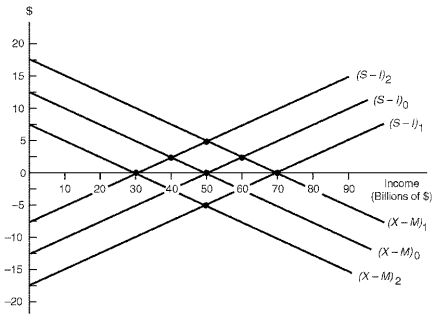 -Refer to Figure 13.2.Starting at equilibrium income $50 billion,where (S-I)? intersects (X-M)?,suppose that increased thriftiness leads to an autonomous increase in Australian saving of $5 billion.Australian income thus ____ which leads to Australia's trade account moving to a ____.
 (Multiple Choice)
4.9/5  (83)
(83) Figure 13.3. U.S. Capital and Financial Account Under a Fixed Exchange Rate System
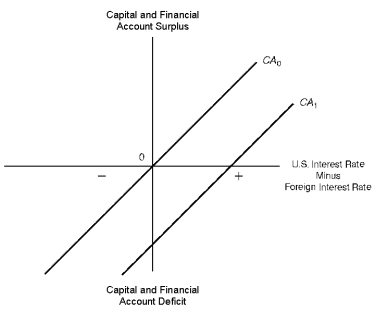 -Refer to Figure 13.3.As the U.S.government decreases taxes on income earned by U.S.residents from foreign investments,the U.S.capital and financial account schedule shifts downward from CA? to CA? and the United States realizes net financial outflows.
 (True/False)
4.9/5 (76)
(76) The monetary approach contends that,under a fixed exchange rate system,an excess demand for money leads to a trade deficit.
(True/False)
4.8/5 (77)
(77) If the marginal propensity to save equals 0.2 and the marginal propensity to import equals 0.3,an autonomous decrease in investment spending of $1 million leads to a $2 million decrease in domestic income and a $600,000 decrease in imports.
(True/False)
4.8/5 (81)
(81) Figure 13.4. Canadian Economy Under a Fixed Exchange Rate System
 -Refer to Figure 13.4.Starting at equilibrium income $100 billion,where (S - I)? intersects (X - M)?,an autonomous decrease in saving of $10 billion leads to a $20 billion increase in income and a trade deficit of $5 billion.
 (True/False)
4.8/5 (74)
(74) Which chain of events would promote payments equilibrium for a surplus nation,according to the price-adjustment mechanism?
(Multiple Choice)
4.9/5 (73)
(73) For an open economy subject to international trade,equilibrium income occurs where saving plus investment equals imports plus exports.
(True/False)
4.9/5 (84)
(84) The monetary approach contends that,under a fixed exchange rate system,an excess supply of money leads to a trade surplus.
(True/False)
4.9/5 (76)
(76) Under the gold standard,a nation with a current-account surplus would realize gold outflows,a decrease in its money supply,and a fall in its domestic price level.
(True/False)
4.8/5 (83)
(83) According to the "rules of the game" of the gold standard era,a country's central bank agreed to react to international gold flows so as to:
(Multiple Choice)
4.8/5 (69)
(69) Figure 13.3. U.S. Capital and Financial Account Under a Fixed Exchange Rate System
-Refer to Figure 13.3.As U.S.interest rates rise relative to foreign interest rates,the U.S.slides upward along schedule CA?,thus moving towards capital and financial account surplus.
-Refer to Figure 13.3.As U.S.interest rates rise relative to foreign interest rates,the U.S.slides upward along schedule CA?,thus moving towards capital and financial account surplus. (True/False)
5.0/5 (86)
(86) If the marginal propensity to save equals 0.1 and the marginal propensity to import equals 0.3,an autonomous increase in exports of $1,000 would expand domestic income by $2,500 which leads to an increase in imports of $750.
(True/False)
4.8/5 (66)
(66) Table 13.1. Canada's Saving, Investment, Import, and Export Functions (in billions of dollars) Under a System of Fixed Exchange Rates
 -Referring to Table 13.1,Canada's equilibrium level of income is:
 (Multiple Choice)
4.9/5 (88)
(88) The "rules of the game" served to reinforce and speed up the interest-rate-adjustment mechanism under a system of fixed exchange rates.
(True/False)
4.7/5 (74)
(74) Compared to classical economists,how did Keynesian economics change the discussion of trade adjustment?
(Essay)
4.8/5 (81)
(81) Figure 13.2. Australian Economy Under a Fixed Exchange Rate System
-Refer to Figure 13.2.Starting at equilibrium income $50 billion,where (S-I)? intersects (X-M)?,suppose that improving economic conditions abroad lead to an autonomous increase in Australian exports of $5 billion.Australian income thus ____ which leads to Australia's trade account moving to a ____.
-Refer to Figure 13.2.Starting at equilibrium income $50 billion,where (S-I)? intersects (X-M)?,suppose that improving economic conditions abroad lead to an autonomous increase in Australian exports of $5 billion.Australian income thus ____ which leads to Australia's trade account moving to a ____. (Multiple Choice)
4.8/5 (80)
(80) Under the classical gold standard,adjustments in domestic prices and short-term interest rates automatically promoted balance-of-payments equilibrium over the long run.
(True/False)
4.9/5 (74)
(74) Explain David Hume's theory of automatic adjustment for balance of payments disequilibria.
(Essay)
4.7/5 (70)
(70) Under the price-adjustment mechanism,a trade-surplus nation would realize gold inflows,an increase in its money supply,and a loss of international competitiveness.
(True/False)
4.8/5 (68)
(68) Refer to Exhibit 13.1.The change in the level of U.S.imports resulting from the rise in U.S.income equals:
(Multiple Choice)
4.8/5 (83)
(83) 
Filters
- Essay(0)
- Multiple Choice(0)
- Short Answer(0)
- True False(0)
- Matching(0)