



 Chat with AI
Exam 11: Foreign Exchange

Exam 1: the International Economy and Globalization48 Questions
Exam 2: Foundations of Modern Trade Theory: Comparative Advantage166 Questions
Exam 3: Sources of Comparative Advantage106 Questions
Exam 4: Tariffs118 Questions
Exam 5: Nontariff Trade Barriers130 Questions
Exam 6: Trade Regulations and Industrial Policies124 Questions
Exam 7: Trade Policies for the Developing Nations98 Questions
Exam 8: Regional Trading Arrangements129 Questions
Exam 9: International Factor Movements and Multinational Enterprises93 Questions
Exam 10: the Balance of Payments99 Questions
Exam 11: Foreign Exchange120 Questions
Exam 12: Exchange-rate Determination129 Questions
Exam 13: Balance-of-payments Adjustments107 Questions
Exam 14: Exchange-rate Adjustments and the Balance of Payments96 Questions
Exam 15: Exchange-rate Systems and Currency Crises105 Questions
Exam 16: Macroeconomic Policy in an Open Economy72 Questions
Exam 17: International Banking: Reserves, debt, and Risk93 Questions
Select questions type


If you have a commitment to pay a friend in Britain 1,000 pounds in 30 days,you could remove the risk of loss due to the appreciation of the pound by:
(Multiple Choice)
4.9/5  (82)
(82) If the Swiss demand for dollars is elastic,an appreciation of the dollar against the franc will lead to a greater quantity of francs being supplied to the foreign exchange market to obtain dollars.
(True/False)
4.8/5 (80)
(80) Table 11.1 gives the exchange rate quotations for the U.S. dollar and the British pound.
Table 11.1. Foreign Exchange Quotations
 -Consider Table 11.1.If one were to sell dollars for immediate delivery,on Tuesday the pound cost of each dollar would be:
 (Multiple Choice)
4.7/5 (76)
(76) Figure 11.2. Market for Francs
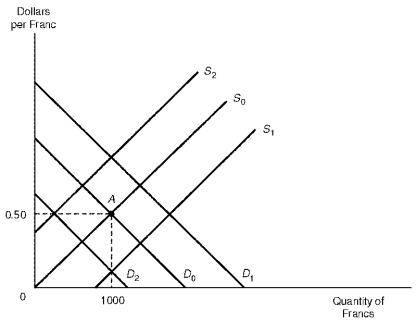 -A (An)____ is an arrangement by which two parties exchange one currency for another and agree that the exchange will be reversed at a stipulated date in the future:
 (Multiple Choice)
4.8/5 (66)
(66) The bid rate refers to the price at which a bank is willing to sell a unit of foreign currency; the offer rate is the price at which a bank is willing to buy a unit of foreign currency.
(True/False)
4.8/5 (77)
(77) Assume you are an American exporter and expect to receive 50 pounds sterling at the end of 60 days.You can remove the risk of loss due to a devaluation of the pound sterling by:
(Multiple Choice)
4.8/5 (78)
(78) If Chase Manhattan Bank quotes bid and offer rates for the Swiss franc at $.5250/$.5260,the bank would realize profits of $1,000 on the purchase and sale of 1 million francs.
(True/False)
4.7/5 (80)
(80) Grain shortages in countries that buy large amounts of grain from the United States would increase the demand for American grain and:
(Multiple Choice)
4.9/5 (87)
(87) A U.S.investor's extra rate of return on an investment in France,as compared to the United States,equals the interest-rate differential adjusted for any change in the dollar/franc exchange rate.
(True/False)
4.8/5 (76)
(76) The trade-weighted dollar is the weighted average of the exchange rates between the dollar and the most important industrial-country trading partners of the United States.
(True/False)
4.7/5 (79)
(79) Refer to Exhibit 11.1.If U.S.investors cover their exchange rate risk,the extra return for the 6 months on the U.K.treasury bills is:
(Multiple Choice)
4.8/5 (82)
(82) Given an upward-sloping supply schedule of pounds and a downward-sloping demand schedule for pounds,an increase in the demand schedule causes an appreciation of the dollar against the pound.
(True/False)
4.9/5 (83)
(83) Suppose the exchange value of the British pound is $2 per pound while the exchange value of the Swiss franc is 50 cents per pound.The cross exchange rate between the pound and the franc is:
(Multiple Choice)
4.8/5 (65)
(65) During the era of dollar appreciation,from 1981 to 1985,a main reason why the dollar did not fall in value was:
(Multiple Choice)
4.9/5 (78)
(78) Given an upward-sloping supply schedule of pounds and a downward-sloping demand schedule for pounds,a decrease in the supply schedule causes an appreciation of the dollar against the pound.
(True/False)
4.7/5 (78)
(78) In the interbank market for foreign exchange,the ____ refers to the difference between the offer rate and the bid rate.
(Multiple Choice)
4.9/5 (71)
(71) 
Filters
- Essay(0)
- Multiple Choice(0)
- Short Answer(0)
- True False(0)
- Matching(0)