



 Chat with AI
Exam 16: Long-Run Growth

Exam 1: The Scope and Method of Economics238 Questions
Exam 2: The Economic Problem: Scarcity and Choice220 Questions
Exam 3: Demand, Supply, and Market Equilibrium298 Questions
Exam 4: Demand and Supply Applications173 Questions
Exam 5: Introduction to Macroeconomics241 Questions
Exam 6: Measuring National Output and National Income292 Questions
Exam 7: Unemployment, Inflation, and Long-Run Growth297 Questions
Exam 8: Aggregate Expenditure and Equilibrium Output355 Questions
Exam 9: The Government and Fiscal Policy362 Questions
Exam 10: Money, the Federal Reserve, and the Interest Rate358 Questions
Exam 11: The Determination of Aggregate Output, the Price Level, and the Interest Rate243 Questions
Exam 12: Policy Effects and Cost Shocks in the Asad Model200 Questions
Exam 13: The Labor Market in the Macroeconomy287 Questions
Exam 14: Financial Crises, Stabilization, and Deficits260 Questions
Exam 15: Household and Firm Behavior in the Macroeconomy: a Further Look364 Questions
Exam 16: Long-Run Growth196 Questions
Exam 17: Alternative Views in Macroeconomics294 Questions
Exam 18: International Trade, Comparative Advantage, and Protectionism301 Questions
Exam 19: Open-Economy Macroeconomics: the Balance of Payments and Exchange Rates308 Questions
Exam 20: Economic Growth in Developing Economies133 Questions
Exam 21: Critical Thinking About Research105 Questions
Select questions type


Economic decline will shift a society's production possibility frontier down and to the left.
(True/False)
4.9/5  (79)
(79) If the capital stock ________ while the supply of labor ________, it is likely that the productivity of labor will fall.
(Multiple Choice)
4.8/5 (72)
(72) Related to the Economics in Practice on p. 308: The emigration of Jewish scientists from Germany to the United States in the late 1930s and early 1940s may have increased patent rates in their fields of chemistry by
(Multiple Choice)
4.7/5 (77)
(77) According to predictions made by the Club of Rome in 1972, the collapse of the world economy will occur because of
(Multiple Choice)
4.9/5 (79)
(79) As growth progresses and countries become richer, pollution
(Multiple Choice)
4.8/5 (72)
(72) Refer to the information provided in Figure 16.1 below to answer the questions that follow. 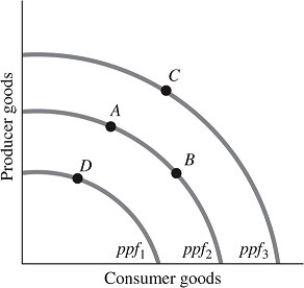 Figure 16.1
-Refer to Figure 16.1. Economic growth is represented by
Figure 16.1
-Refer to Figure 16.1. Economic growth is represented by (Multiple Choice)
4.9/5 (81)
(81) Which of the following was one of the likely causes of the productivity problem of the 1970s?
(Multiple Choice)
4.7/5 (81)
(81) The aggregate production function is Y = 3KL. If there are 30 units of capital and 40 units of labor, aggregate output is
(Multiple Choice)
4.8/5 (84)
(84) Convergence theory suggests that when less developed countries begin to develop, they typically have higher growth rates as they catch up with more developed nations.
(True/False)
4.7/5 (90)
(90) Zuliu Hu and Mohsin Khan have stated that the productivity gains in China over the 20 years following market reforms are, in large part, a result of market reforms from incorporating business into the public sector.
(True/False)
4.8/5 (90)
(90) As growth ________ and countries become ________, pollution ________.
(Multiple Choice)
4.9/5 (74)
(74) Refer to the information provided in Table 16.1 below to answer the questions that follow.
Table 16.1
 -Refer to Table 16.1. During Period 3, labor productivity is equal to
 (Multiple Choice)
4.9/5 (87)
(87) The aggregate production function is Y = 4K0.5L0.5. If there are 169 units of capital and 49 units of labor, aggregate output is
(Multiple Choice)
4.9/5 (91)
(91) A firm used to produce a product using three units of labor and one unit of capital. The firm discovers that it can produce more output at a lower cost if it combines two units of labor with two units of capital. This is an example of
(Multiple Choice)
4.9/5 (72)
(72) Related to the Economics in Practice on p. 304: According to a study cited in the Economics in Practice, if a country is relatively far from the technological frontier of the rest of the world, what would be its best strategy?
(Multiple Choice)
4.8/5 (83)
(83) Refer to the information provided in Figure 16.2 below to answer the questions that follow. 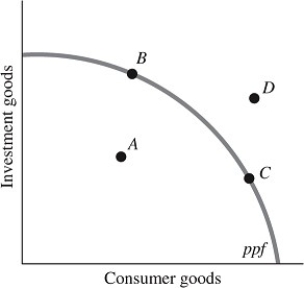 Figure 16.2
-Refer to Figure 16.2. Point ________ is beyond the production capacity of this economy.
Figure 16.2
-Refer to Figure 16.2. Point ________ is beyond the production capacity of this economy. (Multiple Choice)
4.9/5 (72)
(72) Refer to the information provided in Table 16.2 below to answer the questions that follow.
Table 16.2
 -Refer to Table 16.2. When moving from Period 1 to Period 4, labor productivity
 (Multiple Choice)
4.9/5 (83)
(83) 
Filters
- Essay(0)
- Multiple Choice(0)
- Short Answer(0)
- True False(0)
- Matching(0)